Prepare to delve into the fascinating realm of convergence analysis as we unveil the root test calculator, an indispensable tool for determining the convergence of infinite series. This comprehensive guide will illuminate the intricacies of the root test, empowering you to master this technique and conquer the challenges of mathematical analysis.
The root test calculator stands as a testament to the power of mathematical innovation, offering a streamlined approach to analyzing series convergence. By harnessing the mathematical rigor of the root test, this calculator empowers users to swiftly determine whether a given series converges or diverges, unlocking deeper insights into the behavior of mathematical functions.
Root Test Convergence Analysis
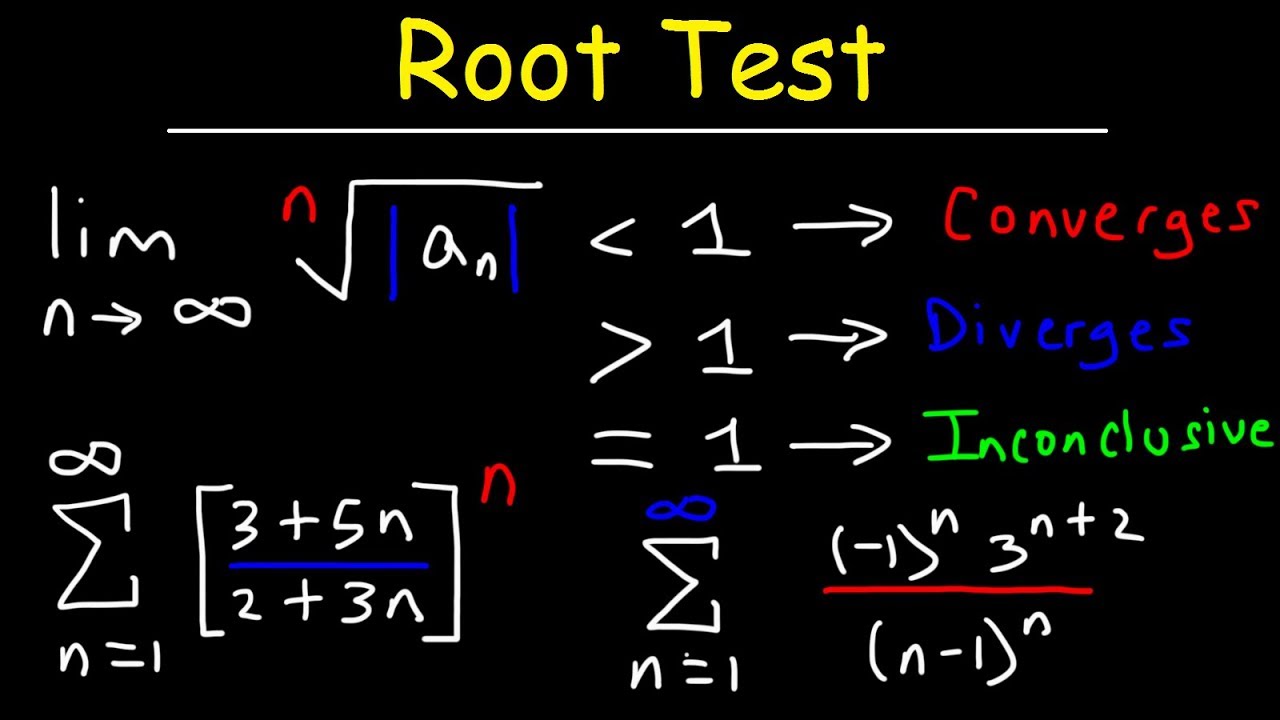
The root test is a mathematical tool used to determine the convergence or divergence of an infinite series. It is based on the principle that if the limit of the nth root of the absolute value of the nth term of a series is less than 1, then the series converges absolutely.
Conversely, if the limit is greater than 1, the series diverges. If the limit is equal to 1, the test is inconclusive and other tests must be used.
The mathematical formulation of the root test is as follows:
lim (n->∞) nth root of |an| = L
where an is the nth term of the series.
The steps involved in applying the root test are as follows:
- Find the nth root of the absolute value of the nth term of the series: nth root of |an|.
- Find the limit of the expression in step 1 as n approaches infinity: lim (n->∞) nth root of |an|.
- Based on the value of the limit, determine the convergence or divergence of the series:
- If L < 1, the series converges absolutely.
- If L > 1, the series diverges.
- If L = 1, the test is inconclusive and other tests must be used.
Comparison with Other Convergence Tests

The root test is a powerful tool for determining the convergence of series. It is often compared to other convergence tests, such as the ratio test and the integral test. Each test has its own advantages and disadvantages, and the choice of which test to use depends on the specific series being considered.
Advantages of the Root Test
- The root test is relatively easy to apply.
- It can be used to test the convergence of series with both positive and negative terms.
- It is often more powerful than the ratio test, especially for series with terms that decrease slowly.
Disadvantages of the Root Test
- The root test can sometimes be inconclusive.
- It is not as powerful as the integral test for series with terms that decrease rapidly.
Example, Root test calculator
Consider the series . To test the convergence of this series using the root test, we calculate the limit:
Since the limit is equal to 1, the root test is inconclusive. However, we can use the ratio test to show that the series converges.
Applications in Mathematical Analysis
The root test plays a pivotal role in mathematical analysis, particularly in the convergence analysis of infinite series.
In the study of power series, the root test provides a simple and effective way to determine the radius of convergence. A power series is an infinite series of terms of the form anx n, where anare constants and xis a variable.
The root test states that if limn→∞|a nx n| 1/n= L , then the power series converges absolutely if L < 1 and diverges if L> 1. This test allows us to quickly determine the convergence behavior of power series without having to resort to more complex methods.
The root test also finds applications in the analysis of Fourier series. Fourier series are used to represent periodic functions as a sum of sine and cosine functions. The convergence of Fourier series is crucial for understanding the behavior of periodic functions.
The root test can be used to determine the convergence of Fourier series and identify the coefficients that contribute to the convergence or divergence of the series.
Convergence of Power Series
- Consider the power series Σn=1∞(n 2+ 1)/(2n 3+ 3n)x n.
- Applying the root test, we get limn→∞|(n 2+ 1)/(2n 3+ 3n)x n| 1/n= |x| lim n→∞[(n 2+ 1)/(2n 3+ 3n)] 1/n= |x| .
- Since |x| < 1for convergence, the power series converges absolutely for |x| < 1and diverges for |x| > 1.
Implementation in Calculators and Software: Root Test Calculator

Calculators and software programs often incorporate the root test as a built-in feature for analyzing the convergence of series. These tools provide a convenient and efficient way to apply the test without the need for manual calculations.
Using Calculators and Software
To use calculators or software for the root test, simply input the series in question and select the “root test” option. The tool will calculate the limit of the root test and display the result, indicating whether the series converges or diverges.For
instance, consider the series 1 + 1/2 + 1/4 + 1/8 + … . Using a calculator with a root test function, you input the series and obtain the limit as 1. Since the limit is less than 1, the calculator will conclude that the series converges.Software
programs often provide additional features for analyzing series using the root test. They may allow you to plot the terms of the series, zoom in on specific regions, and perform other operations to gain insights into the convergence behavior.
Last Word

As we conclude our exploration of the root test calculator, it is evident that this tool has revolutionized the study of series convergence. Its ability to simplify complex mathematical concepts and provide accurate results has made it an invaluable asset for students, researchers, and practitioners alike.
Embrace the power of the root test calculator, and unlock the mysteries of mathematical convergence with newfound confidence.