Unveiling the secrets of chemical kinetics, the rate law calculator unveils the intricate dance of chemical reactions. By harnessing the power of mathematics, this invaluable tool empowers chemists to predict reaction rates, optimize reaction conditions, and unravel the mysteries of reaction mechanisms.
Delving into the depths of rate law equations, we uncover their components and significance, exploring the concepts of rate constants and their units. We embark on a journey of discovery, employing experimental methods to determine rate law expressions, unraveling the order of reactions with respect to each reactant.
Understanding Rate Law Equations: Rate Law Calculator

A rate law equation is a mathematical expression that describes the relationship between the rate of a chemical reaction and the concentrations of the reactants. The rate law equation is determined experimentally and is specific to each reaction.Rate law equations consist of the following components:
- The rate constant, which is a proportionality constant that reflects the frequency of effective collisions between reactant molecules.
- The concentrations of the reactants, each raised to a power that represents the order of the reaction with respect to that reactant.
The order of a reaction with respect to a particular reactant is the exponent to which the concentration of that reactant is raised in the rate law equation. The overall order of a reaction is the sum of the orders with respect to each reactant.Rate
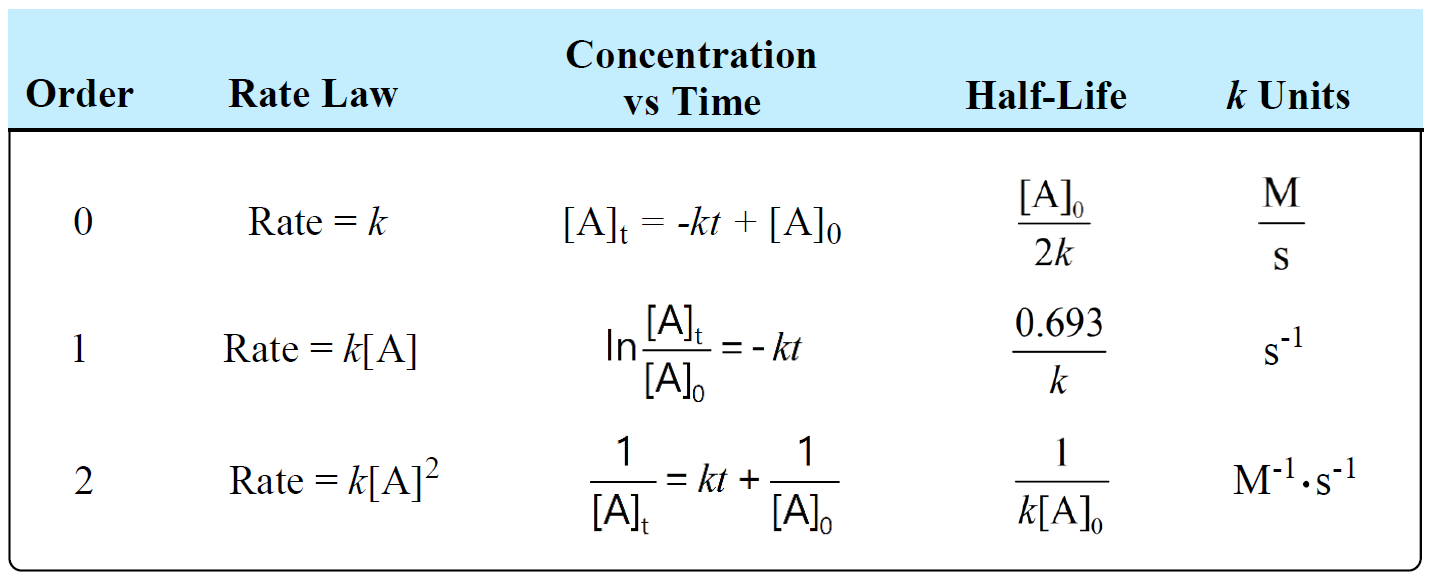
constants have units of concentration/time, which reflect the frequency of effective collisions between reactant molecules. The units of a rate constant depend on the overall order of the reaction. For example, the rate constant for a second-order reaction would have units of M^-1 s^-1.
Determining Rate Law Expressions

Determining the rate law expression for a chemical reaction is crucial for understanding its kinetics. Experimental methods and mathematical techniques are employed to establish the relationship between the reaction rate and the concentrations of reactants.
Initial Rate Data and Integrated Rate Laws
Initial rate data provides valuable insights into the reaction’s order. By measuring the initial rate of the reaction at different initial concentrations of reactants, the order with respect to each reactant can be determined.
Integrated rate laws, derived from the differential rate law, allow for the determination of the rate constant and the order of the reaction. These equations relate the concentration of reactants to time, enabling the calculation of the reaction rate at any given time.
Determining the Order of a Reaction
The order of a reaction with respect to a particular reactant is determined by examining the change in the initial rate when the concentration of that reactant is varied while keeping the concentrations of other reactants constant.
For example, if doubling the concentration of a reactant doubles the initial rate, the reaction is first order with respect to that reactant. Similarly, if tripling the concentration of a reactant triples the initial rate, the reaction is second order with respect to that reactant.
Using Rate Laws for Prediction and Analysis
Rate laws provide a powerful tool for predicting reaction rates under different conditions. By understanding the relationship between reactant concentrations and reaction rate, we can make informed decisions about how to optimize reaction conditions and design experiments.
Applications of Rate Laws in Chemical Kinetics and Reaction Mechanisms, Rate law calculator
- Determining Reaction Order:Rate laws allow us to determine the order of a reaction with respect to each reactant. This information is crucial for understanding the reaction mechanism and predicting its behavior under different conditions.
- Predicting Reaction Rates:Once the rate law is known, we can use it to predict the reaction rate at any given set of reactant concentrations. This is useful for designing experiments, optimizing reaction conditions, and understanding the kinetics of complex reactions.
- Identifying Reaction Intermediates:Rate laws can provide insights into the reaction mechanism by identifying intermediates and their role in the overall reaction. By studying the rate law under different conditions, we can infer the presence of intermediates and their reactivity.
- Designing Experiments:Rate laws help us design experiments to test different hypotheses about reaction mechanisms. By varying reactant concentrations and monitoring the reaction rate, we can gather data that supports or refutes proposed mechanisms.
Advanced Topics in Rate Law Analysis
In this section, we delve into advanced topics related to rate law analysis, exploring numerical methods, the influence of temperature and other factors on reaction rates, and the application of enzyme kinetics in biochemistry.
Numerical Methods for Solving Complex Rate Law Equations
Solving complex rate law equations can be challenging due to their non-linearity and multiple variables. Numerical methods offer a powerful approach to approximate solutions for these equations. Techniques such as the Runge-Kutta method and finite difference methods can be employed to numerically integrate rate laws and obtain time-dependent concentrations of reactants and products.
Impact of Temperature and Other Factors on Reaction Rates
Temperature plays a crucial role in reaction rates. The Arrhenius equation quantifies the relationship between temperature and the rate constant, describing how the rate constant increases exponentially with increasing temperature. Other factors, such as solvent effects, ionic strength, and the presence of catalysts, can also influence reaction rates.
Understanding these factors is essential for optimizing chemical reactions and predicting their behavior under various conditions.
Enzyme Kinetics and its Applications in Biochemistry
Enzyme kinetics is the study of the rates of enzyme-catalyzed reactions. Enzymes are biological catalysts that accelerate specific chemical reactions in living organisms. Understanding enzyme kinetics is fundamental in biochemistry and has applications in drug design, metabolic engineering, and disease diagnosis.
Enzyme kinetic studies involve determining the Michaelis-Menten constant, which characterizes the enzyme’s affinity for its substrate, and the turnover number, which represents the maximum rate of catalysis.
Ending Remarks
As we conclude our exploration of rate law analysis, we venture into advanced topics, employing numerical methods to solve complex equations and delving into the impact of temperature and other factors on reaction rates. Enzyme kinetics emerges as a fascinating application, showcasing the power of rate laws in understanding biochemical processes.