
Potential energy calculator – Step into the captivating realm of potential energy calculations with our meticulously crafted calculator. As you embark on this journey, discover the intricacies of gravitational, elastic, and electrical potential energy, unlocking a world of applications in physics, engineering, and chemistry.
From understanding the conversion of potential energy to kinetic and electrical energy to exploring potential energy diagrams, our calculator empowers you to unravel the mysteries of this fundamental concept. Immerse yourself in the seamless integration of potential energy calculations, enriching your understanding and igniting your curiosity.
Potential Energy Formulas
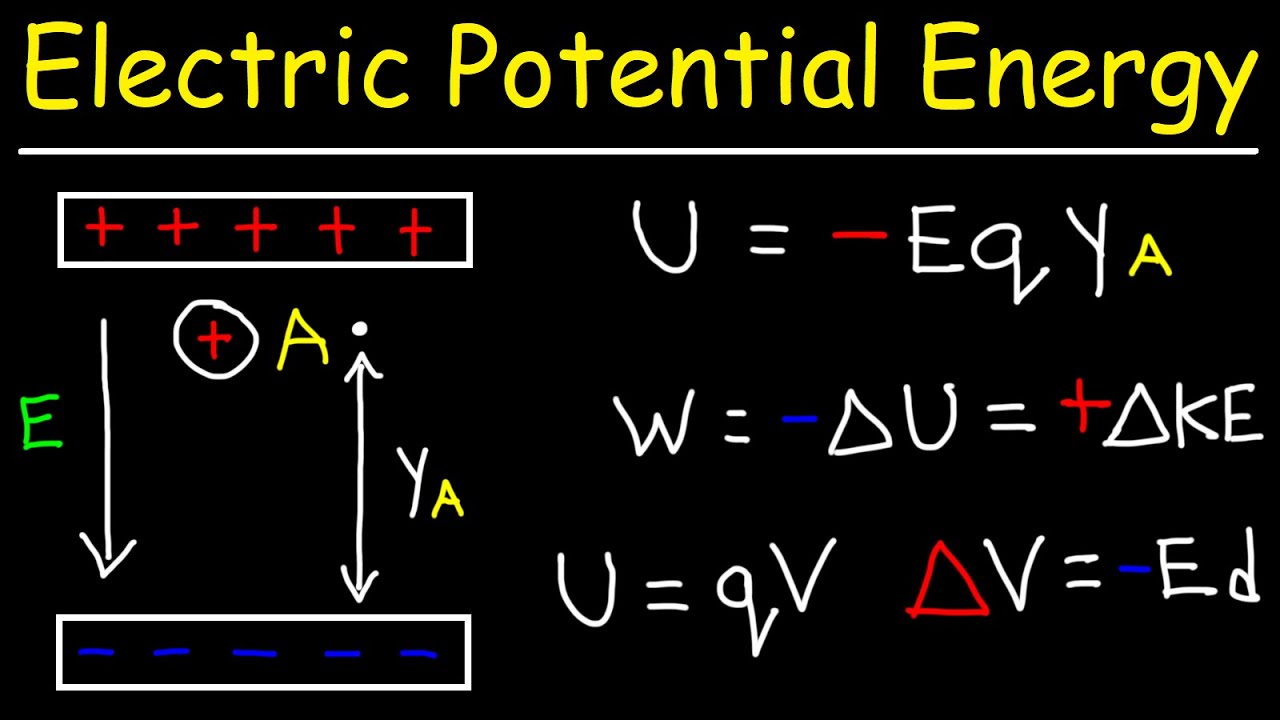
Potential energy is the energy stored in an object due to its position or condition. There are different types of potential energy, each with its own formula.
The formula for gravitational potential energy is:
U = mgh
where:
- U is the gravitational potential energy in joules (J)
- m is the mass of the object in kilograms (kg)
- g is the acceleration due to gravity (9.8 m/s^2 on Earth)
- h is the height of the object above a reference point in meters (m)
The formula for elastic potential energy is:
U = 1/2kx^2
where:
- U is the elastic potential energy in joules (J)
- k is the spring constant in newtons per meter (N/m)
- x is the displacement of the spring from its equilibrium position in meters (m)
The formula for electrical potential energy is:
U = kq1q2/r
where:
- U is the electrical potential energy in joules (J)
- k is Coulomb’s constant (8.988 x 10^9 N m^2/C^2)
- q1 and q2 are the charges of the two objects in coulombs (C)
- r is the distance between the two objects in meters (m)
Applications of Potential Energy Calculations

Potential energy calculations are widely employed across various scientific disciplines, including physics, engineering, and chemistry. Understanding the potential energy of a system is crucial for predicting its behavior and devising effective solutions.
Applications in Physics
In physics, potential energy calculations are used to:
- Determine the trajectory of objects in motion, such as projectiles or satellites.
- Calculate the forces acting on objects due to gravity, electric fields, or magnetic fields.
- Understand the behavior of waves, such as sound waves or electromagnetic waves.
Applications in Engineering
In engineering, potential energy calculations are applied in:
- Designing structures to withstand external forces, such as buildings, bridges, and aircraft.
- Optimizing the performance of machines and engines by minimizing energy losses.
- Analyzing the stability and dynamics of complex systems, such as vehicles or robotic systems.
Applications in Chemistry, Potential energy calculator
In chemistry, potential energy calculations are utilized to:
- Predict the reactivity of molecules and chemical reactions.
- Determine the stability of molecular structures and conformations.
- Model the behavior of chemical systems in various environments, such as solvents or biological systems.
Potential Energy Conversion

Potential energy is not a fixed quantity; it can be transformed into other forms of energy. In this section, we’ll explore some common ways in which potential energy is converted into different energy forms.
Conversion of Potential Energy to Kinetic Energy
When an object falls, its potential energy is converted into kinetic energy. This is because as the object falls, its height above the ground decreases, and its velocity increases. The amount of kinetic energy gained is equal to the amount of potential energy lost.
Conversion of Potential Energy to Electrical Energy
Hydroelectric dams convert the potential energy of water stored in a reservoir into electrical energy. As the water flows through the dam, its potential energy is converted into kinetic energy, which is then used to turn a turbine that generates electricity.
Conversion of Potential Energy to Other Forms of Energy
Potential energy can also be converted into other forms of energy, such as thermal energy, sound energy, and chemical energy. For example, when a rubber band is stretched, its potential energy is converted into thermal energy as it heats up.
When a bell is rung, its potential energy is converted into sound energy. And when a battery is charged, its potential energy is converted into chemical energy.
Potential Energy Diagrams: Potential Energy Calculator
Potential energy diagrams are graphical representations of the potential energy of a system as a function of its position or configuration. They are useful for visualizing the energy landscape of a system and understanding its behavior.
There are three main types of potential energy diagrams: harmonic oscillator, gravitational, and electrical.
Harmonic Oscillator
The potential energy of a simple harmonic oscillator is given by:
$$U(x) = \frac12kx^2$$
where:
- $U(x)$ is the potential energy
- $k$ is the spring constant
- $x$ is the displacement from equilibrium
The potential energy diagram for a harmonic oscillator is a parabola. The minimum of the parabola is at $x = 0$, which is the equilibrium position. The potential energy increases as $x$ moves away from equilibrium.
Gravitational
The potential energy of a gravitational system is given by:
$$U(r) =
\fracGm_1m_2r$$
where:
- $U(r)$ is the potential energy
- $G$ is the gravitational constant
- $m_1$ and $m_2$ are the masses of the two objects
- $r$ is the distance between the two objects
The potential energy diagram for a gravitational system is a hyperbola. The potential energy decreases as $r$ increases. The potential energy becomes more negative as the objects get closer together.
Electrical
The potential energy of an electrical system is given by:
$$U(r) = \frac14\pi\epsilon_0\fracq_1q_2r$$
where:
- $U(r)$ is the potential energy
- $\epsilon_0$ is the permittivity of free space
- $q_1$ and $q_2$ are the charges of the two objects
- $r$ is the distance between the two objects
The potential energy diagram for an electrical system is a hyperbola. The potential energy decreases as $r$ increases. The potential energy becomes more negative as the charges get closer together.
| Positive Charge | Negative Charge | |
|---|---|---|
| Positive Charge | Repulsive | Attractive |
| Negative Charge | Attractive | Repulsive |
Ultimate Conclusion
As we conclude our exploration of potential energy, we leave you with a profound appreciation for its transformative power. Our calculator has illuminated the intricate interplay of potential energy in various fields, empowering you to tackle complex problems with confidence.
May this newfound knowledge inspire you to delve deeper into the wonders of science and technology.
