
Unleash the power of the Local Minima and Maxima Calculator, a revolutionary tool that empowers you to decipher the intricate landscapes of functions. With unparalleled precision, this calculator pinpoints local minima and maxima, providing invaluable insights for optimization, data analysis, and beyond.
Delve into the fascinating world of local extrema, where functions reach their peaks and valleys. Our calculator unveils the secrets of these critical points, empowering you to harness their knowledge for a wide range of applications.
Overview of Local Minima and Maxima
In the realm of mathematics, local minima and maxima play a pivotal role in understanding the behavior of functions. A local minimum (or minimum) is a point where the function’s value is lower than at all neighboring points. Conversely, a local maximum (or maximum) is a point where the function’s value is higher than at all neighboring points.
These concepts find widespread application in various fields, including optimization and data analysis. Identifying local minima and maxima helps researchers and practitioners optimize systems, models, and processes, ultimately leading to improved outcomes.
Examples of Local Minima and Maxima
Consider the function f(x) = x^2. At x = 0, the function has a local minimum because the value of f(0) is lower than the values of f(x) for any other value of x near 0.
In contrast, the function g(x) = -x^2 has a local maximum at x = 0 because the value of g(0) is higher than the values of g(x) for any other value of x near 0.
Calculator Functionality
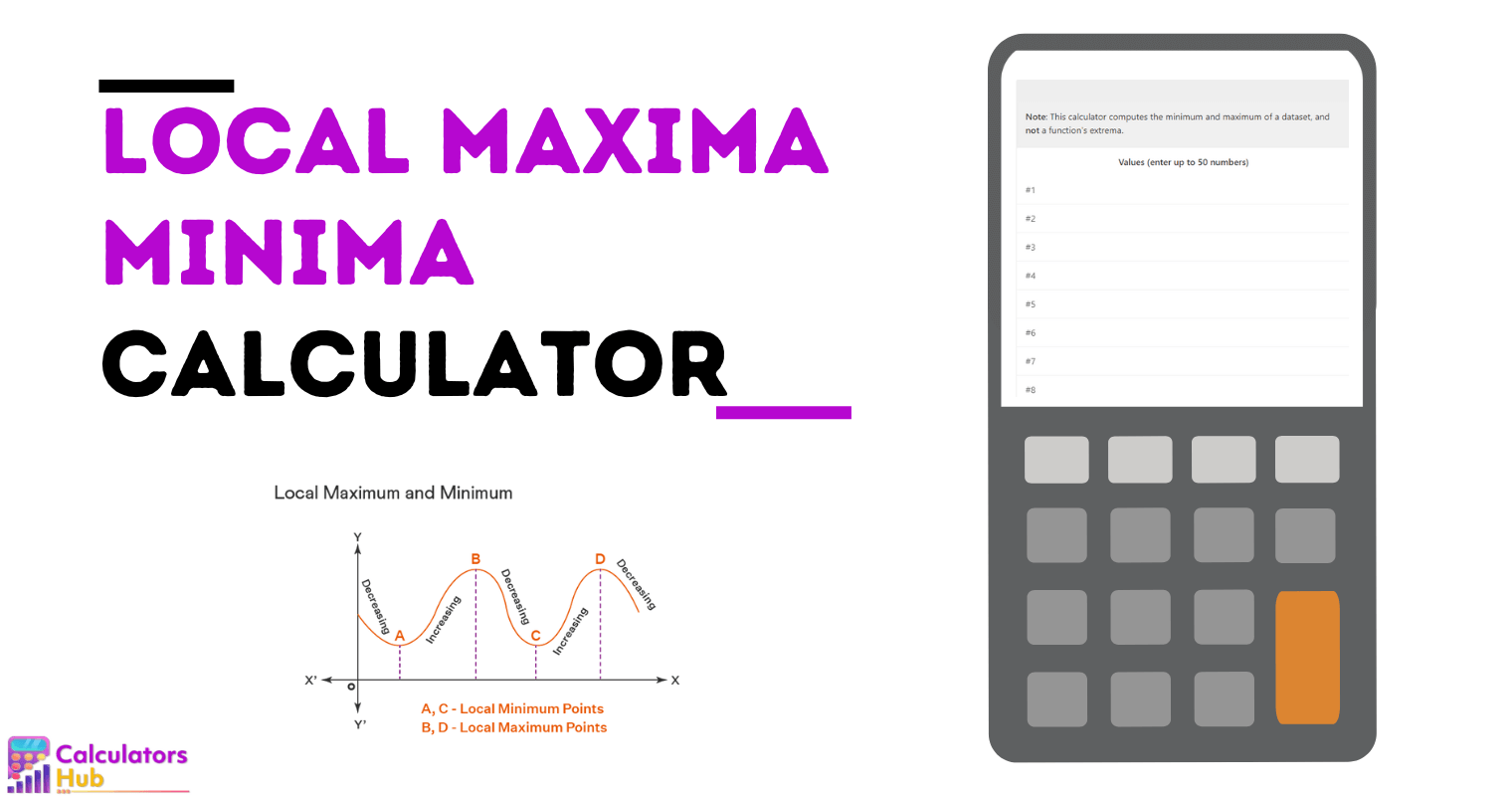
A local minima and maxima calculator is a powerful tool that can help you find the critical points of a function. These points represent the locations where the function changes from increasing to decreasing (local maxima) or from decreasing to increasing (local minima).
To use the calculator, simply enter the function you want to analyze into the input field. The calculator will then use a variety of algorithms and techniques to find the local minima and maxima of the function.
Algorithms and Techniques
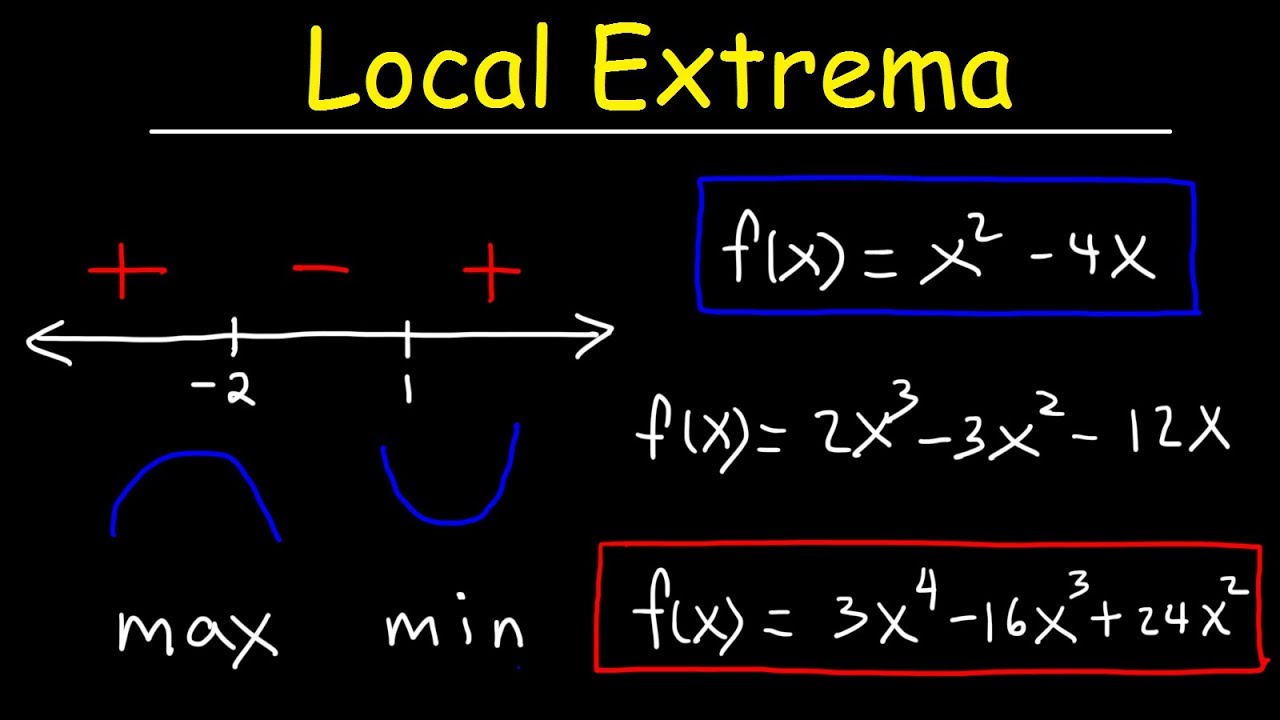
- First Derivative Test:This test uses the first derivative of the function to find the critical points. At a critical point, the first derivative is either zero or undefined.
- Second Derivative Test:This test uses the second derivative of the function to determine whether a critical point is a local minimum, local maximum, or neither.
- Numerical Methods:These methods use numerical approximations to find the local minima and maxima of the function. Some common numerical methods include the bisection method, the secant method, and the Newton-Raphson method.
Applications of Local Minima and Maxima Calculator
Local minima and maxima calculators are versatile tools with wide-ranging applications in various domains, including:
Optimization Problems
In optimization problems, the goal is to find the values of variables that minimize or maximize a given objective function. Local minima and maxima calculators can be used to efficiently identify these optimal points, which is particularly valuable in situations where analytical solutions are complex or infeasible.
- Example:A manufacturing company wants to determine the optimal production quantity to maximize profits. The calculator can be used to find the quantity that results in the highest profit, considering factors such as production costs, sales prices, and demand.
Curve Fitting
Curve fitting involves finding a mathematical function that best represents a set of data points. Local minima and maxima calculators can be employed to determine the parameters of the function that minimize the error between the function and the data points.
- Example:A researcher wants to model the growth of a population over time. The calculator can be used to find the parameters of an exponential or logistic function that best fits the observed data, providing insights into the population’s growth rate and carrying capacity.
Data Analysis
In data analysis, local minima and maxima calculators can be used to identify trends, patterns, and outliers in datasets. By finding the local minima and maxima, analysts can gain insights into the behavior of the data and make informed decisions.
- Example:A financial analyst wants to identify potential investment opportunities by analyzing historical stock prices. The calculator can be used to find the local maxima, which represent potential buying opportunities, and local minima, which represent potential selling opportunities.
Machine Learning
In machine learning, local minima and maxima calculators are used to optimize the parameters of machine learning models. By finding the local minima of a loss function, the model’s performance can be improved, resulting in better predictions and classifications.
- Example:A computer vision algorithm is being trained to recognize images of cats. The calculator can be used to find the local minima of the loss function, which corresponds to the optimal weights for the algorithm’s neural network, improving its ability to correctly identify cats.
Benefits of Using Local Minima and Maxima Calculator:
- Efficient and accurate identification of local minima and maxima
- Simplifies complex optimization problems
- Provides insights into data patterns and trends
- Enhances the performance of machine learning models
Limitations of Using Local Minima and Maxima Calculator:
- May not find global minima or maxima, especially in complex functions
- Accuracy depends on the accuracy of the input data
- May require additional analysis to interpret the results in context
Advanced Features
The Local Minima and Maxima Calculator offers advanced features to enhance its usability and effectiveness.
Complex Function Handling
The calculator can handle complex functions, allowing users to input functions with multiple variables, trigonometric functions, exponential functions, and other complex mathematical expressions. This feature expands the calculator’s capabilities to analyze a wider range of functions and determine their local minima and maxima.
Function Visualization
The calculator provides a visual representation of the function being analyzed. This visualization helps users understand the function’s shape, identify potential local minima and maxima, and observe how the function changes over different input values. The visual representation enhances the user’s understanding of the function’s behavior and makes it easier to identify critical points.
Exporting Results, Local minima and maxima calculator
The calculator allows users to export the results of their analysis in various formats, such as text files, CSV files, or images. This feature enables users to easily share their findings with others, store the results for future reference, or use them for further analysis in other software or applications.
The ability to export results increases the calculator’s utility and makes it a valuable tool for researchers, students, and professionals.
Closing Notes: Local Minima And Maxima Calculator
As we bid farewell to this exploration of local minima and maxima, remember that the calculator remains your steadfast companion, ready to unravel the complexities of any function. Embrace its capabilities, and unlock a world of optimization and discovery.
