The Laplace inverse calculator is an indispensable tool for engineers, mathematicians, and scientists, empowering them to unravel the mysteries of complex functions and solve intricate problems with unparalleled ease. This comprehensive guide will delve into the fascinating world of Laplace transforms, exploring their properties, methods, and applications while showcasing the remarkable capabilities of Laplace inverse calculators.
From understanding the fundamental concepts of Laplace transforms to mastering the art of finding inverse Laplace transforms, this guide will provide a thorough understanding of this powerful mathematical tool.
Laplace Transform Concepts
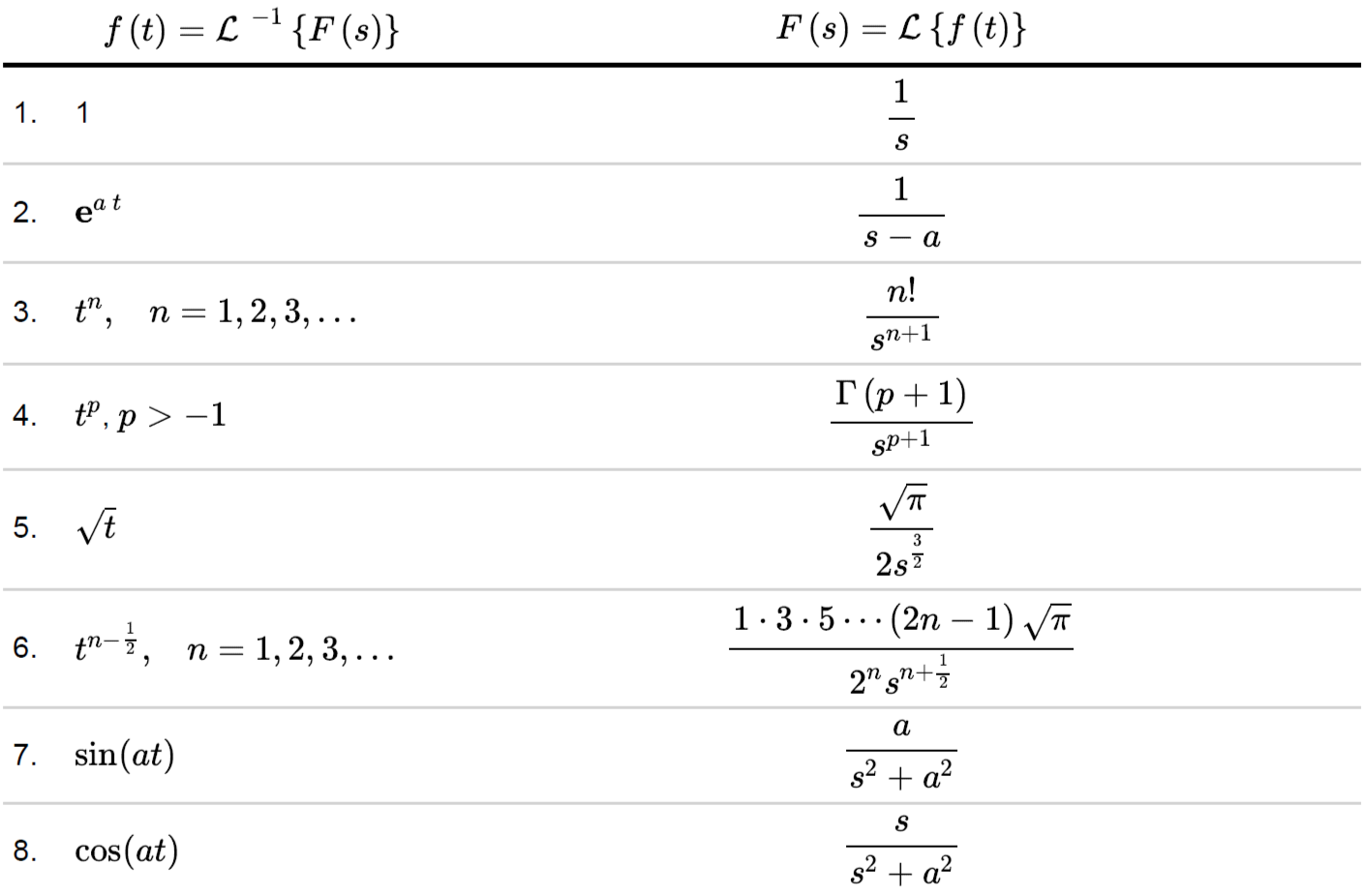
The Laplace transform is a mathematical tool used to convert a function of a real variable (typically time) into a function of a complex variable (typically frequency). It is widely used in engineering, physics, and mathematics to solve differential equations, analyze stability, and study the behavior of systems in the frequency domain.The
Laplace transform of a function f(t) is defined as:“`F(s) = ∫[0, ∞] e^(-st) f(t) dt“`where s is the complex frequency variable.Some common Laplace transforms and their corresponding functions include:
- f(t) = 1 → F(s) = 1/s
- f(t) = t → F(s) = 1/s^2
- f(t) = e^(-at) → F(s) = 1/(s + a)
- f(t) = sin(ωt) → F(s) = ω/(s^2 + ω^2)
The Laplace transform has several important properties, including:
- Linearity: The Laplace transform of a linear combination of functions is equal to the linear combination of the Laplace transforms of the individual functions.
- Time-shifting: If f(t) is shifted by a constant amount a, then the Laplace transform of f(t – a) is equal to e^(-as)F(s).
These properties make the Laplace transform a powerful tool for analyzing and solving problems in a variety of fields.
Laplace Inverse Transform Methods
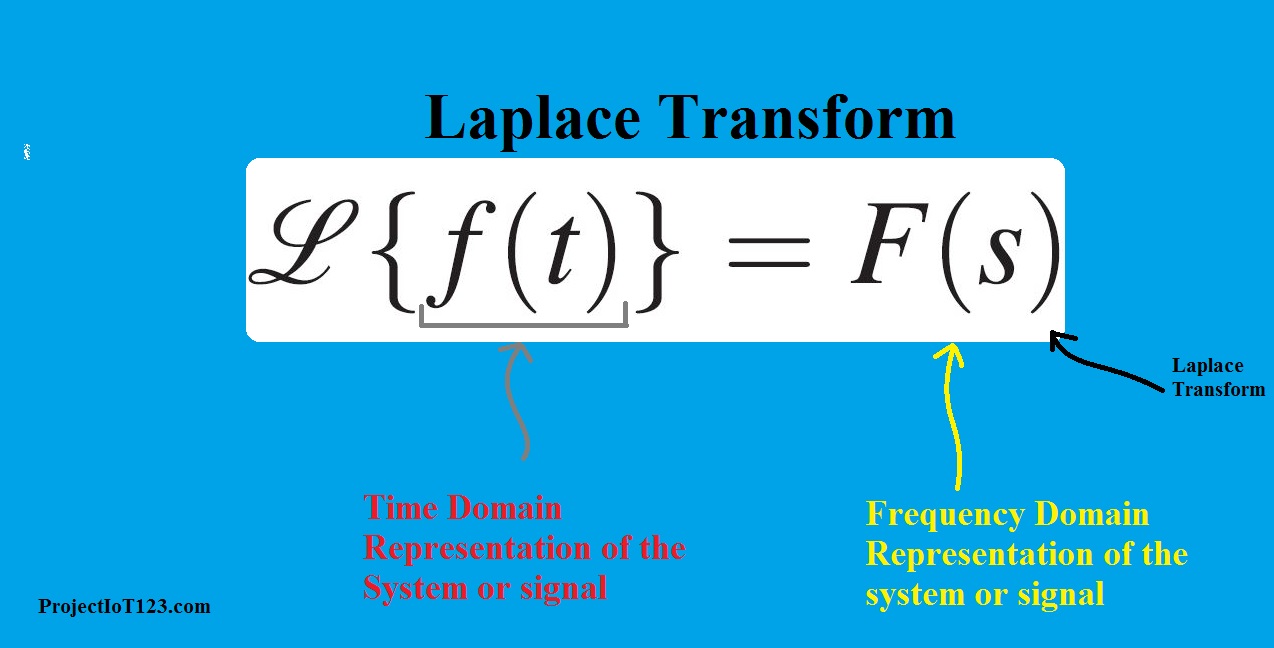
The inverse Laplace transform is a mathematical operation that allows us to determine the original function from its Laplace transform. There are several methods for finding the inverse Laplace transform, each with its own advantages and disadvantages.
Partial Fraction Decomposition
Partial fraction decomposition involves expressing the Laplace transform as a sum of simpler fractions, which can then be inverted using standard formulas. This method is particularly useful when the Laplace transform has a complex rational function form.
- Decompose the Laplace transform into partial fractions using algebraic techniques.
- Invert each partial fraction using the inverse Laplace transform formulas.
- Combine the results to obtain the original function.
Convolution Theorem
The convolution theorem states that the inverse Laplace transform of the product of two Laplace transforms is equal to the convolution of the original functions. This method is useful when the Laplace transform involves a product of known functions.
- Take the inverse Laplace transform of each Laplace transform.
- Convolve the resulting functions using the convolution integral.
- The result is the original function.
Laplace Transform Tables
Laplace transform tables provide a list of Laplace transforms and their corresponding functions. This method is useful when the Laplace transform of the original function is readily available in the table.
- Find the Laplace transform of the original function in the table.
- Use the inverse Laplace transform formula to obtain the original function.
The choice of method for finding the inverse Laplace transform depends on the complexity of the Laplace transform and the availability of relevant information. Partial fraction decomposition is generally more suitable for complex rational functions, while the convolution theorem is useful for products of known functions.
Laplace transform tables offer a quick and convenient solution when the Laplace transform is readily available.
Applications of Laplace Transforms

Laplace transforms find widespread applications in various scientific and engineering disciplines, particularly in solving differential and integral equations. They provide a powerful tool to analyze and solve complex problems involving time-dependent functions.
In electrical engineering, Laplace transforms are extensively used to analyze electrical circuits, study transient responses, and design control systems. They enable engineers to determine the behavior of circuits under different input signals and design systems with desired performance characteristics.
Control Systems
In control systems, Laplace transforms are used to analyze the stability and performance of feedback systems. They allow engineers to determine the transfer function of a system, which represents the relationship between the input and output signals. By analyzing the transfer function, engineers can design control systems with desired stability, response time, and accuracy.
Signal Processing
In signal processing, Laplace transforms are used to analyze and manipulate signals in the frequency domain. They enable engineers to filter out unwanted noise, enhance signal quality, and perform other signal processing operations. Laplace transforms are also used in image processing and computer vision to analyze and enhance images.
While Laplace transforms are a powerful tool, they have certain limitations and assumptions. One limitation is that the Laplace transform of a function must exist for the transform to be applicable. Additionally, the Laplace transform assumes that the function is defined for all positive values of time, which may not always be the case in practical applications.
Laplace Inverse Calculator Features
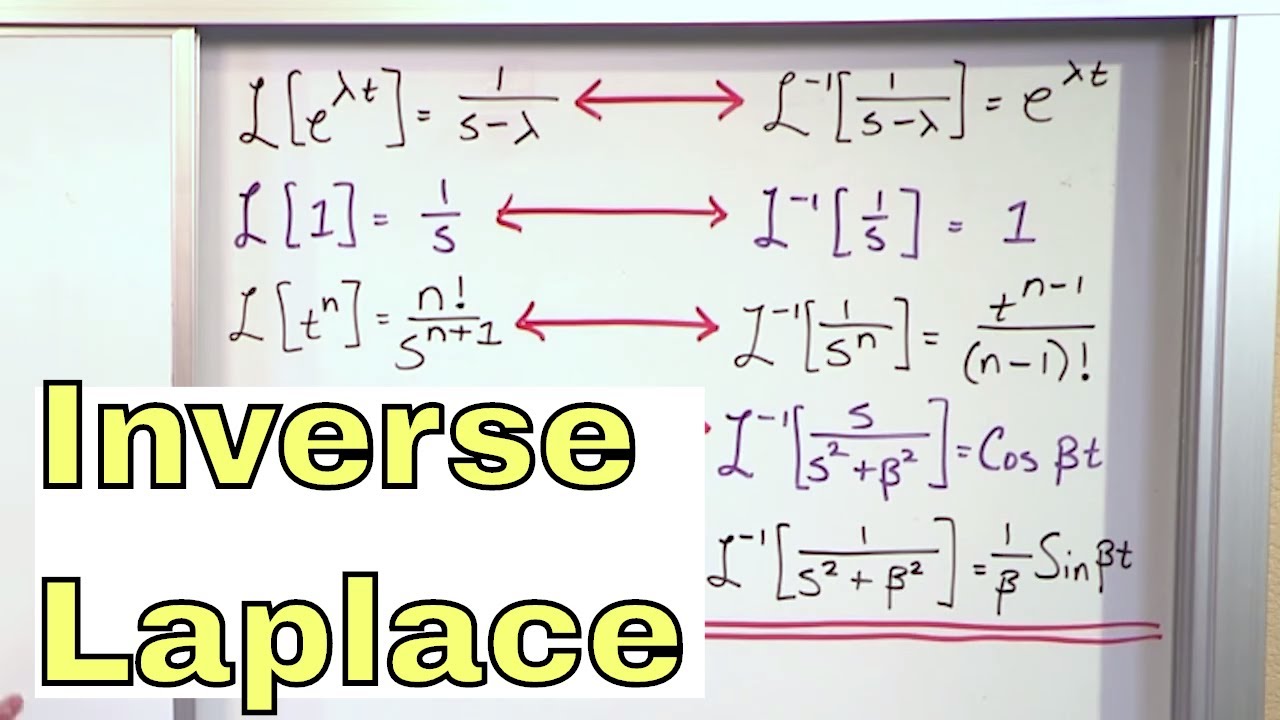
Laplace inverse calculators are powerful tools that can help you find the inverse Laplace transform of a function. These calculators use a variety of methods to find the inverse Laplace transform, including the Laplace transform table, the convolution theorem, and the partial fraction expansion method.
Types of Laplace Inverse Calculators
There are many different types of Laplace inverse calculators available, each with its own features and capabilities. Some of the most popular types of calculators include:
- Online calculators:These calculators are available online and can be used to find the inverse Laplace transform of a function without having to install any software.
- Software calculators:These calculators are installed on your computer and can be used to find the inverse Laplace transform of a function offline.
- Handheld calculators:These calculators are portable and can be used to find the inverse Laplace transform of a function anywhere.
Accuracy and Limitations, Laplace inverse calculator
The accuracy of Laplace inverse calculators depends on the method used to find the inverse Laplace transform. The Laplace transform table method is the most accurate method, but it can only be used to find the inverse Laplace transform of a limited number of functions.
The convolution theorem and partial fraction expansion methods are less accurate, but they can be used to find the inverse Laplace transform of a wider range of functions.
Laplace inverse calculators can be a valuable tool for finding the inverse Laplace transform of a function. However, it is important to be aware of the accuracy and limitations of these calculators before using them.
Outcome Summary
In conclusion, the Laplace inverse calculator is a game-changer for solving complex problems in various fields. Its ability to simplify intricate mathematical operations and provide accurate results makes it an invaluable asset for professionals seeking efficient and reliable solutions.