Unveiling the linear independence calculator, a groundbreaking tool that empowers you to effortlessly determine the linear independence of vector sets. Delve into the captivating world of linear algebra as we unravel the significance and applications of this remarkable concept.
Linear independence, a cornerstone of vector analysis, plays a pivotal role in solving systems of linear equations, matrix theory, geometry, and physics. With the linear independence calculator at your fingertips, you can effortlessly assess the linear independence of any given set of vectors, unlocking a treasure trove of mathematical insights.
Linear Independence and its Significance
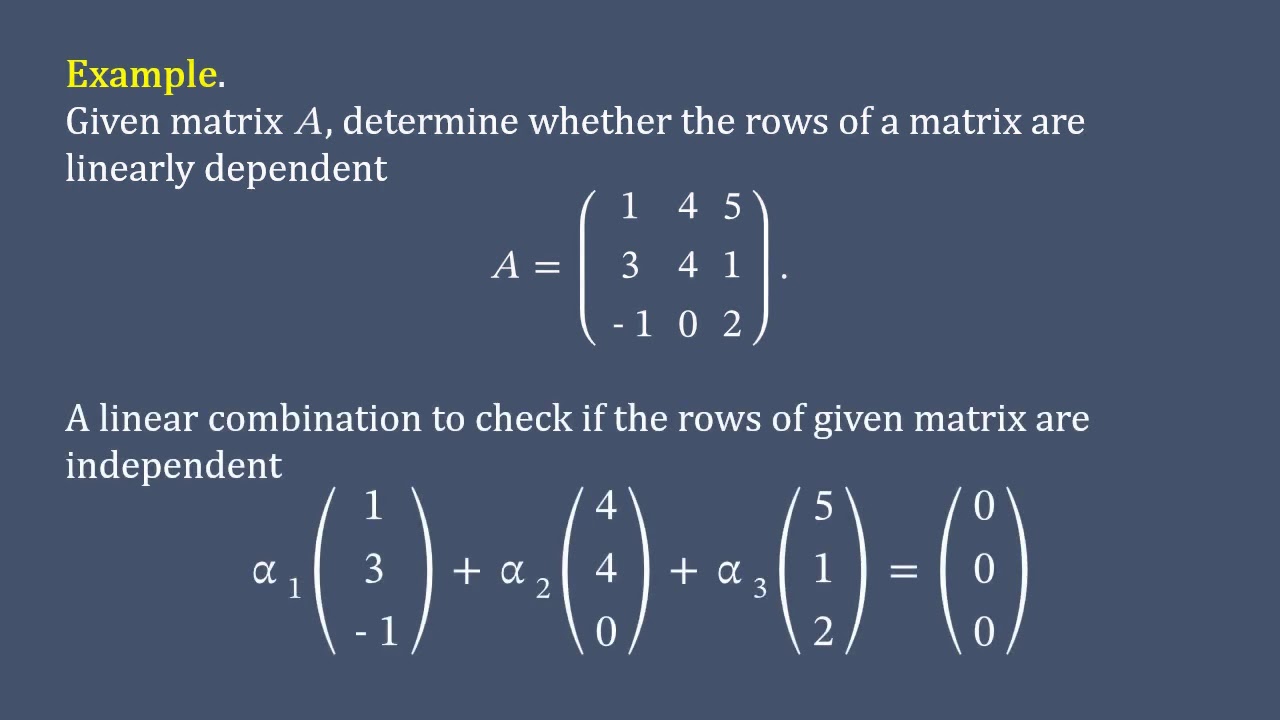
Linear independence is a crucial concept in linear algebra that describes the behavior of vectors in a vector space. It determines whether a set of vectors can be expressed as a linear combination of each other or not.
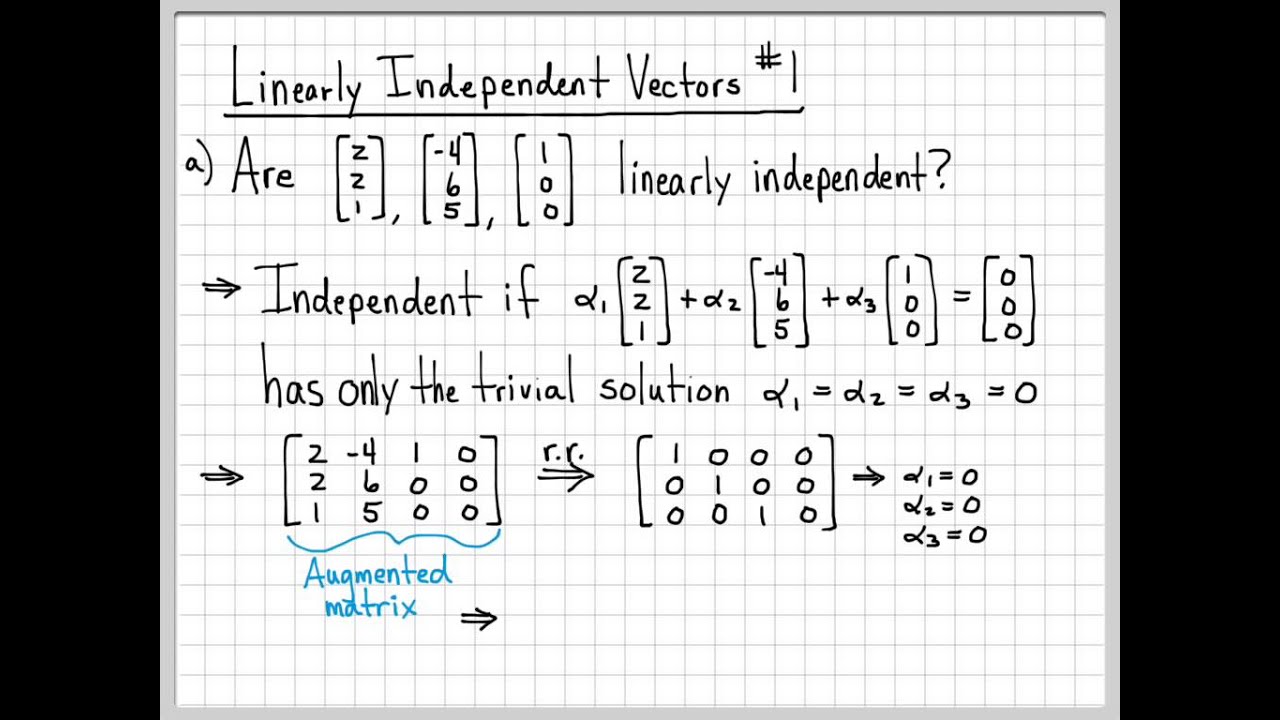
Formally, a set of vectors v1, v2, …, vn is said to be linearly independent if and only if the equation a1v1 + a2v2 + … + anvn = 0 implies that all coefficients a1, a2, …, an are equal to zero.
Examples
Consider the following sets of vectors:
- (1, 0), (0, 1) is linearly independent because neither vector can be expressed as a multiple of the other.
- (1, 1), (2, 2) is linearly dependent because (2, 2) can be expressed as a multiple of (1, 1).
Importance
Linear independence plays a significant role in various mathematical applications:
- Basis and Dimension:Linearly independent sets form a basis for a vector space, and their number determines the dimension of the space.
- Solving Systems of Equations:Linear independence of the columns of a matrix ensures that a system of linear equations has a unique solution.
- Matrix Invertibility:A square matrix is invertible if and only if its columns are linearly independent.
Methods for Determining Linear Independence
Determining linear independence is a crucial step in various mathematical applications. Several methods exist to assess the linear independence of a set of vectors, each with its advantages and limitations.
Row Reduction Method
The row reduction method involves transforming a matrix representing the vectors into its reduced row echelon form. If the reduced row echelon form has a pivot in every row, the vectors are linearly independent. Otherwise, they are linearly dependent.
Determinant Method
The determinant method involves calculating the determinant of the matrix representing the vectors. If the determinant is nonzero, the vectors are linearly independent. If the determinant is zero, the vectors are linearly dependent.
Cross-Product Method (for 3D Vectors), Linear independence calculator
For a set of three vectors in three-dimensional space, the cross-product method can be used to determine linear independence. If the cross-product of two vectors is the zero vector, then the three vectors are linearly dependent. Otherwise, they are linearly independent.
Applications of Linear Independence
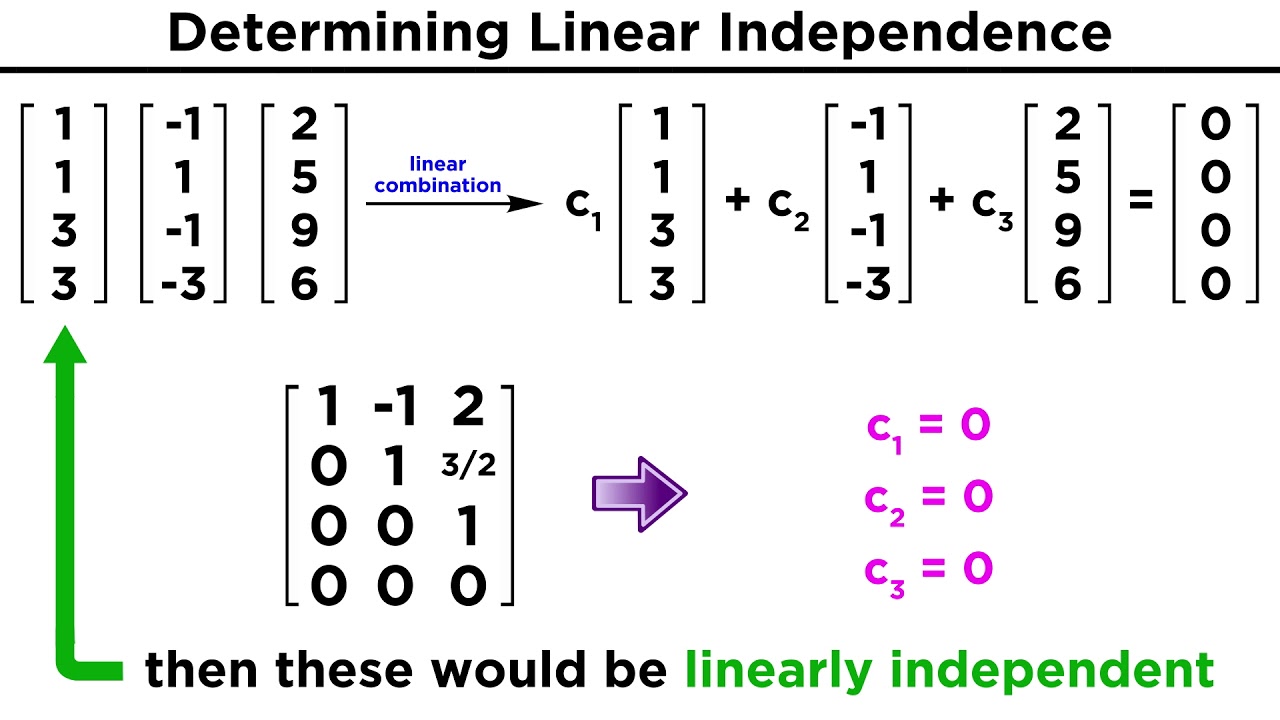
Linear independence finds applications in various fields of mathematics, including linear algebra, geometry, and physics. It plays a crucial role in solving systems of linear equations, understanding matrix theory, and analyzing geometric shapes and physical systems.
Solving Systems of Linear Equations
In solving systems of linear equations, linear independence determines whether a unique solution exists. If the coefficient matrix of the system is linearly independent, then the system has a unique solution. Conversely, if the coefficient matrix is linearly dependent, the system may have no solutions or infinitely many solutions.
- Example:Consider the system of equations 2x + 3y = 5 and x – y = 1. The coefficient matrix is $$\beginbmatrix 2 & 3 \\\ 1 & -1 \endbmatrix$$. The determinant of this matrix is -5, which is non-zero.
Therefore, the coefficient matrix is linearly independent, and the system has a unique solution.
Calculator Tools for Linear Independence Analysis
Linear independence calculators are online tools that assist in determining whether a given set of vectors is linearly independent or not. These calculators simplify the process by performing the necessary mathematical operations and providing a clear result.
Using Linear Independence Calculators
To use a linear independence calculator, follow these steps:
- Enter the vectors into the calculator. You can typically input the vectors as lists of coordinates or as matrices.
- Select the method for determining linear independence (e.g., determinant, rank).
- Click on the “Calculate” button.
- The calculator will display the result, indicating whether the vectors are linearly independent or not.
Advantages and Limitations
Using calculators for linear independence analysis offers several advantages:
- Convenience:Calculators automate the process, saving time and effort.
- Accuracy:Calculators perform the calculations accurately, eliminating human error.
- Visual aids:Some calculators provide visual representations of the vectors and their linear independence.
However, calculators also have some limitations:
- Limited functionality:Calculators may not support all methods for determining linear independence.
- Lack of understanding:Calculators do not provide an in-depth understanding of the concept of linear independence.
- Dependency:Users may become overly reliant on calculators, neglecting to develop their own analytical skills.
Concluding Remarks: Linear Independence Calculator
Harnessing the power of the linear independence calculator, you can confidently navigate the intricacies of vector analysis, unlocking a deeper understanding of linear algebra and its far-reaching applications. Embrace the power of this invaluable tool and elevate your mathematical prowess to new heights.