Cramer rule calculator, a powerful tool for solving systems of linear equations, takes center stage as we delve into its fascinating world. Its ability to effortlessly crunch numbers and unravel complex equations makes it an indispensable asset for students, researchers, and professionals alike.
This comprehensive guide will illuminate the intricacies of Cramer’s Rule, providing a step-by-step roadmap for its application and exploring its wide-ranging applications in various fields. Get ready to embark on an enlightening journey into the realm of linear algebra, where Cramer’s Rule reigns supreme.
Cramer’s Rule Overview: Cramer Rule Calculator
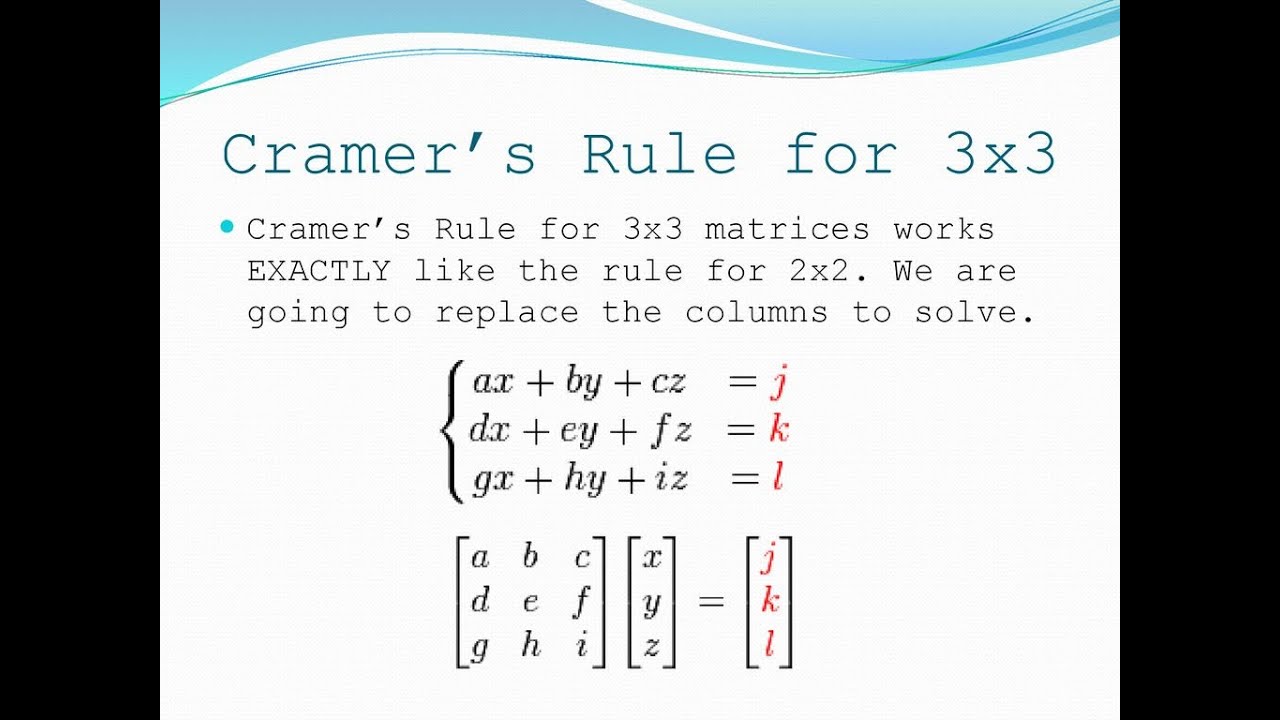
Cramer’s Rule is a mathematical technique used to solve systems of linear equations with the same number of equations as variables. It provides a systematic method for finding the values of the variables by using determinants.
Mathematical Formula
The formula for Cramer’s Rule is:$$x_i = \fracD_iD$$where:* $$x_i$$ is the value of the $$i$$-th variable
- $$D_i$$ is the determinant of the matrix formed by replacing the $$i$$-th column of the coefficient matrix with the constants
- $$D$$ is the determinant of the coefficient matrix
Limitations and Assumptions
Cramer’s Rule has certain limitations and assumptions:* The coefficient matrix must be square, meaning it has the same number of rows and columns.
- The determinant of the coefficient matrix cannot be zero, as division by zero is undefined.
- The system of equations must be consistent, meaning it has at least one solution.
Step-by-Step Guide to Using Cramer’s Rule
Cramer’s Rule is a method for solving systems of linear equations by calculating determinants. Here’s a step-by-step guide to using it:
Calculating the Determinant of the Coefficient Matrix
- Arrange the coefficients of the variables in a square matrix called the coefficient matrix.
- Calculate the determinant of the coefficient matrix using any method (e.g., Laplace expansion, row reduction).
Calculating the Determinant of the Numerator Matrices
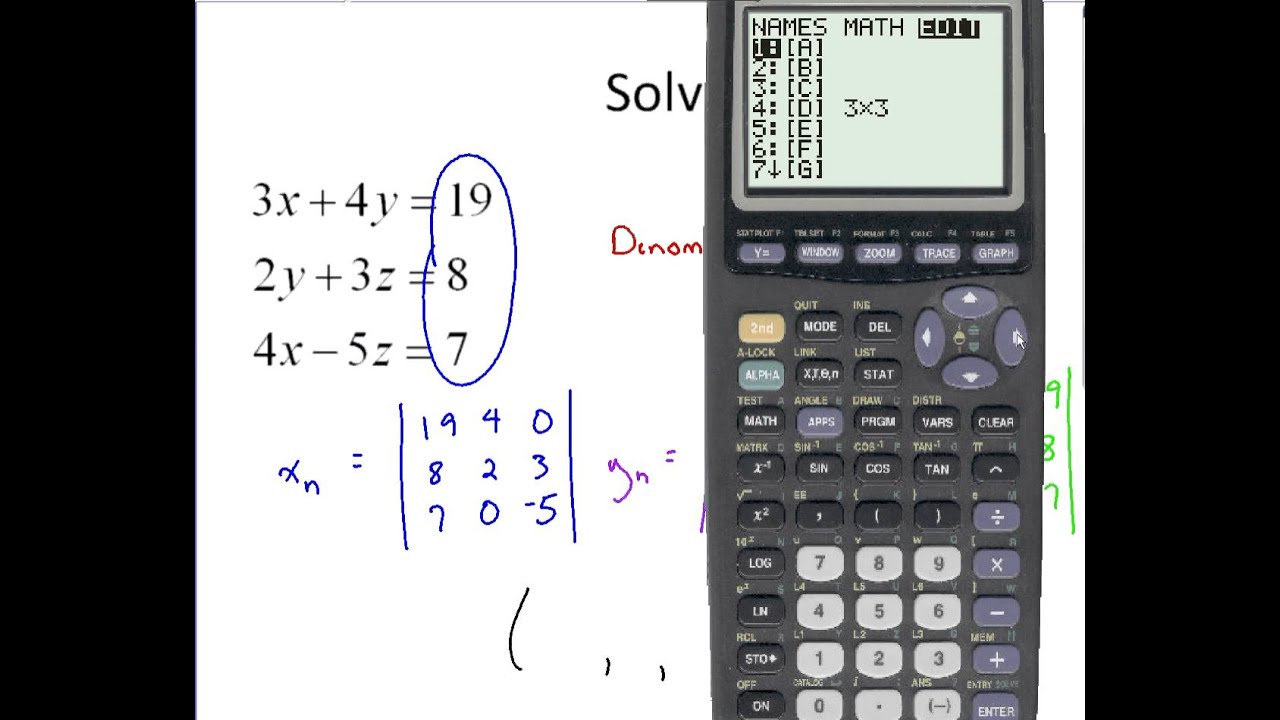
- For each variable, create a new matrix by replacing the column of coefficients corresponding to that variable with the column of constants.
- Calculate the determinant of each numerator matrix.
Solving for the Variables
- For each variable, divide the determinant of the corresponding numerator matrix by the determinant of the coefficient matrix.
- The result is the value of that variable.
Applications of Cramer’s Rule
Cramer’s Rule is a powerful tool that finds widespread applications in various fields, including engineering, physics, and economics. It offers a systematic approach to solving systems of linear equations, making it a valuable technique for tackling complex real-world problems.
Engineering
In engineering, Cramer’s Rule is employed to analyze structural stability, design electrical circuits, and optimize fluid dynamics. For instance, it can be used to determine the forces acting on a bridge under different load conditions, ensuring its structural integrity.
Physics
Cramer’s Rule plays a crucial role in physics, particularly in solving problems involving particle motion, electromagnetic fields, and wave propagation. It allows physicists to determine the unknown variables that govern these phenomena, leading to a deeper understanding of physical systems.
Economics, Cramer rule calculator
In economics, Cramer’s Rule is utilized to analyze market equilibrium, optimize resource allocation, and forecast economic trends. It enables economists to solve systems of equations representing supply and demand, production costs, and consumer behavior, providing valuable insights into market dynamics.
Nonlinear Equations
While Cramer’s Rule is primarily used for solving systems of linear equations, it can also be applied to solve certain types of nonlinear equations. By employing numerical methods such as the Newton-Raphson method, it is possible to iteratively approximate the solutions to nonlinear equations using Cramer’s Rule as a starting point.
Advanced Techniques and Extensions
Cramer’s Rule, while a powerful tool, can be extended to solve more complex systems of equations and matrix-related problems.
Using Cramer’s Rule with Complex Coefficients
Cramer’s Rule can be extended to solve systems of equations with complex coefficients, i.e., coefficients that contain imaginary numbers (√-1). The process is similar to solving systems with real coefficients, but the calculations involve complex arithmetic.
Extension to Matrix Inverse
Cramer’s Rule can be used to find the inverse of a matrix, a fundamental operation in linear algebra. By calculating the determinant and the cofactors of a matrix, Cramer’s Rule provides a method to compute its inverse.
Applications in Practice
These advanced techniques find applications in various fields:
Complex Systems Modeling
Solving systems of equations with complex coefficients is crucial in electrical engineering, fluid dynamics, and quantum mechanics.
Matrix Inversion in Linear Algebra
Finding the inverse of a matrix is essential in solving systems of linear equations, matrix transformations, and statistics.
Last Recap
Cramer’s Rule, with its elegance and versatility, stands as a testament to the power of mathematics. Its ability to tackle complex systems of equations with ease makes it a valuable tool in numerous disciplines. As we conclude our exploration, we encourage you to embrace the power of Cramer’s Rule and unlock the secrets of linear equations.