Introducing the Henderson Hasselbalch equation calculator, an invaluable tool for calculating pH and understanding the behavior of acid-base systems. This equation, named after its creators Lawrence Henderson and Karl Hasselbalch, is a cornerstone of chemistry and biology, providing a quantitative framework for predicting and analyzing pH values in various solutions.
The Henderson Hasselbalch equation is a mathematical formula that relates the pH of a solution to the concentrations of its acid and conjugate base components. It allows scientists and researchers to determine the pH of a solution based on known concentrations or to calculate the concentrations of acid and base species given a specific pH value.
This equation is particularly useful for studying buffer solutions, which play a crucial role in maintaining a stable pH in biological systems.
Henderson-Hasselbalch Equation Fundamentals
The Henderson-Hasselbalch equation is a mathematical formula that relates the pH of a solution to the concentrations of the acid and its conjugate base. It is used to calculate the pH of buffer solutions, which are solutions that resist changes in pH when small amounts of acid or base are added.
The equation is derived from the law of mass action, which states that the equilibrium constant for a chemical reaction is equal to the product of the concentrations of the reactants divided by the product of the concentrations of the products.
For the dissociation of a weak acid, the equilibrium constant is:
Ka = [H+][A-] / [HA]
where Ka is the acid dissociation constant, [H+] is the concentration of hydrogen ions, [A-] is the concentration of the conjugate base, and [HA] is the concentration of the acid.
Taking the negative logarithm of both sides of this equation gives:
- log Ka =
- log[H+]
- log[A-] / [HA]
But -log Ka is equal to the pKa, -log[H+] is equal to the pH, and -log[A-] / [HA] is equal to the log([A-] / [HA]). So the Henderson-Hasselbalch equation can be written as:
pH = pKa + log([A-] / [HA])
This equation shows that the pH of a solution is determined by the pKa of the acid and the ratio of the concentrations of the conjugate base and the acid.
Applications of the Henderson-Hasselbalch Equation
The Henderson-Hasselbalch equation is a powerful tool for understanding and manipulating pH in various fields. It plays a crucial role in calculating the pH of buffer solutions, which are essential for maintaining stable pH in biological systems and numerous applications in chemistry, biology, and medicine.
Calculating pH of Buffer Solutions
Buffer solutions resist changes in pH when small amounts of acid or base are added. The Henderson-Hasselbalch equation allows us to calculate the pH of a buffer solution based on its concentration of weak acid and its conjugate base:
pH = pKa + log([A-]/[HA])
Where:
- pH is the pH of the buffer solution
- pKa is the dissociation constant of the weak acid
- [A-] is the concentration of the conjugate base
- [HA] is the concentration of the weak acid
Limitations of the Henderson-Hasselbalch Equation: Henderson Hasselbalch Equation Calculator

The Henderson-Hasselbalch equation is a useful tool for estimating the pH of a solution, but it has several limitations. These limitations arise from the assumptions underlying the equation, such as the assumption that the solution is dilute and that the ionic strength is constant.
Factors Affecting Accuracy, Henderson hasselbalch equation calculator
- Ionic strength:The ionic strength of a solution is a measure of the concentration of ions in the solution. The Henderson-Hasselbalch equation assumes that the ionic strength is constant, but this is not always the case. In solutions with high ionic strength, the activity coefficients of the ions can change, which can affect the accuracy of the equation.
- Temperature:The Henderson-Hasselbalch equation also assumes that the temperature is constant. However, the pKa of a weak acid or base can change with temperature. This is because the equilibrium constant for the dissociation of the weak acid or base is temperature-dependent.
Situations Where the Equation May Not Be Applicable
- Solutions with high ionic strength:The Henderson-Hasselbalch equation may not be accurate for solutions with high ionic strength. This is because the activity coefficients of the ions can change in solutions with high ionic strength, which can affect the accuracy of the equation.
- Solutions with temperature-dependent pKa values:The Henderson-Hasselbalch equation may not be accurate for solutions with temperature-dependent pKa values. This is because the equation assumes that the pKa is constant, but this is not always the case. In solutions with temperature-dependent pKa values, the accuracy of the equation will decrease as the temperature changes.
Interactive Tools for Using the Henderson-Hasselbalch Equation
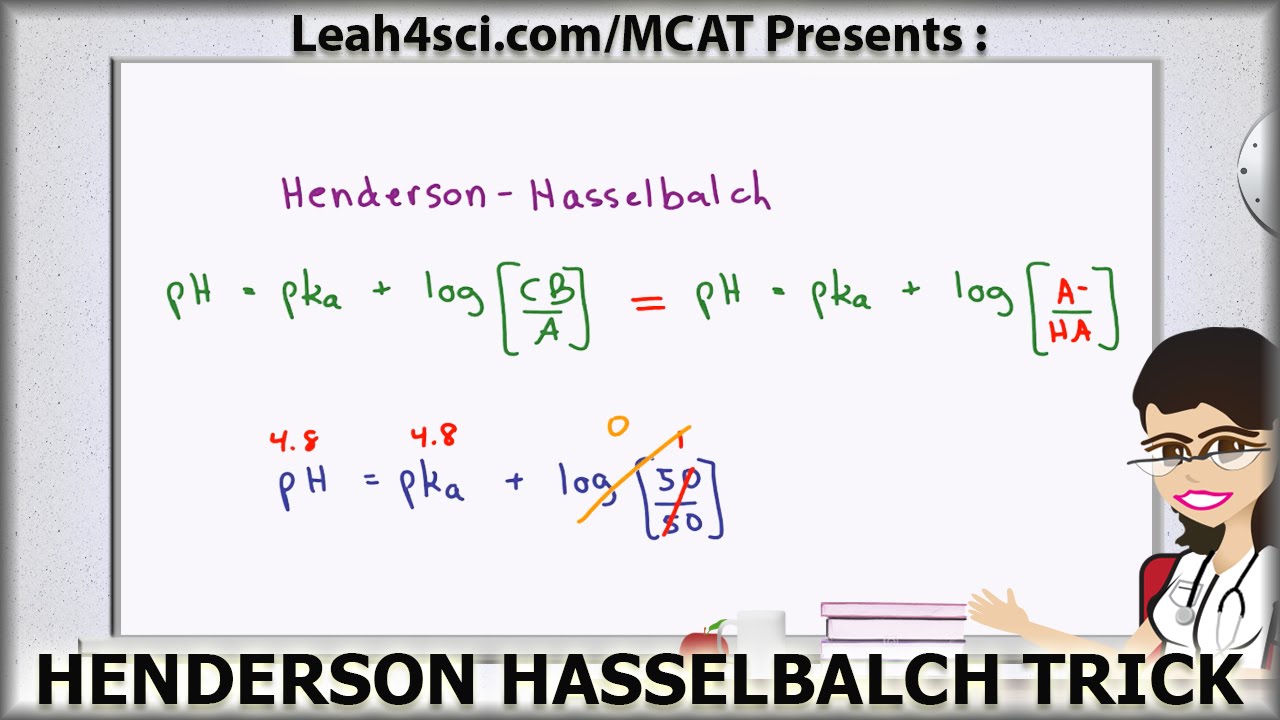
The Henderson-Hasselbalch equation is a powerful tool for understanding and manipulating the pH of buffer solutions. To make it easier to use this equation, several interactive tools have been developed.
These tools can help you to calculate the pH of a buffer solution, determine the concentrations of the acid and base forms of a buffer, and explore the effects of different parameters on the pH of a buffer solution.
Interactive Calculator
An interactive calculator is a web-based tool that allows you to input values for pKa and acid/base concentrations and calculate the corresponding pH. These calculators are easy to use and can be a valuable resource for students and researchers.
Table of Key Parameters
A table of key parameters can be a helpful resource for understanding the effects of different parameters on the pH of a buffer solution. This table can summarize the key parameters, such as pKa, acid concentration, and base concentration, and their effects on the pH of a buffer solution.
Flowchart for Using the Equation
A flowchart can be a helpful guide for using the Henderson-Hasselbalch equation for different applications. This flowchart can provide step-by-step instructions for using the equation to calculate the pH of a buffer solution, determine the concentrations of the acid and base forms of a buffer, and explore the effects of different parameters on the pH of a buffer solution.
Final Conclusion

In summary, the Henderson Hasselbalch equation calculator is an essential tool for anyone working with acid-base systems. Its versatility and accuracy make it invaluable for a wide range of applications, from chemistry and biology to medicine and environmental science. By providing a deeper understanding of pH and acid-base behavior, this calculator empowers researchers and practitioners to optimize solutions, predict outcomes, and make informed decisions in their respective fields.