
Fantasy points calculators are indispensable tools for fantasy sports enthusiasts, providing valuable insights into player performance and helping managers make informed decisions. These calculators utilize advanced metrics, historical data, and regression analysis to project fantasy points, giving players an edge in roster management and lineup optimization.
Understanding the various scoring systems used in fantasy sports is crucial for interpreting fantasy points projections. Different positions (QB, RB, WR, TE, K, DEF) have unique scoring methods, and these variations can significantly impact player rankings and team strategy.
Fantasy Points Scoring Systems
Fantasy sports employ various scoring systems to determine player performance and team success. These systems assign points based on statistical achievements, with each position having its unique set of scoring methods. Understanding the nuances of these scoring systems is crucial for optimizing player selection and team strategy.
Quarterbacks (QB)
- Passing yards: Typically 0.04 points per yard.
- Passing touchdowns: 4-6 points per touchdown.
- Interceptions: -1 to -2 points per interception.
- Rushing yards: 0.1 points per yard.
- Rushing touchdowns: 4-6 points per touchdown.
Running Backs (RB)
- Rushing yards: 0.1 points per yard.
- Rushing touchdowns: 4-6 points per touchdown.
- Receptions: 0.5 points per reception.
- Receiving yards: 0.1 points per yard.
- Receiving touchdowns: 4-6 points per touchdown.
Wide Receivers (WR)
- Receptions: 0.5 points per reception.
- Receiving yards: 0.1 points per yard.
- Receiving touchdowns: 4-6 points per touchdown.
- Rushing yards: 0.1 points per yard.
- Rushing touchdowns: 4-6 points per touchdown.
Tight Ends (TE)
- Receptions: 0.5 points per reception.
- Receiving yards: 0.1 points per yard.
- Receiving touchdowns: 4-6 points per touchdown.
- Rushing yards: 0.1 points per yard.
- Rushing touchdowns: 4-6 points per touchdown.
Kickers (K)
- Field goals made: 3-4 points per field goal.
- Extra points made: 1 point per extra point.
Defenses (DEF)
- Points allowed: -1 point per point allowed.
- Sacks: 1-2 points per sack.
- Interceptions: 2-4 points per interception.
- Fumbles recovered: 2-4 points per fumble recovered.
- Touchdowns: 6-10 points per touchdown.
The choice of scoring system can significantly impact player rankings and team strategy. For instance, in a league that heavily emphasizes passing yards, quarterbacks with high yardage totals will be more valuable than those with fewer yards but more touchdowns.
Conversely, in a league that rewards touchdowns more heavily, quarterbacks with a high touchdown-to-interception ratio will be more sought after. Understanding the scoring system used in your league is essential for making informed player selections and developing a winning strategy.
Advanced Metrics for Fantasy Points Projection: Fantasy Points Calculator
To enhance the accuracy of fantasy points calculators, advanced metrics can be incorporated. These metrics delve into specific aspects of a player’s performance, providing insights that traditional statistics may overlook.
These advanced metrics can capture nuanced elements of a player’s game, such as their ability to create scoring opportunities for teammates, their defensive prowess, or their efficiency in converting possessions into points.
Player Impact Metrics
Player impact metrics quantify the overall impact a player has on their team’s performance. These metrics consider both individual statistics and the player’s influence on the team’s success.
- Player Efficiency Rating (PER):Measures a player’s overall efficiency by combining various statistical categories into a single metric.
- True Shooting Percentage (TS%):Considers the efficiency of a player’s shooting by accounting for field goals, free throws, and three-pointers.
- Win Shares:Estimates the number of wins a player contributes to their team based on their individual performance and team success.
Advanced Defensive Metrics
Advanced defensive metrics assess a player’s defensive capabilities beyond traditional statistics like rebounds and blocks.
- Defensive Real Plus-Minus (DRPM):Estimates a player’s impact on their team’s defensive efficiency.
- Defensive Box Plus-Minus (DBPM):Similar to DRPM, but it also considers a player’s individual defensive statistics.
- Steals Plus Blocks (STL+BLK):Combines steals and blocks into a single metric to measure a player’s defensive playmaking ability.
Usage Metrics
Usage metrics measure the frequency and efficiency with which a player is involved in their team’s offense.
- Usage Percentage (USG%):Calculates the percentage of team possessions a player uses while on the court.
- Offensive Box Plus-Minus (OBPM):Estimates a player’s impact on their team’s offensive efficiency.
- Assist Percentage (AST%):Measures the percentage of a player’s team’s assists they are responsible for.
Historical Data and Regression Analysis

Historical data plays a crucial role in fantasy points projection. It provides a rich dataset that captures the performance of players over time, allowing us to identify patterns and trends that can inform our predictions.
Regression analysis is a powerful statistical technique that can be used to create a fantasy points calculator. By fitting a regression model to historical data, we can estimate the relationship between a player’s performance and a set of independent variables, such as their statistics, matchup, and team performance.
Linear Regression
Linear regression is a simple but effective regression model that assumes a linear relationship between the dependent variable (fantasy points) and the independent variables. It is widely used in fantasy sports due to its ease of interpretation and implementation.
$$FP = \beta_0 + \beta_1 X_1 + \beta_2 X_2 + … + \beta_n X_n + \varepsilon$$
Where:
- FP is the predicted fantasy points
- X iare the independent variables
- β iare the regression coefficients
- ε is the error term
More Advanced Regression Models, Fantasy points calculator
While linear regression is a good starting point, more advanced regression models can be used to capture non-linear relationships and interactions between variables. These models include:
- Polynomial regression
- Ridge regression
- Lasso regression
- Random forest
- Gradient boosting
The choice of regression model depends on the complexity of the data and the desired level of accuracy.
Customizing Fantasy Points Calculators
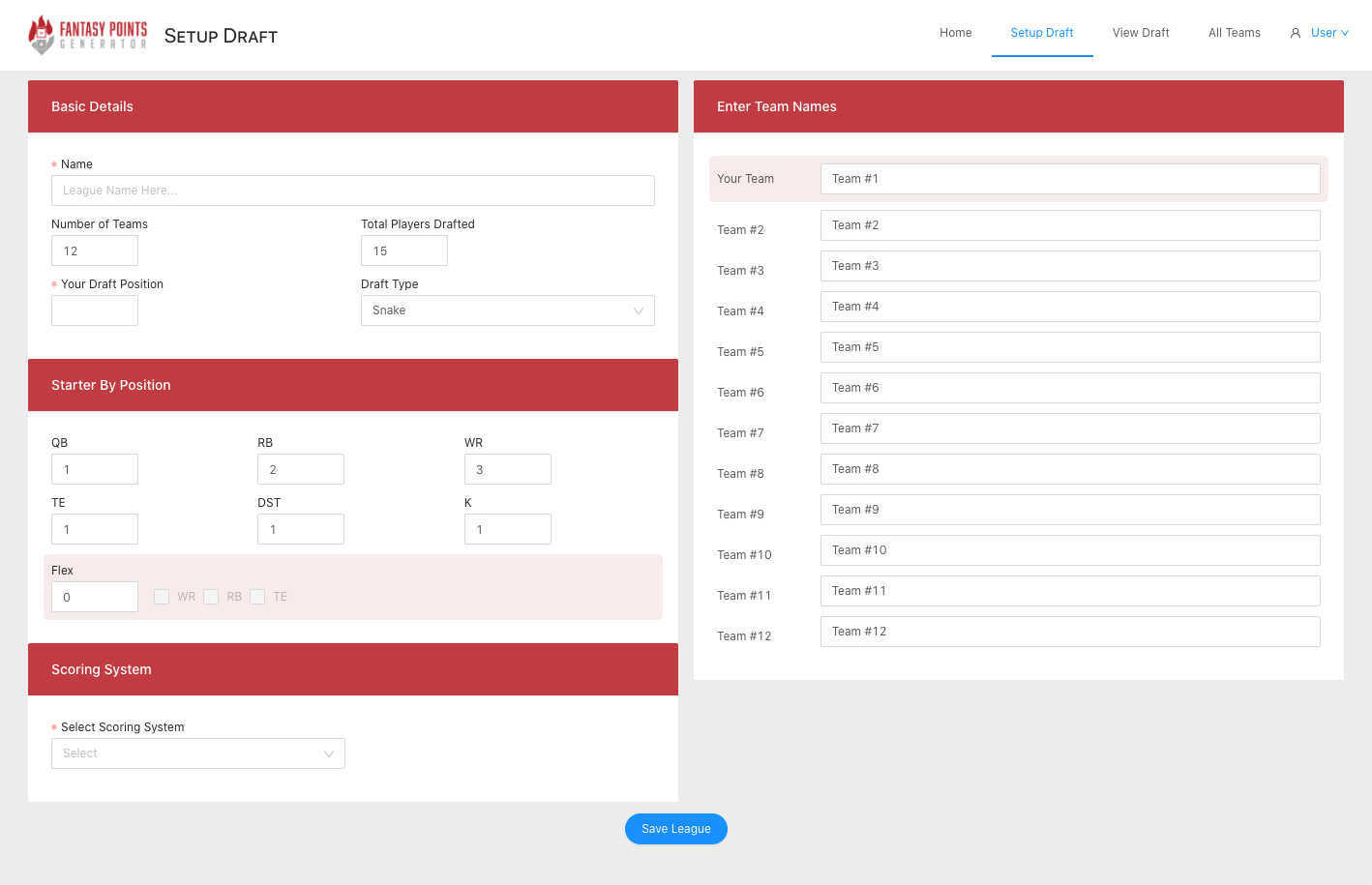
Customizing fantasy points calculators to specific leagues and scoring systems provides several advantages. It allows for:
- Tailoring the calculator to the unique scoring rules of a particular league.
- Ensuring that the projections are accurate and reflect the scoring system being used.
- Providing a more personalized and engaging experience for league members.
Customizing Using HTML Table Tags
To customize a fantasy points calculator using HTML table tags, follow these steps:
- Create a table with columns for each scoring category, such as points per reception, rushing yards, and touchdowns.
- In each cell, enter the value for that category in the league’s scoring system.
- Add a row for each player and enter their projected statistics in the corresponding columns.
- Use a formula to calculate the total fantasy points for each player based on the scoring system.
Customizing Using Bullet Points
Alternatively, you can customize a fantasy points calculator using bullet points. This method is simpler and requires less technical knowledge:
- List each scoring category and its corresponding value in the league’s scoring system.
- For each player, list their projected statistics for each category.
- Multiply each projected statistic by its corresponding value and add the results together to calculate the player’s total fantasy points.
Examples of Custom Calculators
Here are examples of custom fantasy points calculators that have been tailored to different league settings:
- A calculator for a league that uses a PPR (points per reception) scoring system.
- A calculator for a league that uses a IDP (individual defensive player) scoring system.
- A calculator for a league that uses a custom scoring system that combines elements from different standard scoring systems.
Conclusion
Fantasy points calculators empower fantasy sports managers with the knowledge and insights necessary to make informed decisions and achieve success. By leveraging advanced metrics, historical data, and regression analysis, these tools provide valuable projections that can help managers optimize their rosters and maximize their chances of victory.
