Welcome to the realm of economics, where the deadweight loss calculator takes center stage. This tool unravels the complexities of market inefficiencies, providing insights into how distortions hinder economic growth. Join us as we delve into the world of deadweight loss, its causes, and its profound implications for consumers, producers, and policymakers alike.
As we embark on this journey, let’s remember that economics is not just a dry subject filled with jargon. It’s a fascinating field that helps us understand how our world works and how we can make it better. So, buckle up and get ready for an engaging exploration of deadweight loss and its impact on our economy.
Deadweight Loss Measurement

Deadweight loss is an economic concept that measures the inefficiency and welfare loss resulting from market distortions or government interventions that prevent the efficient allocation of resources.
It represents the loss of potential consumer and producer surplus that could have been achieved under perfect competition. Deadweight loss is crucial in economic analysis as it quantifies the economic costs associated with market imperfections.
Calculating Deadweight Loss
Deadweight loss is typically calculated using supply and demand curves. In a perfectly competitive market, the equilibrium price and quantity are determined by the intersection of the supply and demand curves. However, when there is a market distortion, such as a price ceiling or a tax, the market equilibrium shifts away from the efficient outcome.
Deadweight loss = Consumer surplus loss + Producer surplus loss
The consumer surplus loss is the reduction in consumer welfare due to the higher price or lower quantity consumed. The producer surplus loss is the reduction in producer welfare due to the lower price or lower quantity produced.
Graphical Representation
The following graph illustrates deadweight loss in a market with a price ceiling:
- The equilibrium price and quantity in a perfectly competitive market are P* and Q*.
- When a price ceiling is imposed at Pc, the market equilibrium shifts to Qc and Pc.
- The shaded triangle represents the deadweight loss, which is the loss of potential consumer and producer surplus due to the price ceiling.
Causes of Deadweight Loss: Deadweight Loss Calculator
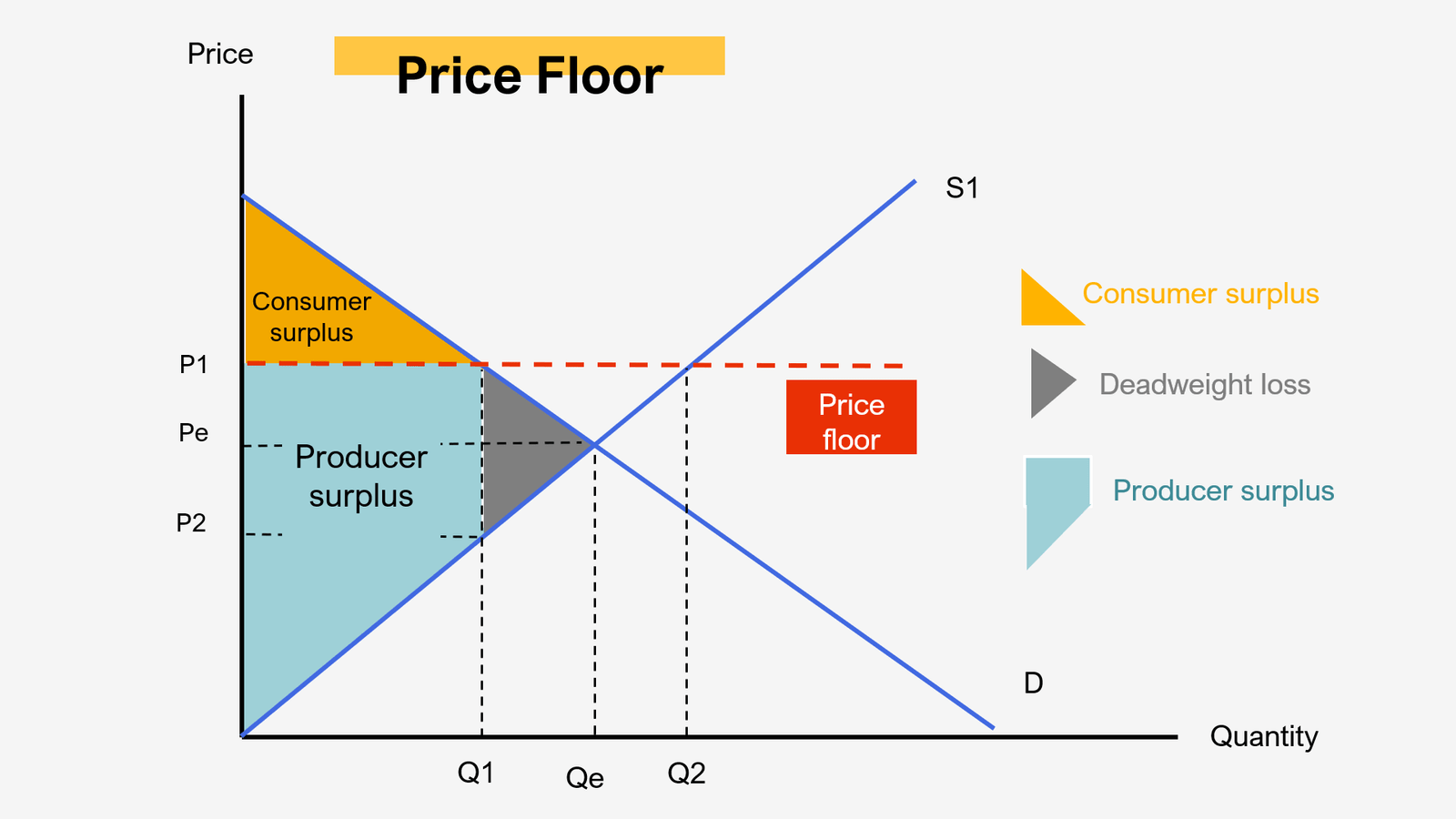
Deadweight loss arises when market forces are distorted, leading to an inefficient allocation of resources and a reduction in overall economic welfare. These distortions can stem from various factors, including government interventions, market imperfections, and other external influences.
Market distortions can manifest in several forms, each affecting supply and demand differently. Understanding these causes is crucial for identifying and addressing the root problems that contribute to deadweight loss.
Taxes and Subsidies
Taxes and subsidies are government-imposed policies that can distort market equilibrium. Taxes increase the cost of production for suppliers, while subsidies reduce it. These interventions disrupt the natural balance of supply and demand, leading to a misallocation of resources.
For instance, a tax on a particular good can reduce its supply, causing a shortage and driving up prices. This reduces consumer surplus and may lead to deadweight loss as resources are diverted away from producing other goods that could have generated higher value.
Impacts of Deadweight Loss
Deadweight loss, a result of market inefficiencies, exerts significant negative consequences on economic well-being. It leads to a reduction in both consumer and producer surplus, ultimately diminishing overall economic efficiency.
Consumer surplus, the difference between the price consumers are willing to pay and the price they actually pay, decreases due to deadweight loss. This implies that consumers are not able to fully capture the value they derive from goods and services, resulting in lower consumer satisfaction.
Reduced Producer Surplus
Producer surplus, the difference between the price producers receive for goods and services and the cost of producing them, also declines in the presence of deadweight loss. As a result, producers receive less revenue than they could have under efficient market conditions, potentially leading to lower production and reduced economic growth.
Diminished Overall Economic Efficiency
Deadweight loss represents a waste of resources within an economy. The inefficient allocation of resources leads to a reduction in overall economic efficiency. The economy fails to produce the optimal quantity of goods and services, resulting in a suboptimal allocation of resources and a lower standard of living for society.
Real-World Examples
Examples of real-world scenarios where deadweight loss has significant implications include:
- Price ceilings:When governments impose price ceilings below the equilibrium price, deadweight loss occurs due to reduced quantity supplied and excess demand.
- Price floors:Similarly, price floors set above the equilibrium price create deadweight loss due to oversupply and reduced demand.
- Taxes and subsidies:Taxes on goods and services can lead to deadweight loss by distorting consumer and producer behavior, while subsidies can create inefficiencies by encouraging overproduction.
- Monopoly power:Monopolists can restrict output to increase prices, resulting in deadweight loss as consumers pay higher prices for reduced quantity.
Policy Implications
Governments play a crucial role in addressing deadweight loss by implementing policies that aim to correct market distortions and promote efficient resource allocation. These policies can take various forms, depending on the specific causes and characteristics of the market failure.
One common approach is to reduce or eliminate barriers to entry and exit in the market, fostering competition and preventing monopolies or oligopolies. This can involve measures such as antitrust laws, deregulation, and subsidies for new entrants.
Policy Measures to Mitigate Market Distortions and Reduce Deadweight Loss, Deadweight loss calculator
| Policy Measure | Description |
|---|---|
| Antitrust Laws | Prevent monopolies and oligopolies by prohibiting anti-competitive practices such as price fixing, market allocation, and predatory pricing. |
| Deregulation | Reduce government regulations that create barriers to entry and exit, allowing new firms to enter the market and existing firms to exit more easily. |
| Subsidies for New Entrants | Provide financial assistance to new firms to overcome entry barriers and promote competition. |
| Pigouvian Taxes and Subsidies | Impose taxes on negative externalities (e.g., pollution) and provide subsidies for positive externalities (e.g., research and development) to internalize these costs and benefits. |
| Price Ceilings and Floors | Set maximum or minimum prices to correct market failures, such as natural monopolies or externalities. |
Another strategy involves addressing externalities, which are costs or benefits that are not reflected in market prices. Pigouvian taxes or subsidies can be used to internalize these externalities, ensuring that the true social costs and benefits are taken into account in decision-making.
In cases where market failures are persistent or severe, more direct interventions may be necessary. Price ceilings or floors can be imposed to correct market outcomes, although these measures should be carefully designed to avoid unintended consequences.
Successful Policy Interventions that Reduced Deadweight Loss
- The breakup of AT&T in the United States in 1984, which promoted competition in the telecommunications industry and led to lower prices and increased innovation.
- The deregulation of the airline industry in the United States in the 1970s, which reduced barriers to entry and led to lower airfares and increased travel options.
- The introduction of carbon taxes in several European countries, which has helped internalize the negative externalities of carbon emissions and reduced greenhouse gas emissions.
These examples demonstrate the effectiveness of well-designed government policies in addressing market failures and reducing deadweight loss, leading to more efficient resource allocation and improved economic outcomes.
Final Conclusion

In conclusion, the deadweight loss calculator serves as a valuable tool for policymakers and economists alike. By quantifying the economic inefficiencies caused by market distortions, it provides a roadmap for implementing effective policies that promote efficient resource allocation and foster economic growth.
Understanding deadweight loss is crucial for creating a more prosperous and equitable society.
As we continue to grapple with economic challenges, the deadweight loss calculator will remain an indispensable tool for analyzing market inefficiencies and designing policies that lead to a more efficient and sustainable economy.