With the rock mass rating calculator at the forefront, this article embarks on a journey into the realm of geotechnical engineering, unraveling the intricacies of rock mass assessment and stability evaluation.
The rock mass rating (RMR) system, a cornerstone of geotechnical practice, provides a comprehensive framework for quantifying rock mass quality. This article delves into the six parameters that underpin the RMR calculation, exploring their significance and interpretation.
Rock Mass Rating (RMR) System
The Rock Mass Rating (RMR) system is a geomechanical classification used to assess the strength and quality of rock masses. It was developed by Bieniawski in 1973 and has become widely used in rock engineering practice.The RMR system is based on six parameters that are assigned numerical ratings:
- Uniaxial compressive strength of intact rock
- Rock quality designation (RQD)
- Spacing of discontinuities
- Condition of discontinuities
- Groundwater conditions
- Orientation of discontinuities
The total RMR value is calculated by summing the ratings for each parameter. The RMR value can range from 0 to 100, with higher values indicating better rock mass quality.The RMR system is used to classify rock masses into five classes:
- Very poor (RMR< 20)
- Poor (RMR 20-40)
- Fair (RMR 40-60)
- Good (RMR 60-80)
- Excellent (RMR > 80)
The RMR classification can be used to estimate the rock mass strength, deformability, and stability. It is also used to design support systems for underground excavations and to assess the stability of slopes.
RMR Calculator Applications

The Rock Mass Rating (RMR) calculator is a valuable tool for geotechnical engineers, providing a comprehensive assessment of rock mass quality and stability. Its applications span a wide range of engineering projects, including:
Underground Structure Design and Evaluation
RMR values play a crucial role in the design and evaluation of underground structures such as tunnels, mines, and caverns. By assessing the rock mass quality, engineers can determine the appropriate support systems, excavation methods, and safety measures to ensure structural stability and longevity.
Slope Stability Analysis
In slope stability analysis, RMR is used to evaluate the stability of rock slopes. The calculator helps engineers assess the potential for rockfalls, landslides, and other slope failures, enabling them to design appropriate mitigation measures.
Foundation Design
RMR is also used in foundation design to assess the bearing capacity and settlement characteristics of rock foundations. The calculator provides engineers with a comprehensive understanding of the rock mass properties, allowing them to design foundations that can withstand the anticipated loads and deformations.
RMR Calculation Methods
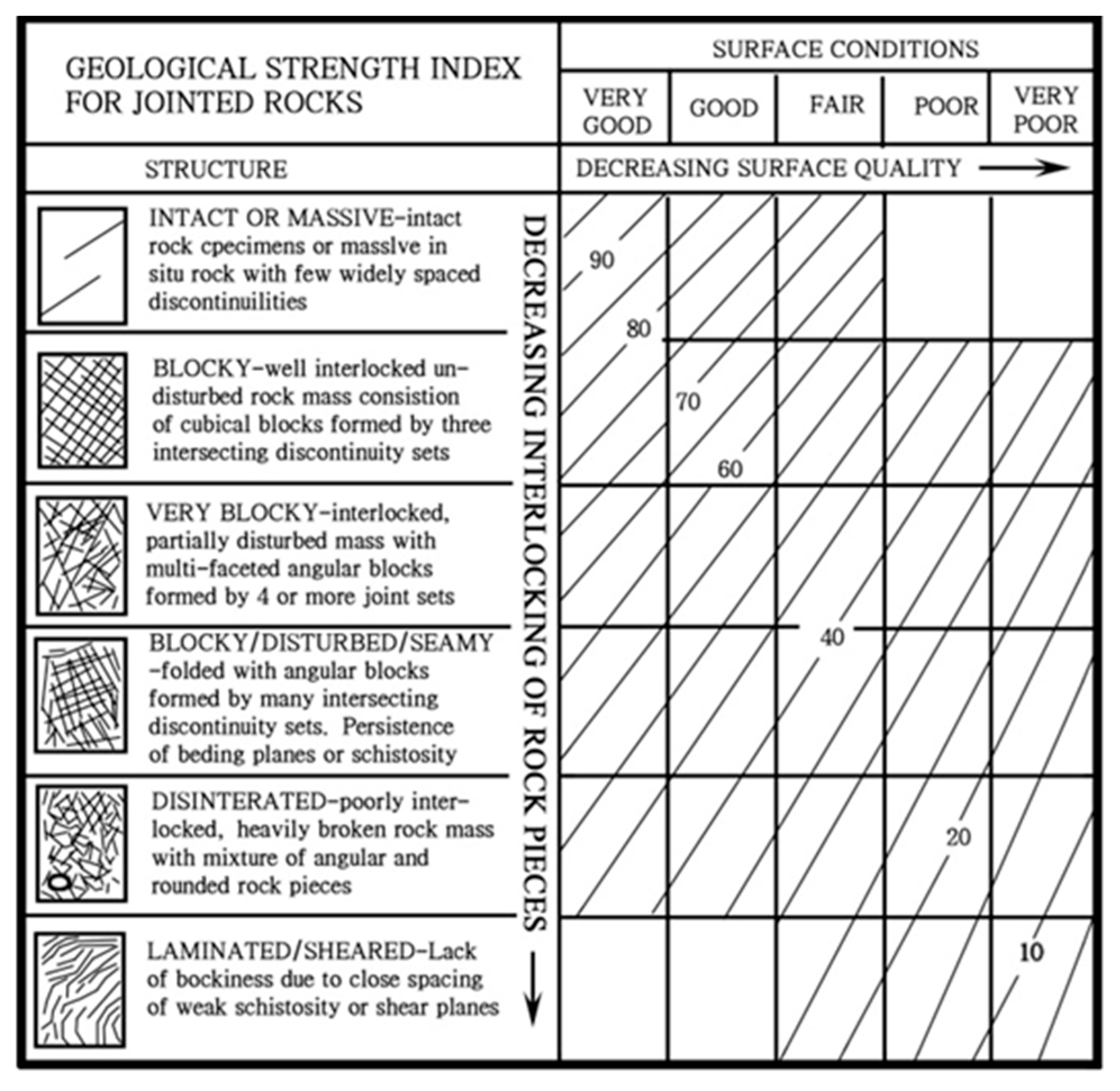
The Rock Mass Rating (RMR) system is a widely used method for assessing the strength and stability of rock masses. There are several different RMR calculation methods, each with its own advantages and disadvantages. The most common method is the original Bieniawski method, developed in 1979. Other methods include the modified RMR systems, which were developed to address some of the limitations of the original method.
Step-by-Step Guide to Calculating RMR Using the Original Bieniawski Method
- Determine the uniaxial compressive strength (UCS) of the rock mass.
- Determine the rock quality designation (RQD) of the rock mass.
- Determine the joint spacing (JS) of the rock mass.
- Determine the joint condition (JC) of the rock mass.
- Determine the groundwater conditions (GW) of the rock mass.
- Calculate the RMR using the following formula:
RMR = UCS + RQD + JS + JC + GW
RMR Calculator Resources
Various online RMR calculators and resources are available to facilitate the application of the RMR system. These tools simplify the calculation process and provide access to extensive RMR databases.
The following resources offer valuable support for RMR calculations and further exploration of the system:
Online RMR Calculators
Multiple online calculators offer user-friendly interfaces and automated calculations based on the RMR system. Here’s a comparative table outlining their features and limitations:
| Calculator | Features | Limitations |
|---|---|---|
| Rocscience RMR Calculator |
|
|
| Geoengineer RMR Calculator |
|
|
| RMR Calculator |
|
|
Published RMR Databases, Rock mass rating calculator
Numerous published RMR databases provide valuable insights into the RMR characteristics of different rock masses. These databases serve as a reference for comparison and validation of RMR calculations:
- Bieniawski, Z.T. (1989). Engineering Rock Mass Classifications. John Wiley & Sons.
- Hoek, E., & Brown, E.T. (1997). Practical Engineering Geology. Spon Press.
- Palmstrom, A., & Broch, E. (2006). RMi – A Rock Mass Characterization System for Rock Engineering Purposes. Swedish Rock Engineering Research Foundation.
Resources for Further Learning and Research
To deepen your understanding of the RMR system, consider exploring the following resources:
- Rocscience RMR Learning Center
- Geoengineer RMR Tutorial
- Rock Mass Rating (RMR) System in Engineering Practice
Closure: Rock Mass Rating Calculator

The rock mass rating calculator has emerged as an indispensable tool in geotechnical engineering, enabling practitioners to assess rock mass quality, evaluate stability, and design underground structures with confidence. Its versatility and accuracy have made it a cornerstone of geotechnical practice, ensuring the safety and integrity of structures built in challenging rock environments.