
Embark on a scientific odyssey with our Wiens Law Calculator, a tool that unlocks the mysteries of blackbody radiation. Discover the fundamental principles, applications, and advanced features of this indispensable tool for astronomers, physicists, and engineers.
Wiens Law, named after the German physicist Wilhelm Wien, provides a crucial relationship between the temperature and wavelength of electromagnetic radiation emitted by a blackbody. Our calculator harnesses this law to empower you with precise calculations and insights into various scientific phenomena.
Wien’s Law Calculator: Wiens Law Calculator
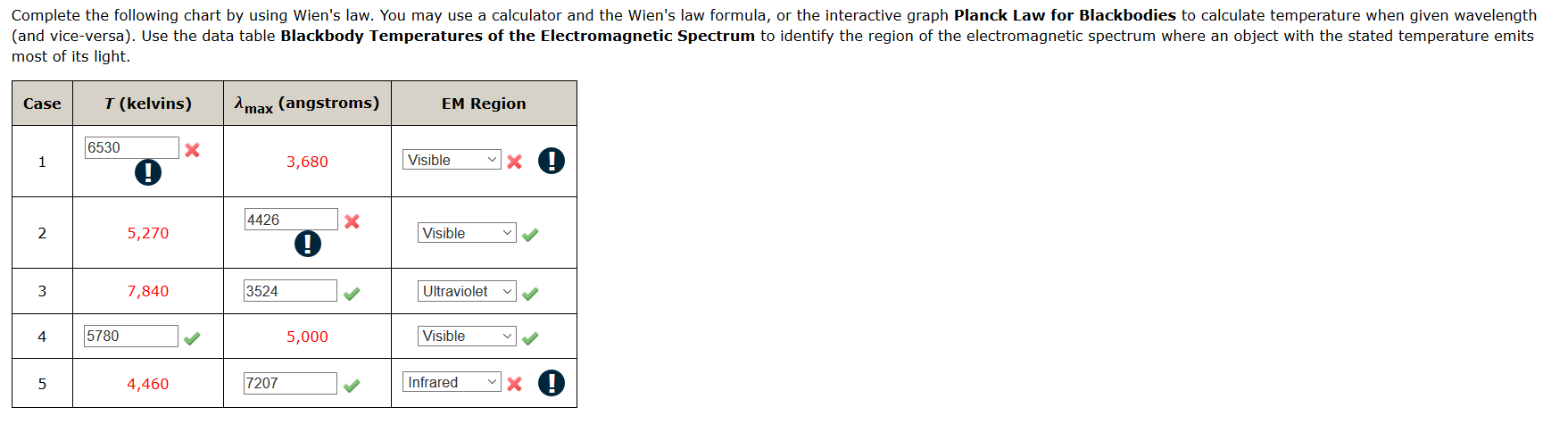
Wien’s Law is a fundamental law in physics that describes the relationship between the wavelength of the maximum emission of electromagnetic radiation from a blackbody and its temperature.
The mathematical formula for Wien’s Law is:
λmax= b/T
where:
- λ maxis the wavelength of the maximum emission in meters
- b is Wien’s displacement constant, approximately 2.898 x 10 -3m K
- T is the temperature of the blackbody in Kelvin
Significance of Wien’s Law
Wien’s Law is significant in various scientific fields, including astrophysics, optics, and thermal physics. It provides a theoretical framework for understanding the emission of electromagnetic radiation from celestial objects, such as stars and planets.
Wien’s Law also has practical applications in fields like:
- Color temperature measurement
- Blackbody radiation modeling
- Thermal imaging
Using Wien’s Law Calculator
Using a Wien’s Law calculator is a straightforward process that involves entering specific parameters and interpreting the results. This step-by-step guide will provide clear instructions on how to effectively utilize a Wien’s Law calculator.
Step-by-Step Guide
Follow these steps to use a Wien’s Law calculator:
- Select a reputable Wien’s Law calculator:Choose a calculator from a trusted source that provides accurate results.
- Enter the wavelength (λ) or temperature (T):Input the known parameter into the designated field. If you have the wavelength, enter it in meters (m). If you have the temperature, enter it in Kelvin (K).
- Specify the units:Ensure that the units for the entered parameter (λ or T) are correctly specified.
- Click “Calculate”:Initiate the calculation process by clicking the “Calculate” button.
- Interpret the results:The calculator will display the calculated value of the unknown parameter. If you entered the wavelength, the result will be the temperature in Kelvin. If you entered the temperature, the result will be the wavelength in meters.
Applications of Wien’s Law Calculator
Wien’s Law Calculator finds applications in various fields, including astronomy, physics, and engineering. It is a valuable tool for scientists and engineers to determine the temperature of objects based on their peak wavelength of emitted radiation.
Astronomy
In astronomy, Wien’s Law Calculator is used to estimate the temperature of stars. By measuring the peak wavelength of the star’s emitted radiation, astronomers can determine its surface temperature. This information is crucial for understanding the star’s evolutionary stage, composition, and distance from Earth.
For example, the Sun’s peak wavelength is around 500 nanometers, which corresponds to a temperature of approximately 5,778 Kelvin. This knowledge helps astronomers study the Sun’s behavior, predict solar flares, and understand its impact on Earth’s climate.
Physics, Wiens law calculator
In physics, Wien’s Law Calculator is used to study blackbody radiation. A blackbody is an ideal object that absorbs and emits all incident radiation, and its spectrum follows Wien’s Law. By analyzing the peak wavelength of a blackbody’s radiation, physicists can determine its temperature.
This knowledge is essential in various fields, such as thermodynamics, heat transfer, and astrophysics. For instance, scientists use Wien’s Law to study the temperature of cosmic microwave background radiation, which is the remnant radiation from the Big Bang.
Engineering
In engineering, Wien’s Law Calculator is used in various applications, including temperature measurement, thermal design, and spectroscopy. For example, engineers use it to design infrared sensors, calibrate thermal cameras, and analyze the thermal properties of materials.
By understanding the relationship between wavelength and temperature, engineers can optimize the performance of thermal systems, improve energy efficiency, and develop innovative technologies in fields such as optics, electronics, and medical imaging.
Advanced Features of Wien’s Law Calculator
Some Wien’s Law calculators offer advanced features that enhance their functionality and enable complex calculations. These features include:
Advanced Wien’s Law calculators can analyze data, plot graphs, and provide statistical information, making them useful for research and analysis tasks.
Customizable Parameters
Advanced calculators allow users to customize input parameters, such as wavelength units (e.g., nanometers, micrometers), temperature scales (e.g., Kelvin, Celsius), and precision levels. This customization enables precise calculations and accurate results tailored to specific requirements.
Data Analysis and Visualization
Advanced calculators offer data analysis and visualization capabilities. They can generate graphs of the blackbody radiation spectrum, allowing users to visualize the relationship between wavelength and intensity. Statistical tools may also be included, providing measures such as mean, median, and standard deviation.
Integration with Other Tools
Some calculators integrate with other scientific tools, such as spreadsheet software or graphing applications. This integration allows users to import or export data, perform additional calculations, and create comprehensive reports.
Advantages of Using Advanced Features:
- Enhanced precision and accuracy in calculations.
- Ability to analyze and visualize data for deeper insights.
- Customization options to suit specific requirements.
- Integration with other tools for comprehensive analysis.
Limitations of Using Advanced Features:
- May require technical expertise to use effectively.
- Can be computationally intensive for complex calculations.
- May not be necessary for simple calculations or quick estimations.
Final Review
With our Wiens Law Calculator, you hold the key to unraveling the secrets of the universe. From determining the temperature of distant stars to analyzing blackbody radiation in engineering applications, this tool empowers you to explore the fascinating realm of physics and astronomy.
