
The partial fraction decomposition calculator is an invaluable tool that simplifies complex fractions, making them manageable and easy to solve. Whether you’re a student grappling with advanced algebra or a professional facing intricate calculations, this calculator empowers you to break down fractions into simpler components, unlocking a deeper understanding of mathematical concepts.
Delve into the intricacies of partial fraction decomposition, exploring its applications in various fields and discovering the benefits it offers in problem-solving. Learn about the different methods for performing partial fraction decomposition, their advantages and disadvantages, and how to utilize the calculator to streamline your calculations.
Partial Fraction Decomposition: Partial Fraction Decomposition Calculator
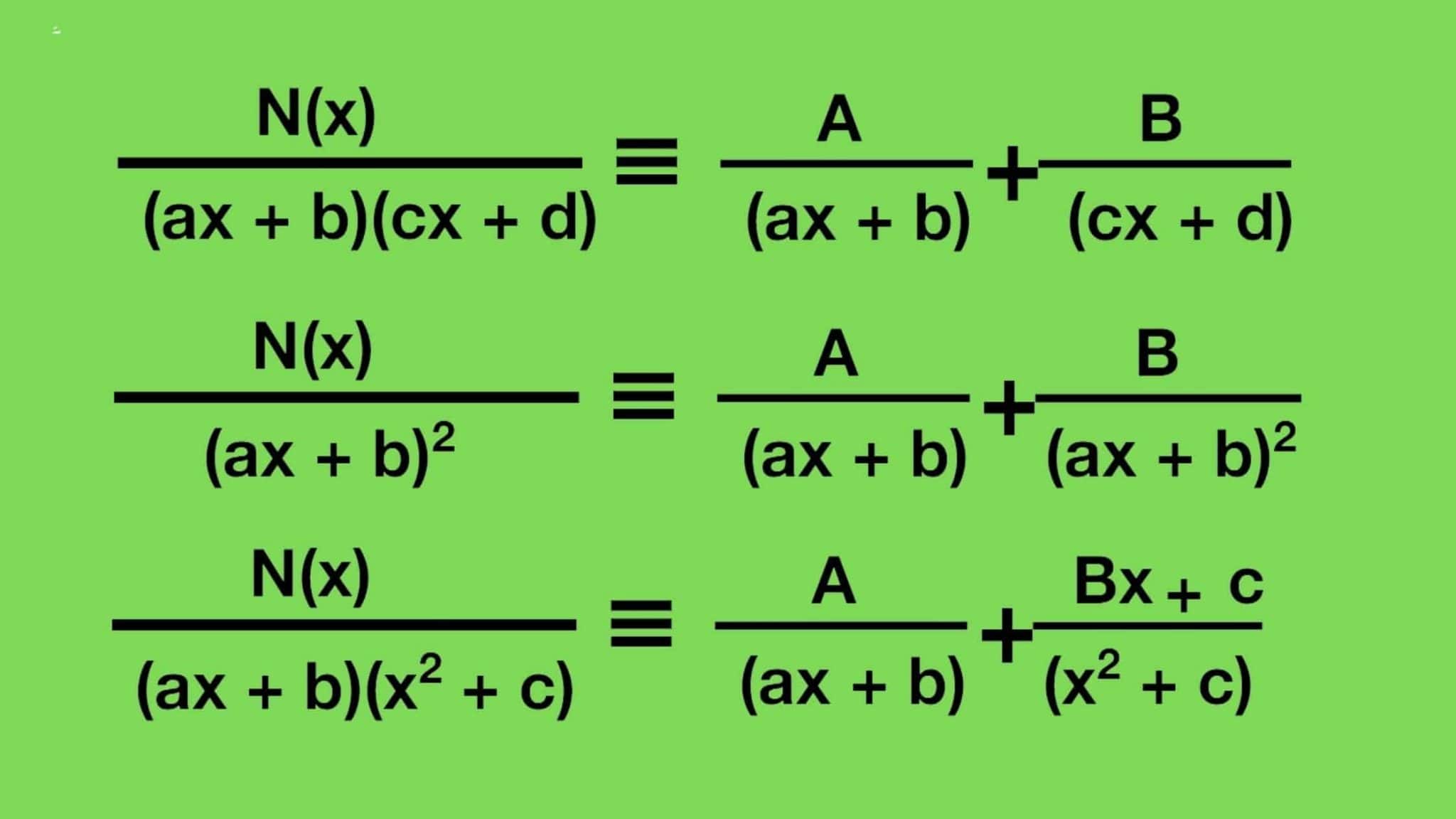
Partial fraction decomposition is a mathematical technique used to express a rational function as a sum of simpler fractions, each of which has a linear or quadratic factor in the denominator.
There are three main types of partial fraction decomposition:
- Linear factors:The denominator of the rational function has only linear factors.
- Quadratic factors:The denominator of the rational function has quadratic factors that are irreducible over the real numbers.
- Repeated factors:The denominator of the rational function has repeated factors, either linear or quadratic.
The steps involved in performing partial fraction decomposition are as follows:
- Factor the denominator of the rational function.
- For each linear factor, write a fraction with that factor in the denominator and an unknown numerator.
- For each quadratic factor, write a fraction with that factor squared in the denominator and two unknown numerators.
- Clear the fractions by multiplying both sides of the equation by the least common multiple of the denominators.
- Solve the resulting system of equations to find the unknown numerators.
Applications of Partial Fraction Decomposition
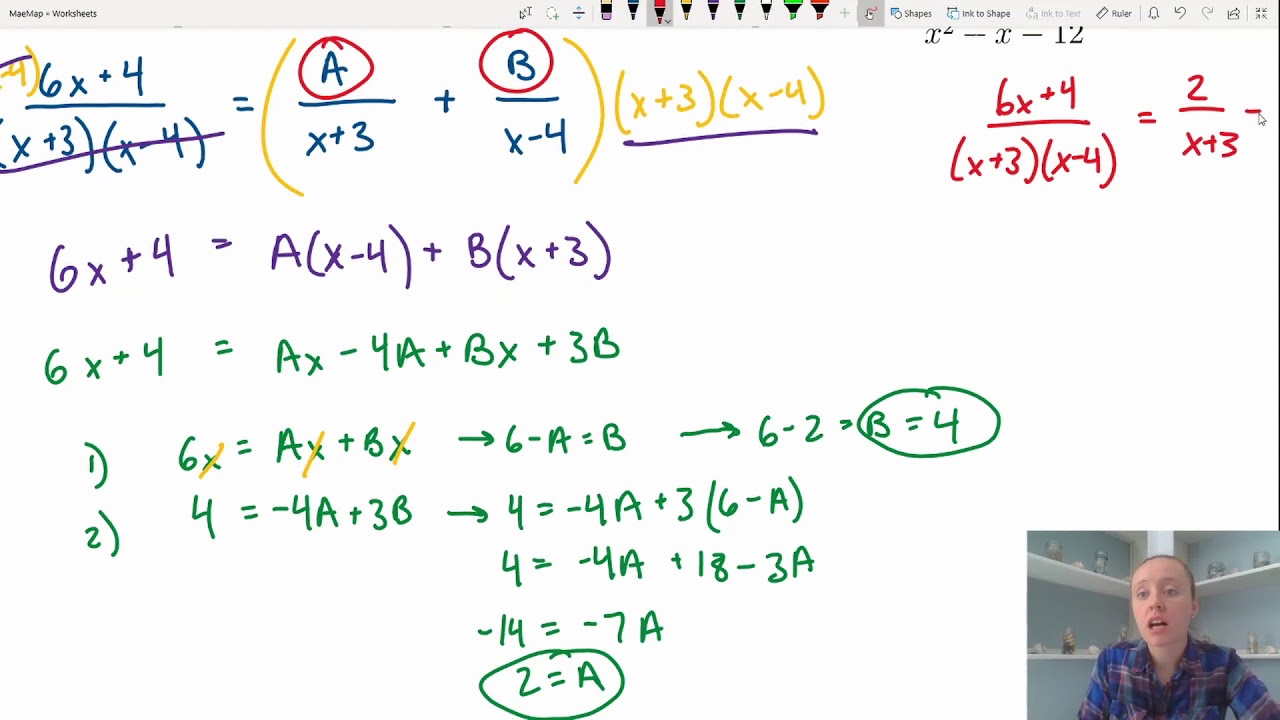
Partial fraction decomposition (PFD) is a mathematical technique used to simplify complex rational expressions into a sum of simpler fractions. It finds wide application in various fields, including engineering, physics, and economics, as it allows for the efficient solution of problems involving rational functions.
One of the key benefits of using PFD is that it enables the integration of rational functions. By breaking down a rational function into simpler fractions, it becomes easier to apply integration techniques to each fraction individually, leading to a more manageable and accurate solution.
Applications in Engineering
In engineering, PFD is commonly used in the analysis and design of electrical circuits. It helps simplify complex circuit equations, making it easier to determine circuit properties such as impedance and voltage gain. Additionally, PFD is employed in mechanical engineering for the analysis of vibrations and oscillations in systems.
Applications in Physics
In physics, PFD is used to solve problems involving the motion of particles and the behavior of waves. For instance, it is used in the analysis of electromagnetic fields and the study of quantum mechanics. By decomposing complex rational functions into simpler fractions, physicists can simplify complex equations and gain a deeper understanding of physical phenomena.
Applications in Economics
In economics, PFD is used to model and analyze economic systems. It helps simplify complex economic models and make them more manageable for analysis. For example, PFD is used in the study of consumer behavior, market equilibrium, and economic growth.
Methods for Partial Fraction Decomposition
Partial fraction decomposition (PFD) is a technique for expressing a rational function as a sum of simpler fractions. There are several methods for performing PFD, each with its own advantages and disadvantages.
Method 1: Linear Factors, Partial fraction decomposition calculator
This method is used when the denominator of the rational function can be factored into linear factors. The steps are as follows:
- Factor the denominator into linear factors.
- For each linear factor (ax + b), write a fraction of the form A/(ax + b).
- Solve for the constants A by equating the original rational function to the sum of the fractions and simplifying.
This method is relatively straightforward, but it can be tedious if the denominator has many linear factors.
Method 2: Quadratic Factors
This method is used when the denominator of the rational function can be factored into quadratic factors. The steps are as follows:
- Factor the denominator into quadratic factors.
- For each quadratic factor (ax^2 + bx + c), write a fraction of the form (Ax + B)/(ax^2 + bx + c).
- Solve for the constants A and B by equating the original rational function to the sum of the fractions and simplifying.
This method is more complex than the linear factor method, but it is still relatively straightforward. However, it can be difficult to solve for the constants A and B if the quadratic factors are complex.
Method 3: Complex Conjugate Factors
This method is used when the denominator of the rational function contains complex conjugate factors. The steps are as follows:
- Factor the denominator into complex conjugate factors.
- For each pair of complex conjugate factors (a + bi) and (a
- bi), write a fraction of the form (Ax + B)/(a + bi)(a
- bi).
- Solve for the constants A and B by equating the original rational function to the sum of the fractions and simplifying.
This method is the most complex of the three, but it is necessary when the denominator contains complex conjugate factors.
Comparison of Methods
The following table compares the advantages and disadvantages of the three methods for partial fraction decomposition:
| Method | Advantages | Disadvantages |
|---|---|---|
| Linear Factors | Straightforward | Tedious if the denominator has many linear factors |
| Quadratic Factors | More complex than the linear factor method, but still relatively straightforward | Difficult to solve for the constants A and B if the quadratic factors are complex |
| Complex Conjugate Factors | Necessary when the denominator contains complex conjugate factors | Most complex of the three methods |
The choice of which method to use depends on the factors of the denominator of the rational function.
Calculator for Partial Fraction Decomposition

Partial fraction decomposition is a technique used to simplify complex rational expressions by breaking them down into simpler fractions. This calculator provides a user-friendly interface to perform partial fraction decomposition online.
Using the Calculator
To use the calculator, simply enter the numerator and denominator of the rational expression you want to decompose. The calculator will automatically generate the partial fraction decomposition and display the results.
Example
| Input | Output |
|---|---|
Numerator: x^32x^2 + 3x
|
1/(x
|
Concluding Remarks
With the partial fraction decomposition calculator at your fingertips, you’ll gain a newfound confidence in tackling complex fractions. Its user-friendly interface and step-by-step guidance make it accessible to learners of all levels. Embrace the power of partial fraction decomposition and witness how it transforms your mathematical journey.
