Welcome to the world of unit normal vectors! Our comprehensive guide, the Unit Normal Vector Calculator, will take you on a journey through the fascinating world of normal vectors. Whether you’re a student, researcher, or professional in geometry, physics, or engineering, this guide will provide you with a deep understanding of unit normal vectors, their calculation methods, and their applications in various fields.
Our guide covers everything you need to know about unit normal vectors, from their mathematical definition to their practical applications. We’ll delve into the formulas used to calculate unit normal vectors, provide step-by-step instructions, and introduce you to online tools and software that can simplify your calculations.
Unit Normal Vector Overview
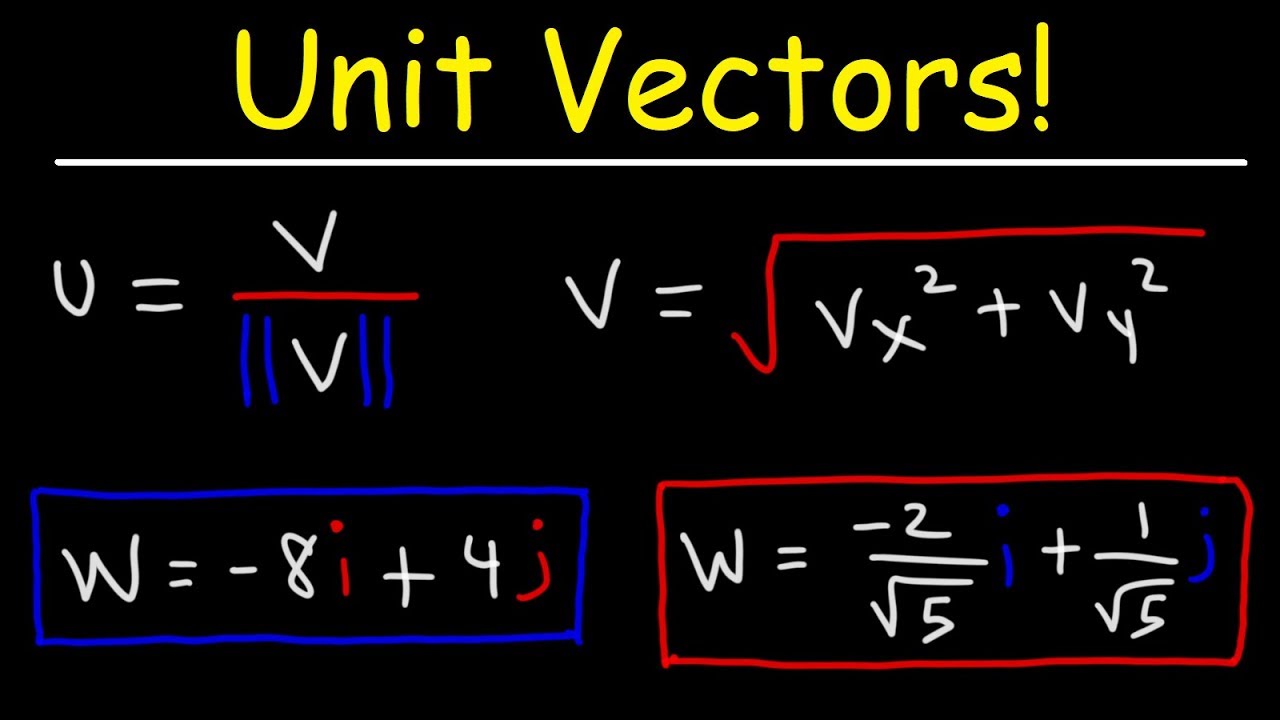
A unit normal vector is a vector that is perpendicular to a surface at a given point and has a magnitude of 1. Unit normal vectors are often used to represent the direction of a surface at a given point, and they are used in a variety of applications, including computer graphics, physics, and engineering.
Examples of Unit Normal Vectors
- The unit normal vector to the surface of a sphere at a given point is the vector pointing directly away from the center of the sphere.
- The unit normal vector to the surface of a plane at a given point is the vector perpendicular to the plane.
- The unit normal vector to the surface of a cylinder at a given point is the vector perpendicular to the axis of the cylinder.
Importance of Unit Normal Vectors
Unit normal vectors are important in a variety of applications, including:
- Computer graphics: Unit normal vectors are used to calculate the shading of surfaces in computer graphics.
- Physics: Unit normal vectors are used to calculate the forces acting on objects in physics.
- Engineering: Unit normal vectors are used to calculate the stresses and strains in materials in engineering.
Calculating Unit Normal Vectors: Unit Normal Vector Calculator

Calculating unit normal vectors is essential for various applications, including computer graphics, physics, and engineering. The unit normal vector is a vector perpendicular to a surface at a given point, with a magnitude of 1. This article provides a comprehensive guide on how to calculate unit normal vectors, covering mathematical formulas, manual calculation steps, and online tools.
Mathematical Formulas
The mathematical formula for calculating the unit normal vector is given by:
n̂ = (û × v̂) / ||û × v̂||
where:
- n̂ is the unit normal vector
- û and v̂ are two tangent vectors at the given point
- × represents the cross product
- ||.|| represents the magnitude of a vector
Manual Calculation Steps
To manually calculate the unit normal vector, follow these steps:
- Find two tangent vectors at the given point.
- Calculate the cross product of the two tangent vectors.
- Normalize the cross product by dividing it by its magnitude.
Online Tools and Software
Several online tools and software are available for calculating unit normal vectors. Some popular options include:
- Online Unit Normal Vector Calculator
- MATLAB
- Python
Applications of Unit Normal Vectors

Unit normal vectors play a crucial role in various fields, providing a fundamental tool for understanding and solving problems in geometry, physics, and engineering.
In geometry, unit normal vectors are used to define the orientation of surfaces and curves. They help determine the direction of the outward normal to a surface, which is essential for calculating surface area and volume. In physics, unit normal vectors are used to describe the direction of forces acting on surfaces, such as pressure and tension.
They also help define the direction of motion of objects moving along surfaces.
Applications in Engineering, Unit normal vector calculator
In engineering, unit normal vectors are widely used in various applications:
- Fluid Dynamics:Unit normal vectors define the direction of fluid flow over surfaces, which is crucial for designing aerodynamic shapes and optimizing fluid flow systems.
- Solid Mechanics:Unit normal vectors are used to calculate the stress and strain on surfaces, which is essential for designing structures that can withstand external forces.
- Heat Transfer:Unit normal vectors determine the direction of heat flow through surfaces, which is important for designing efficient heat exchangers and thermal insulation systems.
The benefits of using unit normal vectors in engineering include:
- Accurate Calculations:Unit normal vectors provide a precise representation of surface orientation, enabling accurate calculations of surface properties and forces.
- Simplified Analysis:Unit normal vectors simplify complex engineering problems by providing a consistent and unambiguous reference direction for surface properties.
- Enhanced Design:Unit normal vectors help engineers optimize designs by providing insights into the behavior of surfaces under various conditions.
Visualizing Unit Normal Vectors
Visualizing unit normal vectors is crucial for comprehending their properties and behavior. Various methods exist to visualize them in different coordinate systems, providing valuable insights into their orientation and relationship with surfaces.
Interactive Illustrations and Animations
Interactive illustrations and animations offer dynamic representations of unit normal vectors. These visualizations allow users to rotate and zoom in on surfaces, observing how the unit normal vectors change accordingly. Such interactive tools enhance the understanding of the vectors’ behavior under different conditions.
Table of Visualization Methods
The following table summarizes the common visualization methods for unit normal vectors in different coordinate systems:
| Coordinate System | Visualization Method |
|---|---|
| Cartesian | Arrows perpendicular to the surface at a given point |
| Cylindrical | Vectors extending radially outward from the surface |
| Spherical | Vectors pointing outward from the center of the sphere |
Conclusion

By the end of this guide, you’ll have a solid grasp of unit normal vectors and their significance in various fields. You’ll be able to calculate unit normal vectors with ease, visualize their behavior, and apply them to solve real-world problems.
So, buckle up and let’s dive into the captivating world of unit normal vectors!