Dive into the world of row reduced echelon form calculators and discover how they can revolutionize your matrix operations. These powerful tools empower you to solve complex linear systems, transform matrices, and unlock a wealth of advanced features.
Row reduced echelon form calculators simplify complex matrix manipulations, providing a step-by-step guide to transforming matrices into their simplest form. They offer a range of advantages, including time-saving, accuracy, and enhanced problem-solving capabilities.
Row Reduced Echelon Form Calculator Basics
A row reduced echelon form calculator is an online tool that helps you transform a given matrix into its row reduced echelon form (RREF). RREF is a special matrix form where each row has a leading 1 (the first non-zero element from the left), and all other elements in the same column are 0. This form is particularly useful for solving systems of linear equations.
Solving Linear Systems
To solve a system of linear equations using a row reduced echelon form calculator, you can input the coefficients of the variables into the matrix and let the calculator perform the necessary row operations. The calculator will transform the matrix into RREF, which will make it easy to identify the solutions to the system.
Understanding Row Reduced Echelon Form
Row reduced echelon form (RREF) is a unique and standardized matrix format that represents the solution to a system of linear equations. It provides a systematic method for solving complex systems efficiently and accurately.
To transform a matrix into RREF, follow these steps:
Step 1: Convert to Matrix Form, Row reduced echelon form calculator
Express the system of linear equations as an augmented matrix, where the coefficients and variables form the matrix and the constants form the augmented column.
Step 2: Create Leading Coefficients
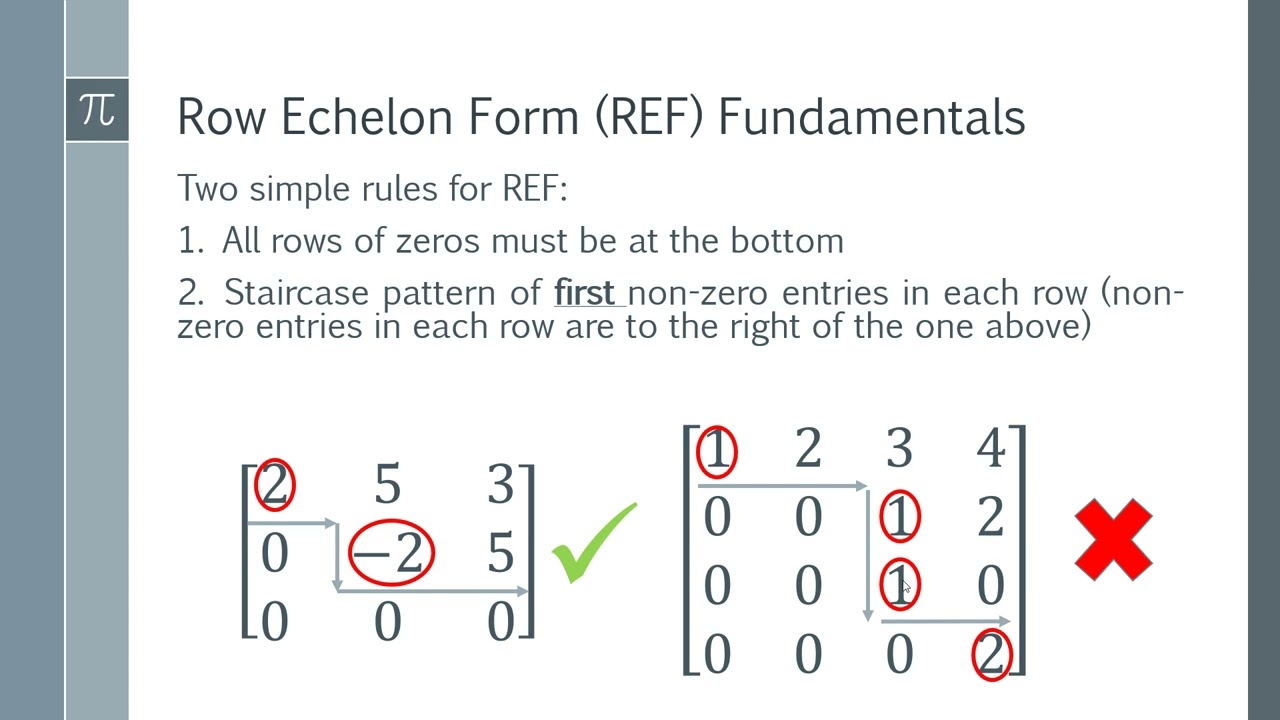
For each row, identify or create a leading coefficient, which is the first non-zero entry from left to right. Use row operations (addition, subtraction, multiplication) to create leading coefficients in each row.
Step 3: Zero Out Below Leading Coefficients
Use row operations to eliminate all non-zero entries below each leading coefficient. This creates a staircase pattern in the matrix.
Step 4: Make Leading Coefficients Equal to 1
Divide each row by its leading coefficient to make them equal to 1. This simplifies the matrix further.
Step 5: Zero Out Above Leading Coefficients
Use row operations to eliminate all non-zero entries above each leading coefficient. This completes the RREF.
Example
Consider the matrix:
$$\beginbmatrix 1 & 2 & 3 \\\ 4 & 5 & 6 \\\ 7 & 8 & 9 \endbmatrix$$
Transforming it into RREF:
$$\beginbmatrix 1 & 0 &
1 \\\ 0 & 1 & 2 \\\ 0 & 0 & 0 \endbmatrix$$
The RREF reveals that the system has infinitely many solutions, represented by the free variable in the last column.
Advanced Features of Row Reduced Echelon Form Calculators

Row reduced echelon form calculators are not just limited to basic row operations. They offer a range of advanced features that can greatly enhance your problem-solving capabilities.
One such feature is matrix inversion. Given a square matrix, the calculator can determine its inverse, which is essential for solving systems of equations and other mathematical operations.
Determinant Calculation
Another useful feature is determinant calculation. The determinant of a matrix is a numerical value that provides insights into its properties and can be used to determine its invertibility and other characteristics.
Null Space Analysis
Row reduced echelon form calculators can also perform null space analysis. The null space of a matrix consists of all vectors that, when multiplied by the matrix, result in the zero vector. This analysis is valuable in areas such as linear algebra and optimization.
For instance, consider the matrix A:
A=$$\beginbmatrix
- & 2 & 3 \\
- & 5 & 6 \\
- & 8 & 9
\endbmatrix$$
Using a row reduced echelon form calculator, we can find the reduced row echelon form of A:
R=$$\beginbmatrix
- & 0 &
- 1 \\
- & 1 & 2 \\
- & 0 & 0
\endbmatrix$$
From this reduced row echelon form, we can determine that the null space of Ais the set of all vectors of the form:
x=$$\beginbmatrixx_1 \\x_2 \\x_3\endbmatrix$$
where x1= x3.
Applications of Row Reduced Echelon Form
Row reduced echelon form (RREF) is a powerful mathematical tool with wide-ranging applications in various fields, including linear algebra, computer science, and economics.
In linear algebra, RREF is used to solve systems of linear equations, find the rank and nullity of a matrix, and determine the linear independence of vectors. It provides a systematic method to manipulate matrices into a form that simplifies these operations.
Computer Science
In computer science, RREF is used in computer graphics, cryptography, and data analysis. For instance, in computer graphics, RREF is employed to solve systems of linear equations that arise in 3D transformations and rendering.
Economics
In economics, RREF is used to analyze input-output models, solve optimization problems, and study economic equilibrium. It helps economists understand the relationships between different sectors of the economy and make predictions about economic behavior.
Limitations and Challenges
While RREF is a versatile tool, it does have some limitations. It can become computationally expensive for large matrices, and it may not be suitable for all types of problems. Additionally, interpreting the results of RREF can be challenging, especially in complex systems.
Conclusion: Row Reduced Echelon Form Calculator
Mastering row reduced echelon form calculators unlocks a world of possibilities. From linear algebra to computer science and economics, these tools empower you to tackle complex problems with ease. Whether you’re a student, researcher, or professional, embrace the power of row reduced echelon form calculators and elevate your matrix manipulation skills.