
Introducing the Riemann Sums Calculator, your ultimate companion for effortlessly approximating definite integrals! This innovative tool empowers you to explore the fascinating world of Riemann sums, unlocking a treasure trove of applications across diverse fields. Prepare to delve into the realm of calculus with unparalleled ease and precision.
With our Riemann Sums Calculator, you’ll gain a deeper understanding of Riemann sums, their types, and their remarkable ability to approximate integrals. Discover how these sums serve as building blocks for advanced calculus concepts and witness their practical applications in real-world scenarios.
Get ready to revolutionize your calculus journey today!
Understanding Riemann Sums

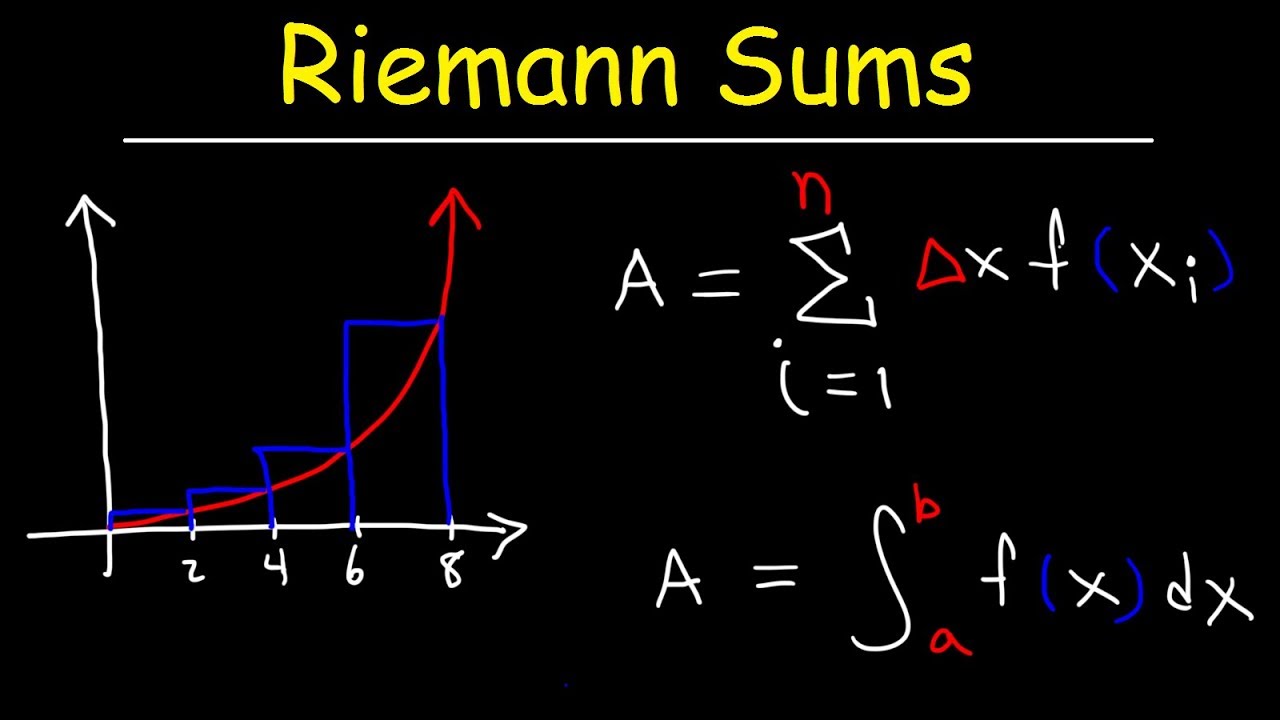
Riemann sums are a powerful tool for approximating definite integrals. They are based on the idea of dividing the area under a curve into a series of rectangles and then summing the areas of these rectangles.
There are three main types of Riemann sums: left Riemann sums, right Riemann sums, and midpoint Riemann sums. Left Riemann sums use the left endpoint of each subinterval to calculate the height of the rectangle, while right Riemann sums use the right endpoint.
Midpoint Riemann sums use the midpoint of each subinterval.
Riemann sums can be used to approximate the area under any curve. They are particularly useful for approximating the area under curves that are not easily integrated using other methods.
Example
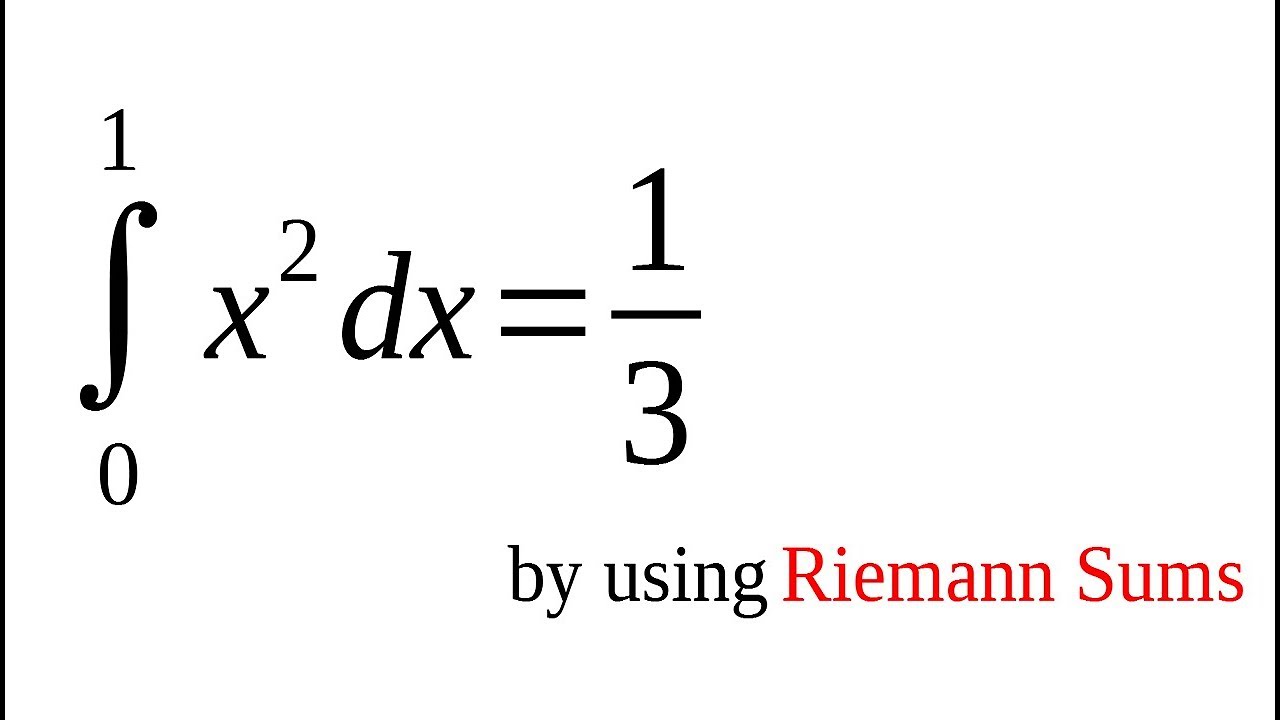
Consider the curve y= x2on the interval [0, 1]. We can approximate the area under this curve using a left Riemann sum with n= 4 subintervals.
The width of each subinterval is 1/4, and the height of each rectangle is f( xi), where xiis the left endpoint of the ith subinterval.
The area of the ith rectangle is therefore f( xi) – (1/4), and the total area under the curve is approximately the sum of the areas of these rectangles:
“`Area ≈ f(0)
- (1/4) + f(1/4)
- (1/4) + f(1/2)
- (1/4) + f(3/4)
- (1/4)
“`
Plugging in the values of f( x), we get:
“`Area ≈ 0 + 1/16 + 1/4 + 9/16“`
Therefore, the approximate area under the curve y= x2on the interval [0, 1] is 11/16.
Riemann Sums Calculator
This calculator provides a convenient and accurate way to compute Riemann sums, which are approximations of integrals. It is designed to be user-friendly and accessible to students and professionals alike.
The calculator accepts various input parameters, including the function to be integrated, the interval of integration, the number of subintervals, and the type of Riemann sum (left, right, or midpoint). It then calculates the Riemann sum using the specified parameters and displays the result.
Calculator Functionality
The Riemann sums calculator offers the following features:
- User-friendly interface that allows for easy input of parameters.
- Support for different types of Riemann sums (left, right, and midpoint).
- Automatic calculation of the Riemann sum based on the input parameters.
- Display of the calculated Riemann sum as a numerical value.
- Clear instructions and examples to guide users through the process.
Applications of Riemann Sums
Riemann sums find extensive applications in various fields, providing a powerful tool for approximating integrals and solving real-world problems.
Physics
- Calculating the work done by a force over a distance
- Determining the area under a velocity-time graph to find displacement
- Estimating the volume of an irregularly shaped object using integration
Engineering
- Approximating the area of a curved surface
- Calculating the volume of a solid of revolution
- Estimating the bending moment of a beam under a load
Economics
- Finding the total revenue or cost over a period of time
- Estimating the area under a demand curve to determine consumer surplus
- Calculating the present value of an annuity
Advanced Topics in Riemann Sums
Riemann sums serve as the foundation for understanding the concept of definite integrals, providing a powerful tool for approximating the area under curves and solving complex mathematical problems. As we delve deeper into the realm of Riemann sums, we uncover a fascinating tapestry of theoretical underpinnings and ongoing research directions that push the boundaries of our knowledge.
Theoretical Foundations
The theoretical foundations of Riemann sums lie in the realm of calculus, where they are intricately connected to the concept of limits. Riemann sums approximate the definite integral of a function over a given interval by dividing the interval into subintervals and summing the areas of rectangles inscribed within each subinterval.
As the number of subintervals approaches infinity, the sum converges to the exact value of the definite integral.
Convergence of Riemann Sums
The convergence of Riemann sums to definite integrals is a fundamental property that underscores their importance in calculus. This convergence is guaranteed under certain conditions, such as when the function being integrated is continuous or piecewise continuous. The convergence theorem for Riemann sums provides a rigorous mathematical framework for establishing the equivalence between Riemann sums and definite integrals.
Current Research Directions, Riemann sums calculator
Current research directions in Riemann sums focus on extending their applicability and exploring novel applications. Researchers are investigating the use of Riemann sums in higher-dimensional integrals, stochastic processes, and numerical analysis. Additionally, there is growing interest in developing efficient algorithms for computing Riemann sums and exploring their applications in fields such as data science and machine learning.
Final Conclusion
Our Riemann Sums Calculator stands as a testament to the power of technology in enhancing mathematical exploration. Its user-friendly interface and robust functionality make it an indispensable tool for students, researchers, and professionals alike. Embrace the transformative power of Riemann sums and unlock the secrets of calculus with effortless precision.
Let this calculator be your guide as you conquer the challenges of integral approximation and delve into the boundless realm of mathematical discovery.
