Embark on a mathematical journey with the Rational Zero Theorem Calculator, an indispensable tool that empowers you to decipher the secrets of polynomials. This calculator harnesses the power of the Rational Zero Theorem, a fundamental concept that unveils the potential rational zeros lurking within polynomial equations.
Prepare to witness the elegance of mathematics as we delve into the intricacies of this remarkable theorem and its practical applications.
The Rational Zero Theorem Calculator stands as a beacon of simplicity and efficiency, guiding you through the process of identifying rational zeros with unparalleled ease. Experience the satisfaction of solving complex polynomial equations with newfound clarity and precision. Let us unravel the mysteries of polynomials together, one rational zero at a time.
Rational Zero Theorem
The Rational Zero Theorem is a theorem in algebra that provides a method for finding all rational zeros of a polynomial with integer coefficients.
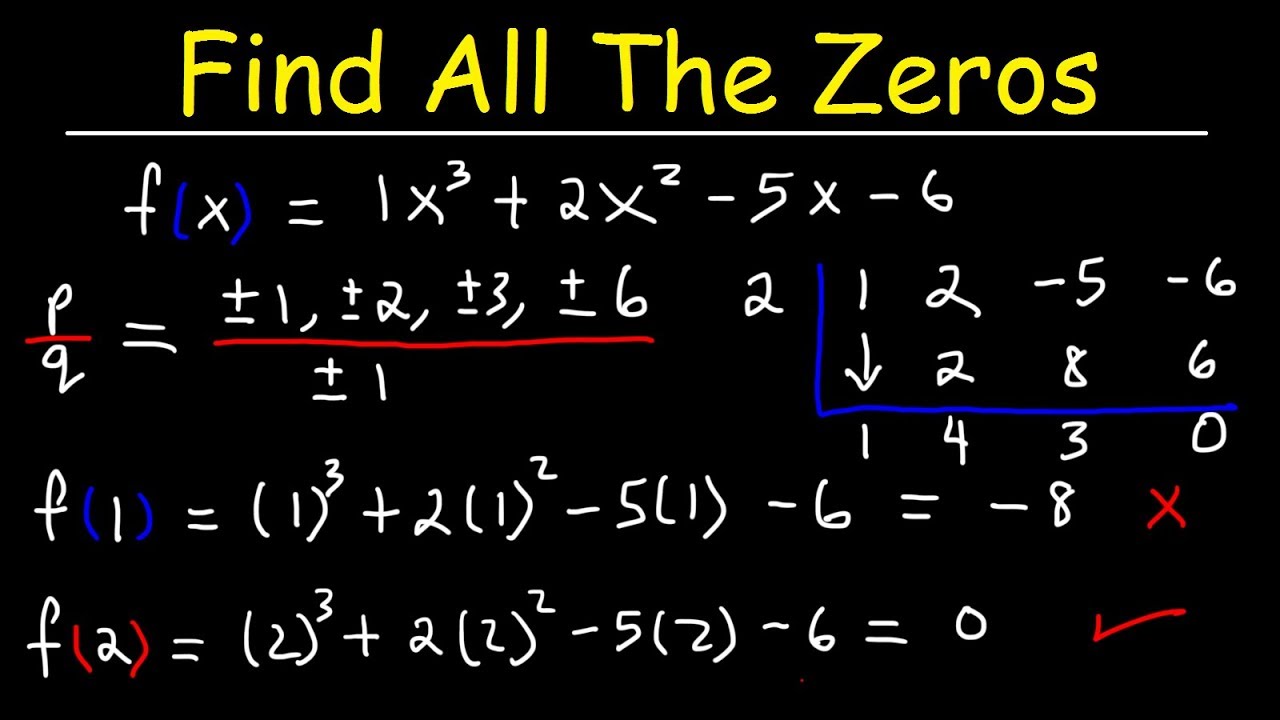
The theorem states that if a polynomial \(P(x) = a_nx^n + a_n-1x^n-1 + \cdots + a_1x + a_0\) has integer coefficients, then every rational zero of \(P(x)\) must be of the form \(p/q\), where \(p\) is a factor of the constant term \(a_0\) and \(q\) is a factor of the leading coefficient \(a_n\).
How to Apply the Rational Zero Theorem
To apply the Rational Zero Theorem to find potential rational zeros of a polynomial, follow these steps:
- List all the factors of the constant term.
- List all the factors of the leading coefficient.
- Create a list of all possible rational zeros by dividing each factor of the constant term by each factor of the leading coefficient.
Step-by-Step Guide to Find All Rational Zeros
To find all rational zeros of a given polynomial, follow these steps:
- Use the Rational Zero Theorem to generate a list of potential rational zeros.
- Substitute each potential rational zero into the polynomial to see if it is a zero.
- If a potential rational zero is a zero, then factor the polynomial using that zero.
- Repeat steps 2 and 3 until all rational zeros have been found.
Rational Zero Theorem Calculator

Rational Zero Theorem Calculator
A Rational Zero Theorem calculator is an online tool that assists users in finding potential rational zeros of a polynomial function based on the Rational Zero Theorem. It offers a user-friendly interface, allowing users to input polynomial coefficients and obtain a list of potential rational zeros.
The calculator also provides a feature to verify whether a given number is indeed a zero of the polynomial.
Features
* Accepts polynomial coefficients as input.
- Generates a list of potential rational zeros based on the Rational Zero Theorem.
- Allows users to verify if a given number is a zero of the polynomial.
- Provides a detailed user guide explaining the functionality and usage of the calculator.
Benefits
* Simplifies the process of finding rational zeros of polynomials.
- Saves time and effort in solving polynomial equations.
- Enhances understanding of the Rational Zero Theorem.
- Assists students and researchers in mathematical problem-solving.
Applications of the Rational Zero Theorem

The Rational Zero Theorem finds practical applications in various fields, including mathematics, engineering, and physics. It provides a systematic approach to identify potential rational roots of polynomial equations, aiding in problem-solving and analysis.
In mathematics, the theorem is used to simplify polynomial equations, determine the number of real roots, and study the behavior of functions.
Engineering and Physics
In engineering and physics, the Rational Zero Theorem is employed to solve problems involving:
- Circuit analysis: Identifying resonant frequencies and impedances in electrical circuits.
- Mechanical vibrations: Determining natural frequencies and damping coefficients of vibrating systems.
- Fluid dynamics: Modeling fluid flow patterns and predicting pressure distributions.
Extensions of the Rational Zero Theorem
The Rational Zero Theorem provides a method to find rational zeros of a polynomial with integer coefficients. However, it has limitations, especially when dealing with polynomials with complex or irrational zeros. Extensions of the Rational Zero Theorem, such as Descartes’ Rule of Signs and Eisenstein’s Criterion, address these limitations and enhance our ability to find rational zeros of polynomials.
Descartes’ Rule of Signs
Descartes’ Rule of Signs is a method for determining the possible number of positive and negative real zeros of a polynomial based on the signs of its coefficients. It states that:
- The number of positive real zeros is equal to the number of sign changes in the coefficients of the polynomial.
- The number of negative real zeros is equal to the number of sign changes in the coefficients of the polynomial when alternating signs are ignored.
For example, the polynomial f(x) = x^3- 2x^2 – 5x + 6
has two sign changes in its coefficients, indicating that it has either one or three positive real zeros. Since there are no sign changes when alternating signs are ignored, it has no negative real zeros.
Eisenstein’s Criterion
Eisenstein’s Criterion is a method for determining whether a polynomial with integer coefficients has at least one rational zero that is not an integer. It states that if there exists a prime number p
such that:
p
divides every coefficient of the polynomial except the constant term.p^2
does not divide the constant term.
Then the polynomial has at least one rational zero that is not an integer.
For example, the polynomial f(x) = x^3- 2x^2 + px – 2
has p
as a factor of every coefficient except the constant term, and p^2
does not divide the constant term. Therefore, it has at least one rational zero that is not an integer.
Comparison of Extensions
The following table compares the Rational Zero Theorem with its extensions:
| Theorem | Conditions | Information Provided |
|---|---|---|
| Rational Zero Theorem | Polynomial with integer coefficients | Possible rational zeros |
| Descartes’ Rule of Signs | Polynomial with real coefficients | Possible number of positive and negative real zeros |
| Eisenstein’s Criterion | Polynomial with integer coefficients | Existence of rational zeros that are not integers |
Ultimate Conclusion: Rational Zero Theorem Calculator
The Rational Zero Theorem Calculator emerges as an invaluable asset in the realm of polynomial exploration. Its user-friendly interface and robust functionality make it an indispensable tool for students, educators, and professionals alike. Whether you seek to unravel the intricacies of mathematics or conquer the challenges of real-world applications, this calculator stands ready to empower your journey.
Embrace the power of the Rational Zero Theorem and unlock the secrets of polynomials with newfound confidence.