Introducing the quick ratio calculator, a tool that empowers you to effortlessly evaluate a company’s short-term financial health. This insightful metric provides a snapshot of a company’s ability to meet its immediate obligations, making it a crucial indicator for investors, creditors, and management alike.
Delve into the intricacies of quick ratio calculation, exploring the financial ratios and formulas that underpin its accuracy. Our step-by-step guide ensures a comprehensive understanding of the process, empowering you to calculate quick ratios with precision.
Understanding Quick Ratio: Quick Ratio Calculator

Quick ratio, also known as acid-test ratio, is a financial metric that assesses a company’s ability to meet its short-term obligations using its most liquid assets.
It measures the extent to which a company can cover its current liabilities with its quick assets, which include cash, cash equivalents, marketable securities, and accounts receivable.
Significance of Quick Ratio
Quick ratio is a crucial indicator of a company’s short-term liquidity and financial health. A high quick ratio indicates that the company has sufficient liquid assets to cover its current liabilities, while a low quick ratio may raise concerns about the company’s ability to meet its short-term obligations.
Investors and creditors use quick ratio to evaluate a company’s ability to pay its debts and meet its operating expenses in the short term.
Calculating Quick Ratio
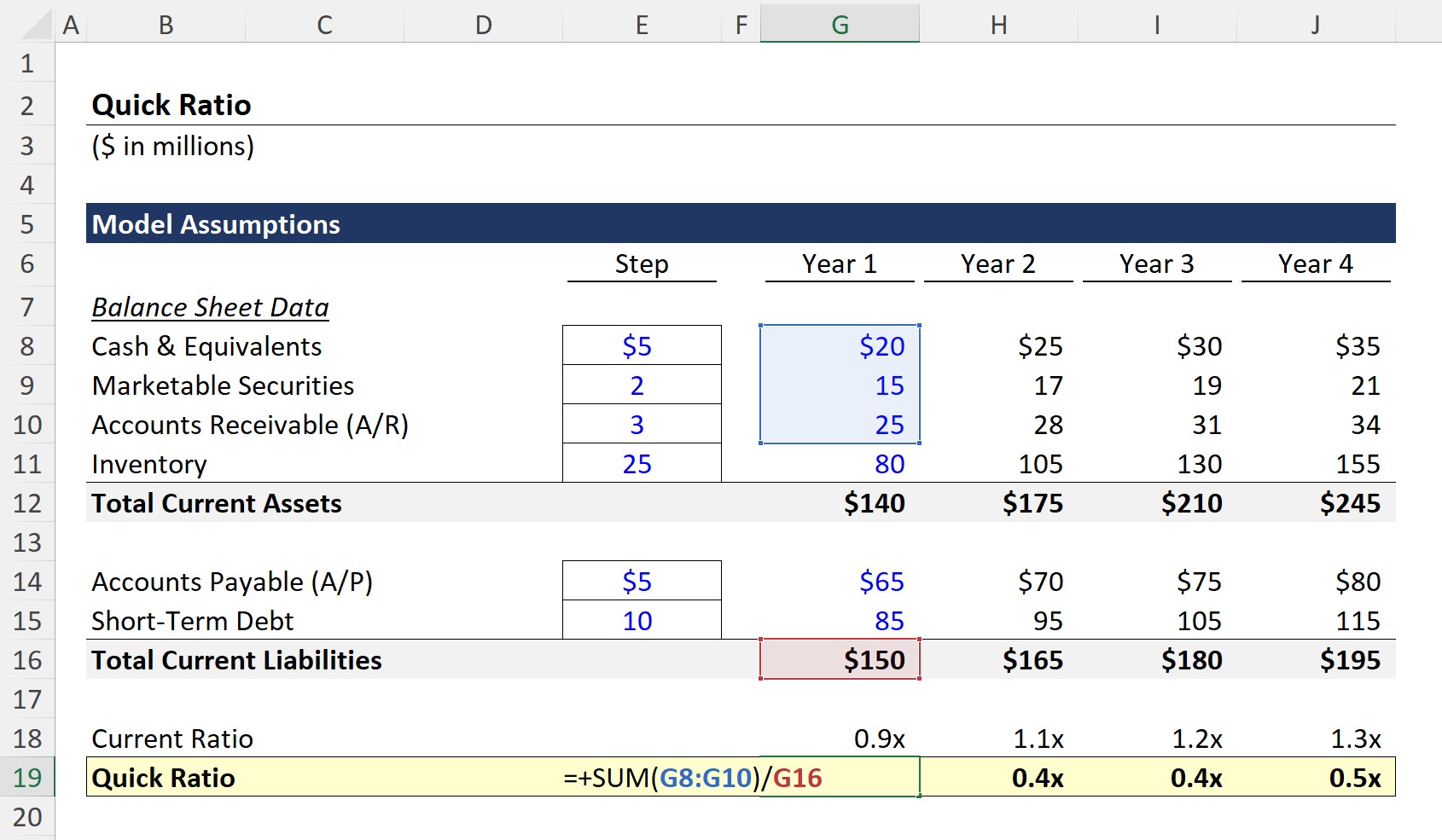
Calculating quick ratio is a straightforward process that involves gathering the necessary financial data and applying the appropriate formula.
The quick ratio formula is as follows:
Quick Ratio = (Current Assets
Inventory) / Current Liabilities
To calculate the quick ratio, follow these steps:
- Gather the following financial data from the company’s balance sheet:
- Current assets
- Inventory
- Current liabilities
- Subtract inventory from current assets.
- Divide the result by current liabilities.
The resulting number is the quick ratio.
For example, consider a company with the following financial data:
| Financial Data | Amount |
|---|---|
| Current assets | $100,000 |
| Inventory | $20,000 |
| Current liabilities | $50,000 |
Using the quick ratio formula, we can calculate the quick ratio as follows:
Quick Ratio = (100,000
20,000) / 50,000 = 1.6
This means that the company has $1.60 of quick assets for every $1.00 of current liabilities.
Interpreting Quick Ratio Results
Understanding the implications of different quick ratio values is crucial for evaluating a company’s short-term liquidity and financial health. Let’s delve into how to interpret quick ratio in relation to industry benchmarks and historical data, along with examples of companies with strong and weak quick ratios.
A quick ratio above 1 indicates that a company has sufficient liquid assets to cover its current liabilities. Generally, a quick ratio between 1 and 2 is considered healthy, indicating that the company can meet its short-term obligations without difficulty.
Benchmarking Quick Ratio
Benchmarking a company’s quick ratio against industry averages provides valuable insights into its financial performance. Companies within the same industry tend to have similar quick ratios due to comparable operating environments and business models. A quick ratio significantly lower than the industry average may indicate potential liquidity issues or financial distress.
Historical Analysis
Tracking a company’s quick ratio over time can reveal trends and patterns. A consistently declining quick ratio may suggest deteriorating liquidity, while a gradual increase indicates improved financial health. Historical analysis helps identify potential areas of concern and monitor progress in addressing liquidity challenges.
Examples of Strong and Weak Quick Ratios
- Company A:A quick ratio of 1.5 indicates a strong liquidity position, suggesting the company has ample liquid assets to meet its current liabilities.
- Company B:A quick ratio of 0.8 raises concerns about the company’s ability to cover its short-term obligations. This low ratio may indicate potential liquidity issues and financial stress.
Applications of Quick Ratio
The quick ratio is a valuable tool for various stakeholders, including investors, creditors, and company management. It provides insights into a company’s ability to meet its short-term obligations and maintain financial stability.
Importance for Investors
- Assesses a company’s liquidity and short-term solvency, which is crucial for evaluating investment potential.
- Helps investors make informed decisions about the risk and stability of their investments.
- Provides a comparative measure of liquidity among different companies within the same industry.
Importance for Creditors, Quick ratio calculator
- Evaluates a company’s ability to repay short-term debts, reducing the risk of default.
- Determines the appropriate level of credit to extend and the terms of the loan agreement.
- Provides a basis for negotiating loan terms and interest rates.
Importance for Company Management
- Monitors the company’s liquidity and financial health, allowing for proactive decision-making.
- Identifies areas where liquidity can be improved, such as managing inventory or optimizing working capital.
- Supports strategic planning and decision-making related to short-term financing and cash flow management.
Case Studies
In 2022, a leading retailer used the quick ratio to assess the liquidity of several potential acquisition targets. The analysis revealed that one target had a significantly lower quick ratio than the others, indicating potential liquidity concerns. As a result, the retailer decided not to proceed with the acquisition.
Another case study involved a manufacturing company that used the quick ratio to monitor its financial performance during an economic downturn. The company’s quick ratio declined steadily, prompting management to take immediate actions to improve liquidity, including reducing inventory and negotiating extended payment terms with suppliers.
Ultimate Conclusion

The quick ratio calculator serves as an invaluable tool for assessing a company’s short-term liquidity, providing stakeholders with a clear understanding of its financial resilience. Its applications extend far and wide, informing investment decisions, creditworthiness assessments, and strategic planning. Embrace the power of the quick ratio calculator and gain a competitive edge in navigating the complexities of financial analysis.