Welcome to the realm of matrix mathematics, where Powers of Matrices Calculator emerges as your ultimate guide. This versatile tool empowers you to navigate the intricacies of matrix calculations with unparalleled precision and efficiency. Prepare to unravel the secrets of matrices and delve into a world of mathematical exploration.
With the Powers of Matrices Calculator at your fingertips, you’ll conquer matrix addition, subtraction, multiplication, and scalar multiplication with ease. Discover the fascinating properties of matrix operations and unravel the significance of the identity matrix. Step into the world of matrix applications and witness their transformative power in solving systems of linear equations, computer graphics, and beyond.
Matrix Calculations

Matrices are mathematical objects that represent a rectangular array of numbers. They are used extensively in various fields such as linear algebra, physics, and computer science.
Matrix calculations involve operations like addition, subtraction, multiplication, and scalar multiplication. These operations are fundamental to matrix algebra and form the basis for more complex matrix operations.
Matrix Addition and Subtraction
Matrix addition and subtraction are operations performed on matrices with the same dimensions. The corresponding elements of the matrices are added or subtracted to obtain the result.
For example, consider two matrices A and B:$$A = \beginbmatrix 1 & 2 \\\ 3 & 4 \endbmatrix \quad \textand \quad B = \beginbmatrix 5 & 6 \\\ 7 & 8 \endbmatrix$$Then, the sum of A and B is:$$A + B = \beginbmatrix 1+5 & 2+6 \\\ 3+7 & 4+8 \endbmatrix = \beginbmatrix 6 & 8 \\\ 10 & 12 \endbmatrix$$And the difference of A and B is:$$A
- B = \beginbmatrix 1-5 & 2-6 \\\ 3-7 & 4-8 \endbmatrix = \beginbmatrix
- 4 &
- 4 \\\
- 4 &
- 4 \endbmatrix$$
Matrix Multiplication, Powers of matrices calculator
Matrix multiplication is an operation performed on two matrices, where the elements of the first matrix are multiplied by the corresponding elements of the second matrix, and the results are summed to obtain the corresponding element of the product matrix.
For example, consider two matrices A and B:$$A = \beginbmatrix 1 & 2 \\\ 3 & 4 \endbmatrix \quad \textand \quad B = \beginbmatrix 5 & 6 \\\ 7 & 8 \endbmatrix$$Then, the product of A and B is:$$AB = \beginbmatrix 1\cdot5 + 2\cdot7 & 1\cdot6 + 2\cdot8 \\\ 3\cdot5 + 4\cdot7 & 3\cdot6 + 4\cdot8 \endbmatrix = \beginbmatrix 19 & 22 \\\ 43 & 50 \endbmatrix$$
Scalar Multiplication
Scalar multiplication is an operation performed on a matrix and a scalar (a real number). Each element of the matrix is multiplied by the scalar to obtain the corresponding element of the product matrix.
For example, consider a matrix A and a scalar k = 2:$$A = \beginbmatrix 1 & 2 \\\ 3 & 4 \endbmatrix$$Then, the product of k and A is:$$kA = 2\beginbmatrix 1 & 2 \\\ 3 & 4 \endbmatrix = \beginbmatrix 2 & 4 \\\ 6 & 8 \endbmatrix$$
Matrix Applications
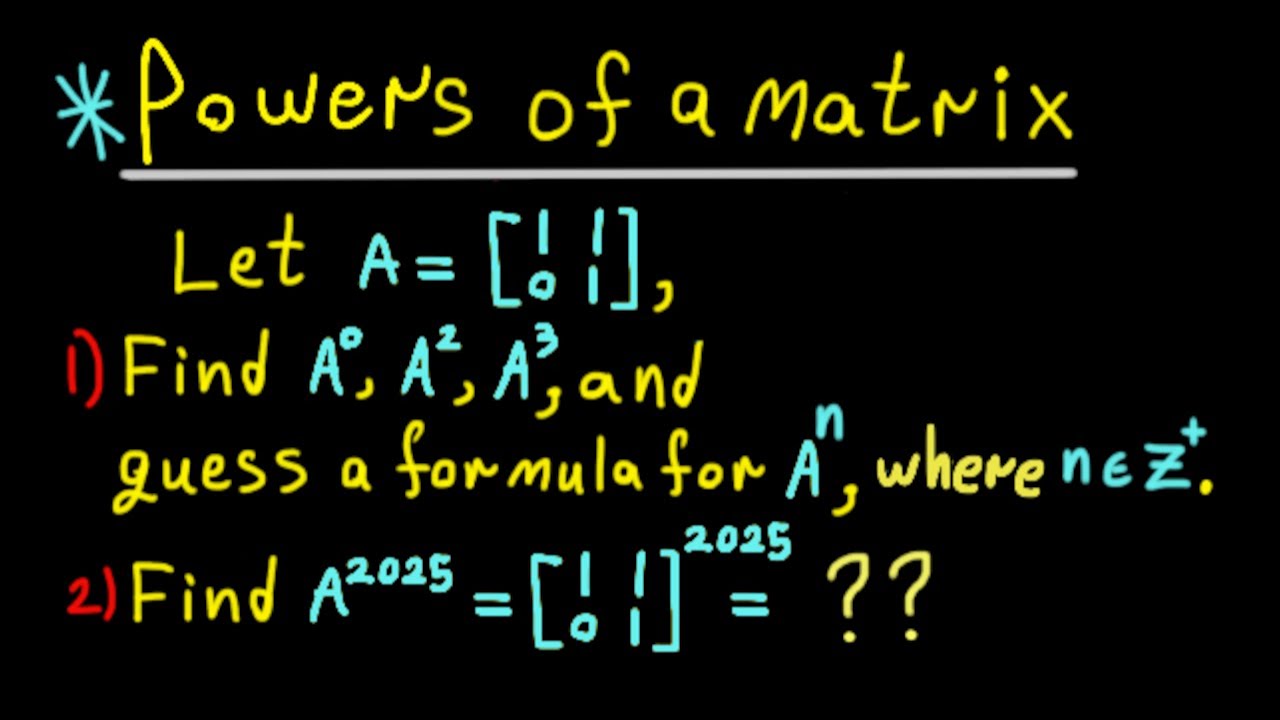
Matrices are mathematical tools with widespread applications across various fields, including mathematics, computer science, physics, and engineering. They offer a concise and efficient way to represent and manipulate complex systems of data, enabling the analysis and solution of intricate problems.
One of the fundamental applications of matrices lies in solving systems of linear equations. These systems arise in numerous real-world scenarios, such as economic modeling, electrical circuit analysis, and structural mechanics. By representing the system as a matrix equation, we can employ efficient algorithms like Gaussian elimination or matrix inversion to find the solution set.
Computer Graphics
In the realm of computer graphics, matrices play a pivotal role in transforming and projecting objects within virtual environments. Transformation matrices enable the translation, rotation, and scaling of objects, while projection matrices facilitate the conversion of 3D coordinates into 2D screen coordinates.
These transformations are essential for creating realistic and immersive visual experiences in video games, animations, and virtual reality applications.
Physics and Engineering
Matrices find extensive use in physics and engineering for modeling and analyzing physical systems. In classical mechanics, matrices are employed to describe the motion of objects, forces, and torques. In electromagnetism, they are used to represent electric and magnetic fields.
Furthermore, matrices are crucial in solving complex differential equations that arise in various engineering disciplines, such as structural analysis, fluid dynamics, and heat transfer.
Matrix Properties

Matrix properties play a crucial role in understanding the behavior and applications of matrices. They provide valuable insights into the characteristics and relationships within a matrix. Let’s delve into the key properties of matrices, including the determinant, different types of matrices, and their impact on matrix operations.
Determinant of a Matrix
The determinant of a square matrix is a scalar value that captures essential information about the matrix. It measures the “size” or “volume” of the linear transformation represented by the matrix. The determinant has several important properties:
- The determinant of a matrix is a single numerical value.
- It is invariant under row or column operations, meaning that performing elementary row or column operations on a matrix does not change its determinant.
- The determinant of a matrix is zero if and only if the matrix is singular, meaning it does not have an inverse.
- The determinant of a product of matrices is equal to the product of their determinants.
Types of Matrices
Matrices can be classified into various types based on their properties:
-
-*Singular Matrix
A matrix that has a determinant of zero is called a singular matrix. Singular matrices do not have an inverse and cannot be used to solve systems of linear equations.
-*Invertible Matrix
A matrix that has a non-zero determinant is called an invertible matrix. Invertible matrices have an inverse, which is a matrix that, when multiplied by the original matrix, results in the identity matrix.
-*Orthogonal Matrix
An orthogonal matrix is a square matrix whose inverse is equal to its transpose. Orthogonal matrices are used in rotations and reflections in geometry.
Relationship between Matrix Properties and Matrix Operations
The properties of a matrix influence how it behaves under different matrix operations. For instance:
- The determinant of a matrix can be used to determine whether the matrix is invertible or singular.
- The type of matrix (singular, invertible, orthogonal) affects the solvability of systems of linear equations and the validity of matrix operations.
- Matrix properties can be used to simplify matrix calculations and solve problems more efficiently.
Understanding matrix properties is essential for working with matrices effectively. They provide a deeper understanding of matrix behavior and enable us to use matrices confidently in various applications.
Matrix Representation: Powers Of Matrices Calculator
Matrices offer versatile ways to represent and manipulate data. They can be expressed in different forms, such as row-echelon form and reduced row-echelon form, which simplify operations and reveal matrix properties.
Beyond their algebraic significance, matrices find applications in geometry, representing transformations like rotations, translations, and scaling. These transformations can be visualized as movements and changes in shapes, providing insights into geometric relationships.
Representing Real-World Data
Matrices extend their utility to real-world data representation. They can encode information about entities and their attributes, forming structured datasets. For instance, in a customer database, a matrix can represent customer data with rows for each customer and columns for attributes like name, address, and purchase history.
Summary
As you embark on this mathematical journey, the Powers of Matrices Calculator will illuminate the path. Embrace the intricacies of matrix determinants, explore the diverse types of matrices, and unravel the connections between matrix properties and operations. Represent matrices in various forms, including row-echelon and reduced row-echelon, and witness their ability to capture geometric transformations and real-world data.
Let the Powers of Matrices Calculator be your constant companion, guiding you through the complexities of matrix mathematics with unwavering precision and clarity.