
Welcome to the world of statistical analysis, where the pooled variance calculator stands as a powerful tool in understanding the variability of data. This comprehensive guide will take you on a journey through the concept, applications, and intricacies of pooled variance, empowering you to harness its potential for accurate data analysis.
As we delve deeper into the topic, you’ll discover how pooled variance plays a crucial role in estimating population variance, conducting hypothesis testing, and making informed decisions based on statistical data.
Pooled Variance Definition and Formula
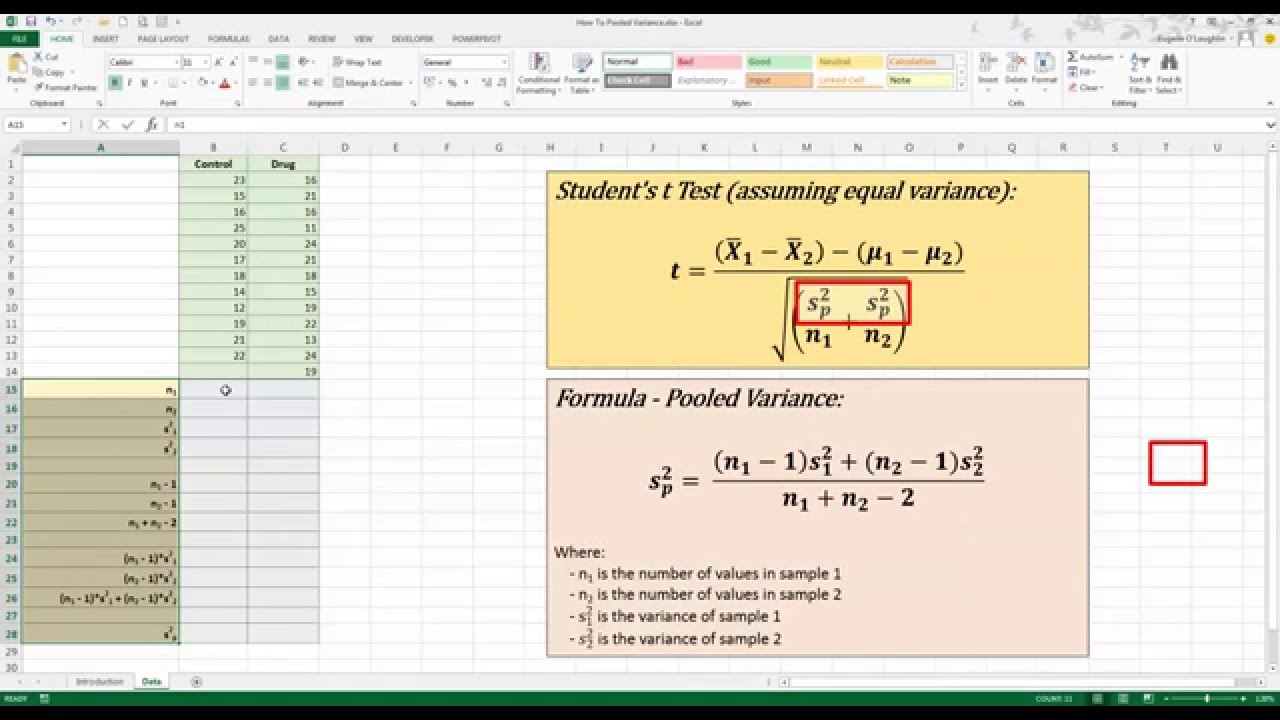
In statistics, pooled variance is a method for estimating the common variance of two or more independent populations when the population variances are unknown. It is used in various statistical tests, such as the t-test and analysis of variance (ANOVA).
Formula for Calculating Pooled Variance
The formula for calculating pooled variance is given by:“`Sp^2 = [(n1
- 1)
- S1^2 + (n2
- 1)
- S2^2] / (n1 + n2
- 2)
“`where:* Sp^2 is the pooled variance
- S1^2 and S2^2 are the sample variances of the two populations
- n1 and n2 are the sample sizes of the two populations
Applications of Pooled Variance: Pooled Variance Calculator
Pooled variance is a valuable statistical tool used in various applications. It plays a crucial role in estimating population variance and hypothesis testing.
One significant application of pooled variance is in estimating the population variance when the variances of multiple populations are unknown. By combining the sample variances from these populations, pooled variance provides a more accurate estimate of the population variance.
Hypothesis Testing, Pooled variance calculator
Pooled variance is also widely used in hypothesis testing. In two-sample hypothesis tests, where the variances of the two populations are assumed to be equal, pooled variance is used to calculate the test statistic. This allows researchers to determine if there is a statistically significant difference between the means of the two populations.
Assumptions and Limitations of Pooled Variance
Pooled variance is a statistical method used to estimate the common variance of two or more populations when the populations are assumed to have equal variances. However, certain assumptions must be met for pooled variance to be valid.
Assumptions of Pooled Variance
- Independence of Samples:The samples used to calculate the pooled variance must be independent of each other. This means that the observations in one sample should not influence the observations in another sample.
- Equal Variances:The populations from which the samples are drawn must have equal variances. This assumption is known as the homogeneity of variances assumption.
- Normally Distributed Populations:The populations from which the samples are drawn must be normally distributed.
Limitations of Pooled Variance
Pooled variance is not always a valid method for estimating the common variance of two or more populations. The following are some of the limitations of pooled variance:
- Violation of Assumptions:If any of the assumptions of pooled variance are violated, the pooled variance estimate may be biased or inaccurate.
- Small Sample Sizes:Pooled variance is not recommended for use with small sample sizes, as the assumption of normality may not be met.
- Outliers:Outliers in the data can significantly affect the pooled variance estimate.
Alternative Methods for Estimating Variance
When the assumptions of pooled variance are not met, alternative methods for estimating variance can be used. These methods include:
- Separate Variance Estimates:The variance of each population can be estimated separately using the sample variance formula.
- Welch’s t-test:This test does not require the assumption of equal variances and can be used to compare the means of two populations with unequal variances.
- Brown-Forsythe test:This test is similar to Welch’s t-test but is more robust to outliers.
Pooled Variance Calculator Tools

Pooled variance calculator tools provide a convenient way to calculate the pooled variance, which is essential for various statistical analyses. These tools are readily available online and can be used with minimal statistical knowledge.
Types of Pooled Variance Calculator Tools
There are several types of pooled variance calculator tools available, each with its own features and benefits:
- Online calculators:These calculators are accessible through web browsers and require no software installation. They are typically easy to use and provide basic functionality for calculating pooled variance.
- Spreadsheet functions:Spreadsheet software such as Microsoft Excel and Google Sheets include functions for calculating pooled variance. These functions offer more flexibility and customization options compared to online calculators.
- Statistical software:Comprehensive statistical software packages like SPSS, R, and SAS provide advanced features for calculating pooled variance and performing various statistical analyses.
How to Use Pooled Variance Calculator Tools
Using pooled variance calculator tools is straightforward. Generally, you will need to provide the following information:
- Sample size for each group
- Sample variance for each group
Once you enter the required information, the calculator will compute the pooled variance and display the result. Some calculators may also provide additional information, such as the degrees of freedom and the F-statistic.
Comparison of Pooled Variance Calculator Tools
The choice of pooled variance calculator tool depends on your specific needs and preferences. Here is a brief comparison of the different types of tools:
| Tool Type | Ease of Use | Flexibility | Advanced Features |
|---|---|---|---|
| Online calculators | Very easy | Limited | None |
| Spreadsheet functions | Easy | Moderate | Limited |
| Statistical software | Requires some knowledge | High | Extensive |
Wrap-Up

In conclusion, the pooled variance calculator is an invaluable asset for researchers, analysts, and anyone seeking to gain insights from statistical data. By understanding its assumptions, limitations, and applications, you can confidently use this tool to enhance the accuracy and reliability of your statistical analyses.
So, embrace the power of pooled variance and embark on a path of statistical enlightenment. Let this guide be your compass as you navigate the complexities of data analysis with precision and confidence.
