
Nash equilibrium calculator is a groundbreaking tool that empowers individuals and organizations to navigate complex strategic situations with confidence. This powerful instrument unveils the intricacies of game theory, providing invaluable insights into decision-making processes.
By harnessing the principles of Nash equilibrium, the calculator empowers users to identify optimal strategies that maximize their outcomes in competitive environments. Whether in business negotiations, political campaigns, or personal interactions, the Nash equilibrium calculator serves as an indispensable guide, illuminating the path to success.
Nash Equilibrium Concepts

The Nash equilibrium, named after mathematician John Nash, is a fundamental concept in game theory that describes the optimal strategy for players in a non-cooperative game.
In a Nash equilibrium, each player’s strategy is the best response to the strategies of the other players. In other words, no player can improve their outcome by unilaterally changing their strategy while the other players keep their strategies the same.
Examples of Nash Equilibrium
Consider the following game:
| Player 2 Cooperates | Player 2 Defects | |
|---|---|---|
| Player 1 Cooperates | 3, 3 | 0, 5 |
| Player 1 Defects | 5, 0 | 1, 1 |
In this game, the Nash equilibrium is for both players to defect. This is because, regardless of what Player 2 does, Player 1 always gets a higher payoff by defecting.
Significance of Nash Equilibrium
The Nash equilibrium is a powerful tool for analyzing non-cooperative games. It can be used to predict the outcome of a game, and it can also be used to design strategies for players.
The Nash equilibrium is not always the most efficient outcome for all players. However, it is often the most stable outcome, as it is unlikely to be disrupted by any player unilaterally changing their strategy.
Nash Equilibrium Calculator Functionality
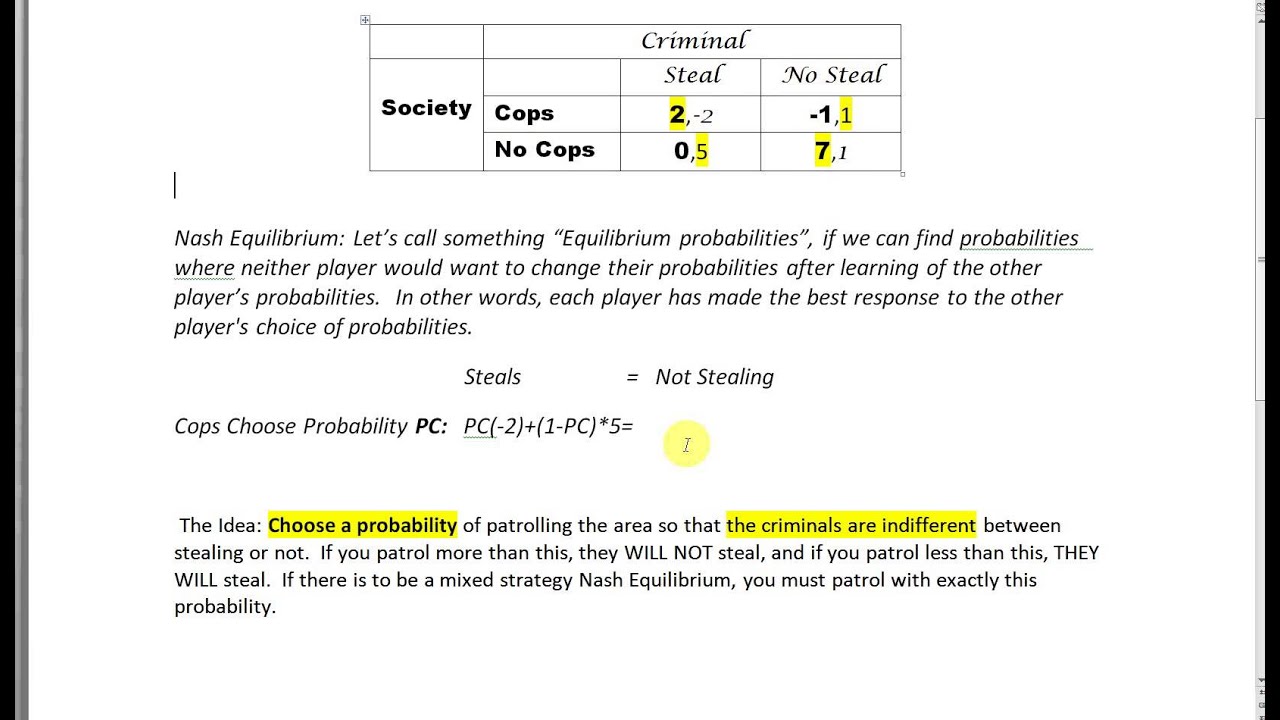
A Nash equilibrium calculator is a computational tool designed to find Nash equilibrium strategies for games.
It operates by evaluating the payoffs for each possible strategy combination and identifying the strategies that yield the highest payoffs for each player, given the strategies of the other players.
Calculating Nash Equilibrium
- Input:The calculator requires the payoff matrix of the game, which specifies the payoffs for each player for every possible strategy combination.
- Processing:The calculator uses an algorithm, such as the Lemke-Howson algorithm, to find the strategies that satisfy the Nash equilibrium conditions.
- Output:The calculator provides the Nash equilibrium strategies and the corresponding payoffs for each player.
Examples of Use
- Prisoner’s Dilemma:The calculator can determine the Nash equilibrium strategies (defect for both players) in the Prisoner’s Dilemma game.
- Matching Pennies:For the Matching Pennies game, the calculator will find that all strategy combinations are Nash equilibria, resulting in a zero-sum game.
- Hawk-Dove Game:The calculator can calculate the mixed-strategy Nash equilibrium for the Hawk-Dove game, where both players play Hawk and Dove with certain probabilities.
Applications of Nash Equilibrium Calculator

A Nash equilibrium calculator is a valuable tool for analyzing strategic interactions in various fields. It enables researchers, policymakers, and practitioners to understand the potential outcomes of different strategies and make informed decisions.
Economics
In economics, Nash equilibrium is used to model competition and cooperation in markets. By calculating the Nash equilibrium, firms can determine the optimal production levels, pricing strategies, and advertising budgets that maximize their profits. Governments can use Nash equilibrium to design policies that promote economic efficiency and prevent monopolies.
Game Theory, Nash equilibrium calculator
Nash equilibrium is fundamental in game theory, which studies strategic interactions between rational players. A Nash equilibrium calculator allows researchers to analyze a wide range of games, including zero-sum games, non-zero-sum games, and cooperative games. It helps identify the optimal strategies for each player and predict the likely outcomes of the game.
Biology
Nash equilibrium has applications in evolutionary biology, where it is used to model the evolution of strategies in populations. For example, in the Prisoner’s Dilemma game, the Nash equilibrium predicts that each player will defect, even though cooperation would lead to a better outcome for both.
This helps explain the evolution of selfish behavior in some biological systems.
Advantages and Limitations
Using a Nash equilibrium calculator offers several advantages. It provides a systematic and objective way to analyze strategic interactions. It can help identify the optimal strategies for each player and predict the likely outcomes of the game. However, it also has limitations.
Nash equilibrium assumes that players are rational and have perfect information, which may not always be the case in real-world situations.
Case Studies
Nash equilibrium has been successfully applied in various fields. For example, in economics, it has been used to analyze the pricing strategies of airlines, the advertising budgets of competing firms, and the design of government policies. In game theory, it has been used to analyze political negotiations, international conflicts, and the evolution of cooperation in social networks.
Designing a Nash Equilibrium Calculator Interface

An effective Nash equilibrium calculator interface should prioritize ease of use, clarity, and accessibility. Here’s a table outlining the key features and functionalities to consider:
| Feature | Description |
|---|---|
| Game Input | Allows users to enter the payoff matrix or define the game strategically. |
| Equilibrium Calculation | Calculates the Nash equilibrium strategies and payoffs for the entered game. |
| Solution Display | Presents the equilibrium strategies and payoffs in a clear and concise manner. |
| Game Visualization | Optionally, provides a visual representation of the game, such as a payoff matrix or strategy profile graph. |
| Customization Options | Allows users to customize the interface, such as changing the number of players or payoff values. |
User Experience Considerations
User experience considerations are crucial for designing an effective interface. Here are some key points:
- Simplicity and Clarity:The interface should be easy to understand and navigate, with clear instructions and minimal clutter.
- Feedback and Validation:The calculator should provide immediate feedback on user input and validate the entered game.
- Error Handling:The interface should handle errors gracefully, providing clear error messages and guidance on how to correct them.
- Responsiveness:The calculator should respond quickly to user input and calculations, providing a smooth user experience.
Accessibility and Usability
Optimizing the calculator’s accessibility and usability ensures that it is accessible to a wide range of users. Here are some suggestions:
- Keyboard Accessibility:The interface should be fully accessible using a keyboard, allowing users with disabilities to navigate and use the calculator.
- Color Contrast and Font Size:The interface should use appropriate color contrast and font sizes to ensure readability for users with visual impairments.
- Screen Reader Compatibility:The interface should be compatible with screen readers, enabling users with visual impairments to access the information.
- Documentation and Help:Comprehensive documentation and help resources should be provided to guide users through the calculator’s functionality.
Wrap-Up
In conclusion, the Nash equilibrium calculator is an indispensable tool for anyone seeking to master the art of strategic decision-making. Its ability to analyze complex scenarios, identify optimal strategies, and predict outcomes empowers users to navigate competitive environments with confidence and achieve their desired goals.
