
Embark on a journey into the world of matrix calculator row reduction, where we unravel the intricacies of transforming matrices into their simplest forms. This technique, a cornerstone of linear algebra, empowers us to solve complex problems with ease.
Delve into the fundamental concepts, practical applications, and advanced techniques of matrix row reduction. Discover its versatility in solving systems of equations, finding matrix inverses, and tackling real-world challenges.
Matrix Row Reduction Basics
Matrix row reduction is a technique used to transform a matrix into an equivalent matrix in row-echelon form or reduced row-echelon form. Row-echelon form is a matrix with the following properties:
- Each row has a leading coefficient, which is the first non-zero entry from left to right.
- The leading coefficient of each row is to the right of the leading coefficient of the row above it.
- All rows consisting entirely of zeros are at the bottom of the matrix.
Reduced row-echelon form is a row-echelon form matrix with the additional property that each leading coefficient is 1 and the other entries in its column are 0.Row reduction is performed by applying a series of elementary row operations to the matrix.
Elementary row operations are:
- Swapping two rows
- Multiplying a row by a non-zero constant
- Adding a multiple of one row to another row
Applications of Matrix Row Reduction
Matrix row reduction, a powerful technique, finds extensive applications in various fields, including solving systems of linear equations, finding the inverse of a matrix, and addressing real-world problems.
Solving systems of linear equations is one of the primary applications of matrix row reduction. By converting a system of equations into an augmented matrix and applying row operations, we can systematically solve for the variables, obtaining the solution to the system.
Finding the Inverse of a Matrix
Matrix row reduction also plays a crucial role in finding the inverse of a matrix. The inverse of a matrix, if it exists, represents the multiplicative inverse, similar to the reciprocal of a number. By augmenting the matrix with the identity matrix and performing row operations, we can determine the inverse, if it exists, and solve systems of equations involving the matrix.
Solving Real-World Problems
Matrix row reduction extends beyond theoretical applications, finding practical use in addressing real-world problems. In fields such as engineering, economics, and physics, systems of linear equations and matrix operations are prevalent. Matrix row reduction provides a systematic and efficient method to solve these systems, leading to valuable insights and solutions.
Advanced Techniques in Matrix Row Reduction
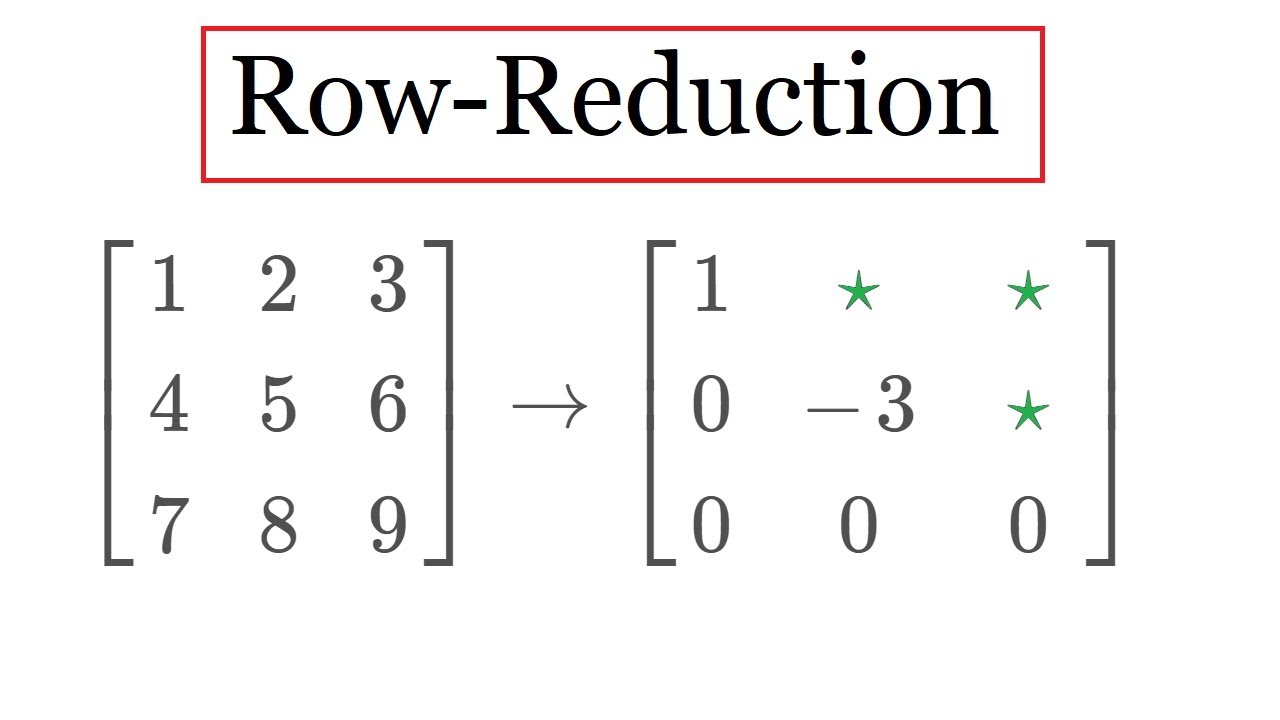
Row reduction is a fundamental technique in linear algebra that allows us to transform a matrix into an equivalent matrix in a simpler form, known as row echelon form. Advanced techniques in matrix row reduction extend these basic concepts to solve more complex problems.
Gaussian Elimination, Matrix calculator row reduction
Gaussian elimination is a systematic method for performing row operations on a matrix to transform it into row echelon form. It involves the following steps:
- Identify the leftmost nonzero entry in the first row.
- Swap rows if necessary to bring the nonzero entry to the top.
- Multiply the row by a constant to make the leading entry equal to 1.
- Use row operations to create zeros in all other entries in the same column.
- Repeat steps 1-4 for each row below the first row.
Row Operations
Row operations are elementary transformations that can be performed on a matrix without changing its solution set. The most common row operations include:
- Swapping rows:Interchanging two rows of the matrix.
- Multiplying a row by a constant:Multiplying all elements in a row by a nonzero constant.
- Adding a multiple of one row to another row:Adding a multiple of one row to another row.
Demonstration of Row Reduction Using a Calculator
Many calculators have built-in functions for performing row reduction. Here is an example of how to use a calculator to reduce the matrix:“`[1 2 3][4 5 6][7 8 9]“`to row echelon form:
- Select the matrix and enter it into the calculator.
- Use the row reduction function (usually labeled “RREF”) to perform Gaussian elimination.
3. The calculator will display the row echelon form of the matrix
“`[1 0 0][0 1 0][0 0 1]“`
Matrix Row Reduction in Practice

Row reduction is a fundamental technique in linear algebra that involves manipulating a matrix to transform it into a simpler form, such as row echelon form or reduced row echelon form. This technique has numerous applications in various fields, including solving systems of linear equations, finding inverses of matrices, and determining the rank and null space of a matrix.
Comparing Different Methods of Row Reduction
There are several methods for performing row reduction, each with its advantages and disadvantages. Here is a table comparing some of the most common methods:| Method | Description | Advantages | Disadvantages ||—|—|—|—|| Gaussian Elimination | A systematic process of performing row operations to transform a matrix into row echelon form.
| Straightforward and easy to apply | Can be inefficient for large matrices || Gauss-Jordan Elimination | An extension of Gaussian elimination that transforms a matrix into reduced row echelon form. | Produces a unique and simplified matrix | More computationally intensive than Gaussian elimination || Elementary Row Operations | A set of basic operations (swapping rows, multiplying a row by a non-zero constant, adding a multiple of one row to another) used to manipulate rows of a matrix.
| Flexible and allows for customized row reduction | Can be more time-consuming than other methods |
Flowchart Illustrating the Steps of Row Reduction
The following flowchart provides a visual representation of the steps involved in performing row reduction using Gaussian elimination:[Image: Flowchart of Gaussian Elimination]
Exercises to Practice Row Reduction Techniques
1. Reduce the following matrix to row echelon form
“`A = [1 2 3] [4 5 6] [7 8 9]“`
2. Find the inverse of the following matrix using row reduction
“`B = [2 1 3] [1 2 1] [3 1 2]“`
3. Determine the rank and null space of the following matrix
“`C = [1 2 3] [4 5 6] [7 8 9]“`
Last Recap: Matrix Calculator Row Reduction
Mastering matrix calculator row reduction opens doors to a vast array of applications. Whether you’re a student grappling with linear algebra or a professional navigating complex data, this guide equips you with the knowledge and skills to simplify matrices with confidence.
