
Understanding mmol is crucial in various fields, including chemistry and medicine. This guide provides a comprehensive overview of how to calculate mmol from mass, volume, and concentration, empowering you with the knowledge to navigate these calculations confidently.
Whether you’re a student, researcher, or professional, this guide will equip you with the essential knowledge and practical steps to master mmol calculations.
Understanding mmol
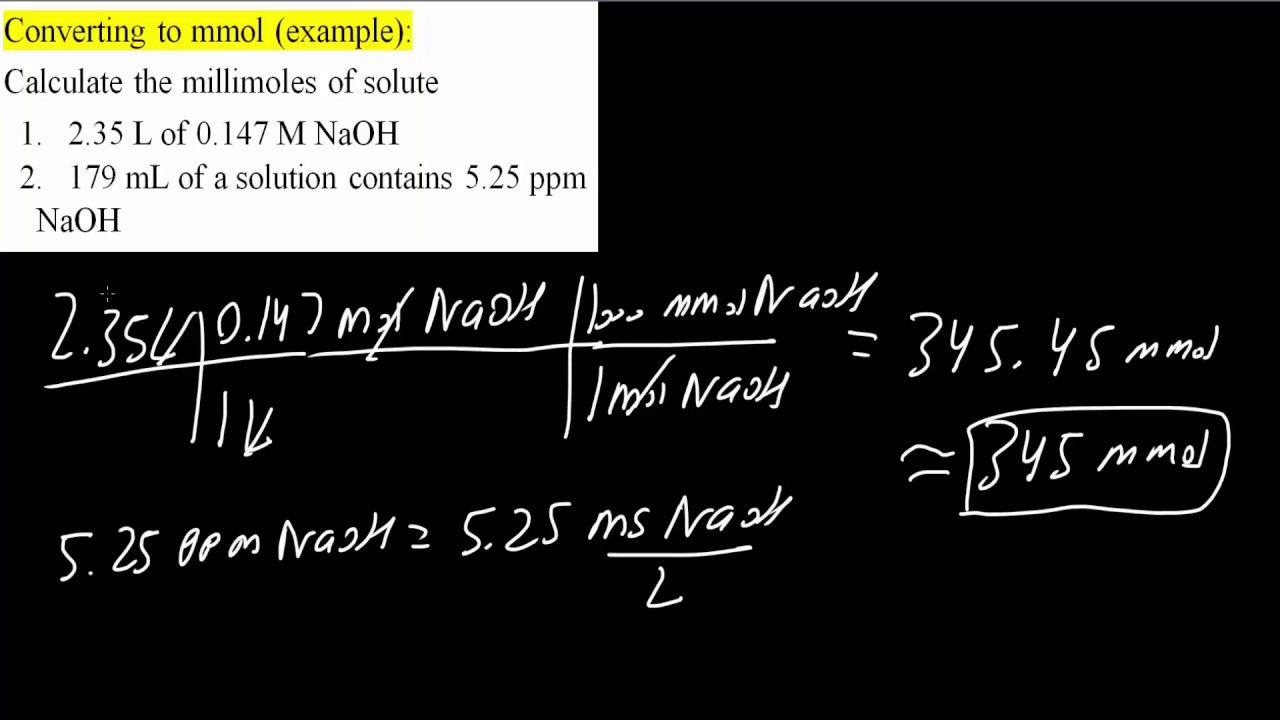
Millimoles (mmol) are a unit of measurement used to quantify the amount of a substance in a solution. It is a metric unit of the International System of Units (SI) and is defined as one thousandth of a mole (mol), which is the SI unit of amount of substance.
The relationship between mmol and moles can be expressed as follows:
mmol = 10-3mol
mmol is a convenient unit for expressing the concentration of a substance in a solution, as it represents the number of millimoles of substance present per liter of solution. For example, a solution with a concentration of 1 mmol/L contains 1 millimole of substance per liter of solution.
Applications of mmol
mmol is used in various fields, including chemistry, biochemistry, and medicine, to express the concentration of substances in solutions.
- In chemistry, mmol is used to express the concentration of reactants and products in chemical reactions.
- In biochemistry, mmol is used to express the concentration of enzymes, substrates, and other biochemical molecules.
- In medicine, mmol is used to express the concentration of drugs and other substances in the body.
Calculating mmol from mass
Calculating mmol from mass involves determining the number of millimoles (mmol) present in a given mass of a substance. This calculation is essential in various fields, including chemistry, biochemistry, and medicine, for understanding the concentration and quantity of substances.
Formula and Steps
The formula for calculating mmol from mass is:
mmol = (mass in grams) / (molar mass in grams/mol)
To perform this calculation, follow these steps:
- Determine the molar mass of the substance using a periodic table or reference materials.
- Convert the given mass of the substance from grams to milligrams (mg) if necessary (1 gram = 1000 milligrams).
- Divide the mass in milligrams by the molar mass in grams/mol.
- The result is the number of millimoles (mmol) present in the given mass.
Practice Problems
Problem 1: Calculate the number of mmol in 500 mg of sodium chloride (NaCl).
Solution:
- Molar mass of NaCl = 58.44 g/mol
- Mass in mg = 500 mg
- mmol = (500 mg) / (58.44 g/mol
1000 mg/g)
- mmol = 8.55 mmol
Problem 2: How many mmol are present in 2.5 g of glucose (C6H12O6)?
Solution:
- Molar mass of glucose = 180.16 g/mol
- Mass in mg = 2.5 g
1000 mg/g = 2500 mg
- mmol = (2500 mg) / (180.16 g/mol
1000 mg/g)
- mmol = 13.88 mmol
Calculating mmol from volume and concentration
In this section, we will explore how to calculate mmol from volume and concentration. Understanding this concept is essential for various applications in chemistry and biology.
Formula for calculating mmol from volume and concentration
The formula for calculating mmol from volume and concentration is:
mmol = volume (in liters) × concentration (in mol/L)
Where:
- mmol is the number of millimoles of the substance
- volume is the volume of the solution in liters
- concentration is the concentration of the solution in moles per liter (mol/L)
Units used in the calculation
The units used in the calculation are:
- mmol: millimoles
- liters (L): volume of the solution
- mol/L: concentration of the solution
Examples of applying the formula
Let’s consider a few examples to illustrate how to apply the formula:
- Example 1:Calculate the number of millimoles in 250 mL of a 0.1 M NaCl solution.
- Example 2:Calculate the concentration of a solution that contains 10 mmol of glucose in 500 mL of water.
Using the formula, we have:
mmol = 0.25 L × 0.1 mol/L = 0.025 mmol
Therefore, there are 0.025 mmol of NaCl in 250 mL of the solution.
Using the formula, we have:
concentration = 10 mmol / 0.5 L = 0.02 mol/L
Therefore, the concentration of the solution is 0.02 mol/L.
Converting between mmol and other units
mmol (millimoles) is a unit of measurement for the amount of substance. It is defined as one thousandth of a mole. The mole is the SI unit for the amount of substance, and it is defined as the amount of substance that contains exactly 6.02214076 × 10^23 elementary entities.
These entities can be atoms, molecules, ions, electrons, or other particles.
mmol is a commonly used unit in chemistry, especially in biochemistry and analytical chemistry. It is often used to express the concentration of a substance in a solution. The concentration of a solution is the amount of substance per unit volume.
mmol/L is the most common unit for expressing concentration.
Converting between mmol and moles
To convert mmol to moles, divide the number of mmol by 1000.
“`mmol ÷ 1000 = moles“`
For example, 10 mmol is equal to 0.01 moles.
Converting between mmol and grams
To convert mmol to grams, multiply the number of mmol by the molar mass of the substance.
“`mmol × molar mass = grams“`
The molar mass of a substance is the mass of one mole of that substance. It is expressed in grams per mole (g/mol).
For example, the molar mass of sodium chloride (NaCl) is 58.44 g/mol. To convert 10 mmol of NaCl to grams, we multiply 10 mmol by 58.44 g/mol, which gives us 584.4 mg.
Converting between mmol and liters
To convert mmol to liters, divide the number of mmol by the concentration of the solution.
“`mmol ÷ concentration = liters“`
The concentration of a solution is the amount of substance per unit volume. It is expressed in mmol/L.
For example, if we have a solution with a concentration of 10 mmol/L, and we want to convert 10 mmol to liters, we divide 10 mmol by 10 mmol/L, which gives us 1 L.
Table of conversion factors, How to calculate mmol
The following table provides a summary of the conversion factors between mmol and other units:
| Unit | Conversion factor |
|---|---|
| mmol to moles | ÷ 1000 |
| mmol to grams | × molar mass |
| mmol to liters | ÷ concentration |
Final Thoughts: How To Calculate Mmol

In summary, calculating mmol is a fundamental skill that involves understanding the concept of millimoles, applying formulas, and converting between different units. By following the steps Artikeld in this guide, you can accurately determine the amount of substance in various scenarios, enhancing your understanding of chemical and biological processes.
