How to calculate Kcat? It’s a crucial question in enzyme kinetics, and this guide will provide a comprehensive exploration of the topic. We’ll delve into the concept of Kcat, its significance, and the methods used to calculate it, both experimentally and computationally.
Whether you’re a seasoned biochemist or just starting to explore enzyme kinetics, this guide will equip you with a thorough understanding of Kcat.
Kcat, the turnover number, is a fundamental parameter in enzyme kinetics that quantifies the catalytic efficiency of an enzyme. It represents the maximum number of substrate molecules an enzyme can convert into product per second. Understanding Kcat is essential for characterizing enzyme activity, optimizing enzyme performance, and designing enzyme-based applications.
Understanding Kcat: How To Calculate Kcat
Kcat, also known as the turnover number, is a crucial parameter in enzyme kinetics that quantifies the catalytic efficiency of an enzyme. It represents the maximum number of substrate molecules an enzyme can convert into product per second under optimal conditions.
Significance of Kcat
Kcat plays a vital role in understanding enzyme function and kinetics. It provides insights into the enzyme’s catalytic power, substrate specificity, and overall efficiency. By comparing Kcat values for different enzymes, scientists can assess their relative catalytic abilities and identify enzymes with superior performance.
Factors Affecting Kcat
Kcat is influenced by several factors, including:
- Temperature:Optimal temperature conditions are crucial for enzyme activity. Deviations from the optimum temperature can lead to decreased Kcat values.
- pH:Enzymes have an optimal pH range within which they exhibit maximum catalytic activity. Extreme pH values can alter the enzyme’s structure and reduce Kcat.
Calculating Kcat Using Experimental Data

Determining Kcat is crucial for understanding enzyme kinetics. Here’s a guide to calculating Kcat using experimental data:
Michaelis-Menten Equation
The Michaelis-Menten equation describes the relationship between reaction rate, substrate concentration, and enzyme concentration:
v = (Vmax
[S]) / (Km + [S])
where:* v is the reaction rate
- Vmax is the maximum reaction rate
- [S] is the substrate concentration
- Km is the Michaelis constant
Calculating Kcat, How to calculate kcat
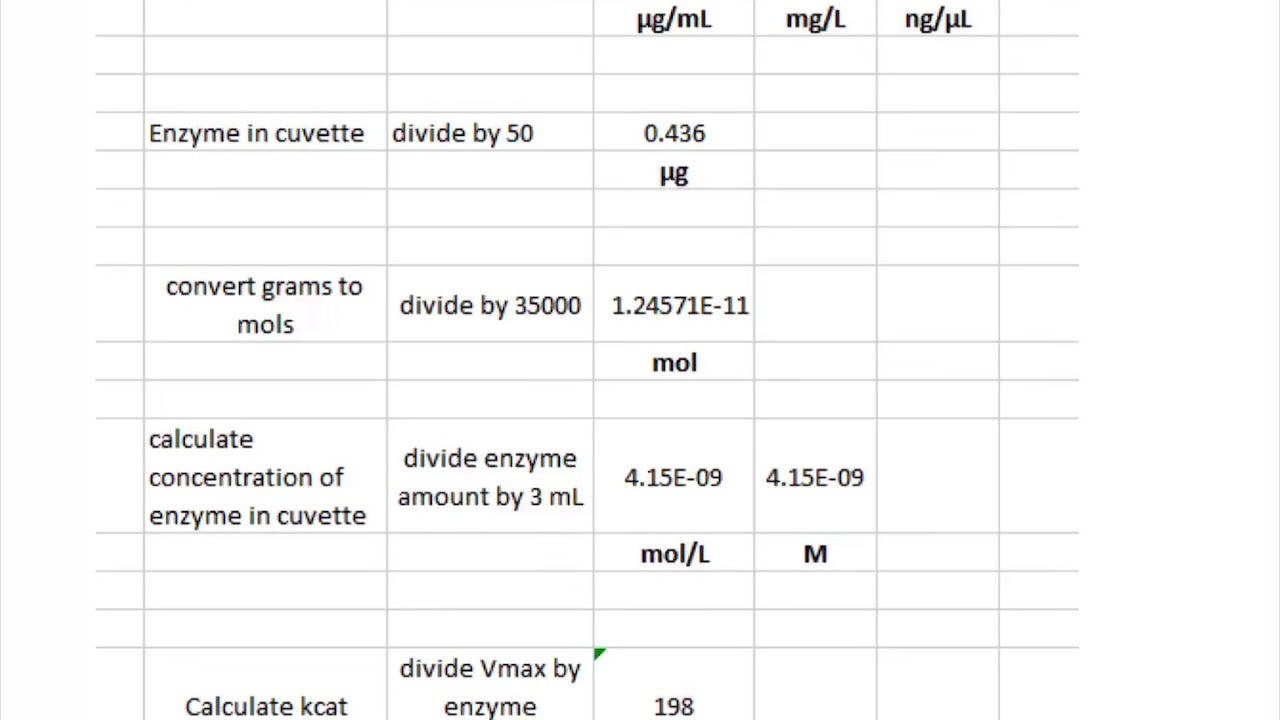
Kcat, the turnover number, is a special case of Vmax and can be calculated using the following steps:
- Plot the reaction rate (v) against the substrate concentration ([S]): This will generate a hyperbolic curve.
- Determine the maximum reaction rate (Vmax): This is the plateau value of the curve, where the reaction rate is independent of substrate concentration.
- Calculate the enzyme concentration ([E]): This is typically provided in the experimental data or can be determined using enzyme assays.
- Use the equation Kcat = Vmax / [E]: This will give you the Kcat value, which represents the number of substrate molecules converted per second by a single enzyme molecule.
By following these steps, you can accurately calculate Kcat from experimental data, providing valuable insights into enzyme kinetics.
Computational Methods for Calculating Kcat
Computational methods offer a valuable approach to calculating Kcat, complementing experimental techniques. These methods provide insights into enzyme behavior at the molecular level, enabling the exploration of factors influencing catalysis.
Molecular Dynamics Simulations
Molecular dynamics (MD) simulations simulate the dynamic behavior of enzymes and substrates over time. By tracking the atomic trajectories, MD simulations provide information on conformational changes, substrate binding, and catalytic events. This data can be used to calculate Kcat by measuring the rate of product formation or substrate conversion.
Quantum Mechanics Calculations
Quantum mechanics (QM) calculations employ sophisticated mathematical models to describe the electronic structure and bonding interactions within enzymes. QM calculations can provide accurate estimates of activation energies and reaction rates, which are essential for determining Kcat. By considering the quantum nature of enzymes and substrates, QM methods offer a detailed understanding of the catalytic mechanism.
Examples of Computational Kcat Calculations
Computational methods have been successfully applied to calculate Kcat for various enzymes. For instance, MD simulations have been used to study the catalytic mechanism of chymotrypsin, providing insights into the role of specific amino acid residues in substrate binding and catalysis.
QM calculations have been employed to calculate Kcat for cytochrome P450 enzymes, revealing the importance of specific electronic interactions in substrate activation.
Applications of Kcat in Enzyme Engineering

Kcat is a valuable metric in enzyme engineering, guiding the optimization of enzyme performance and the development of more efficient enzymes for industrial applications.
Strategies for Increasing Kcat
Enzyme engineering employs various strategies to enhance Kcat, including:
- Site-directed mutagenesis:Altering specific amino acids at the enzyme’s active site to improve substrate binding and catalytic efficiency.
- Directed evolution:Iterative rounds of mutation and selection to create enzyme variants with increased Kcat.
- Protein engineering:Designing new enzymes with tailored catalytic properties, including higher Kcat values.
Examples of Improved Kcat through Enzyme Engineering
Enzyme engineering has successfully increased Kcat for enzymes used in various industrial applications, such as:
- Proteases in detergent formulations:Engineered proteases with higher Kcat enhance stain removal and cleaning performance.
- Lipases in biofuel production:Improved Kcat of lipases facilitates efficient conversion of triglycerides into biodiesel.
- Cellulases in bioethanol production:Engineering cellulases with increased Kcat accelerates the breakdown of cellulose into fermentable sugars.
Outcome Summary

In conclusion, calculating Kcat is a crucial aspect of enzyme kinetics, providing valuable insights into enzyme activity and catalytic efficiency. By understanding the concepts, methods, and applications of Kcat, researchers can harness the power of enzymes in various fields, including biotechnology, medicine, and environmental science.
This guide has provided a comprehensive overview of Kcat, empowering you to explore the fascinating world of enzyme kinetics and its practical implications.