
Growth and decay calculator – Embark on a journey into the realm of growth and decay functions with our comprehensive guide and calculator. From exponential growth in populations to radioactive decay, discover the captivating applications and techniques involved in this fascinating field.
Unveiling the concepts, applications, and problem-solving techniques of growth and decay functions, this guide empowers you to delve deeper into this intriguing subject.
Growth and Decay Functions: Growth And Decay Calculator
Growth and decay functions are mathematical equations that describe the change in a quantity over time. These functions are commonly used to model various phenomena in fields such as population growth, radioactive decay, and financial investments.
Exponential growth and decay functions are two primary types of growth and decay functions. Exponential growth functions represent situations where the quantity increases or decreases at a constant percentage rate over time. Exponential decay functions, on the other hand, represent situations where the quantity decreases at a constant percentage rate over time.
The Growth/Decay Factor
The growth/decay factor, often denoted by “r,” plays a crucial role in growth and decay functions. This factor determines the rate at which the quantity changes over time. A positive growth/decay factor indicates growth, while a negative growth/decay factor indicates decay.
The value of the growth/decay factor determines the shape of the growth or decay curve. A larger growth/decay factor leads to a steeper curve, indicating a more rapid change in the quantity over time.
Applications of Growth and Decay Functions

Growth and decay functions are widely used in various fields to model phenomena involving exponential growth or decay. They find applications in diverse areas, including population growth, radioactive decay, and economic modeling.
Population Growth Modeling
Growth functions play a crucial role in population growth modeling. The exponential growth function is often used to represent the growth of a population over time. The growth rate, which is a constant, determines the rate at which the population increases.
This model is commonly applied in ecology and population biology to predict population trends and estimate future population sizes.
Radioactive Decay Scenarios
Decay functions are essential in modeling radioactive decay scenarios. The exponential decay function describes the decay of radioactive isotopes over time. The decay constant, which is also a constant, represents the rate at which the radioactive substance decays. This model is used in nuclear physics and environmental science to predict the decay rates of radioactive materials and assess their potential hazards.
Solving Growth and Decay Problems
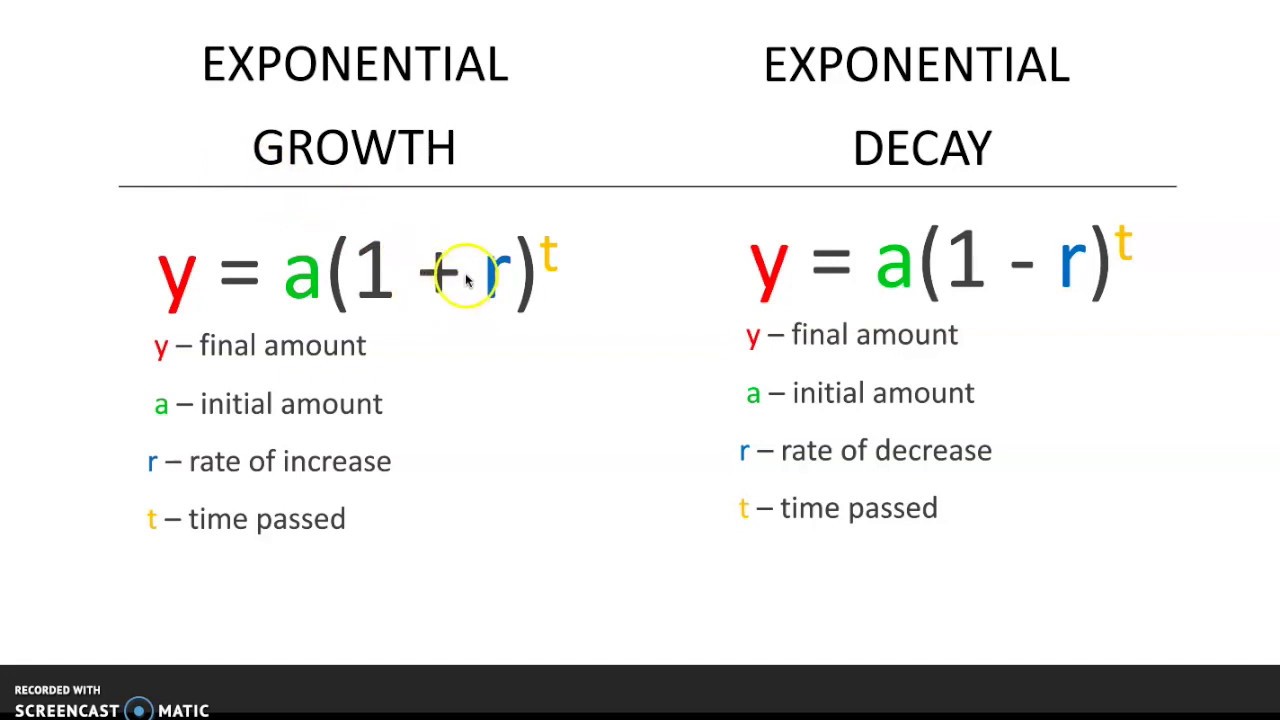
Understanding how to solve growth and decay problems is essential for various applications in science, economics, and other fields. Here’s a step-by-step guide to help you solve these problems effectively:
The key to solving growth and decay problems is to identify the type of growth or decay occurring and apply the appropriate formula. Here’s a table summarizing the formulas and examples for different scenarios:
Types of Growth and Decay
| Type | Formula | Example |
|---|---|---|
| Exponential Growth | y = a
|
A population of bacteria grows exponentially with a rate constant of 0.1 per hour. After 5 hours, the population has grown to 1000. What was the initial population? |
| Linear Growth | y = mx + b | The height of a child grows linearly at a rate of 2 inches per year. After 5 years, the child is 42 inches tall. What was the child’s height at birth? |
| Exponential Decay | y = a
|
The amount of radioactive substance decays exponentially with a half-life of 10 years. After 20 years, the amount of substance remaining is 10%. What was the initial amount? |
| Linear Decay | y = mx + b | The value of a car depreciates linearly by 10% per year. After 5 years, the car is worth $15,000. What was the original value of the car? |
In addition to using formulas, you can also use a calculator to solve growth and decay equations. Most scientific calculators have built-in functions for exponential and logarithmic calculations. Here’s how to use a calculator to solve a growth equation:
- Enter the initial value (a) and the growth rate (k).
- Use the exponential key (e x) to raise the initial value to the power of the growth rate multiplied by time (t).
- The result is the final value (y).
Visualizing Growth and Decay
Visualizing growth and decay functions helps us understand their behavior and characteristics. By plotting these functions on a graph, we can observe their exponential nature and compare their growth rates.
Graphical Representation, Growth and decay calculator
A graph of a growth function typically shows an upward-sloping curve, indicating an increase in the quantity over time. Conversely, a decay function exhibits a downward-sloping curve, representing a decrease in the quantity.
Exponential Nature
The exponential nature of growth and decay functions is evident from their graphs. The rate of change of the function increases exponentially, leading to a rapid increase or decrease in the quantity.
Comparative Growth Rates
A table can be used to compare the growth rates of different functions. By calculating the percentage change over a specific period, we can determine which function grows or decays at a faster rate.
Outcome Summary
In this comprehensive guide, we have illuminated the concepts, applications, and problem-solving techniques of growth and decay functions. By harnessing the power of the accompanying calculator, you are now equipped to tackle real-world scenarios with confidence.
May this guide serve as a valuable resource, empowering you to explore the captivating world of growth and decay.
