Introducing the grams to atoms calculator, your indispensable tool for navigating the intricacies of weight conversions. This comprehensive guide will empower you with the knowledge and resources to seamlessly convert between grams and atoms, unraveling the mysteries of atomic structure and mass.
Delve into the fascinating world of atomic mass and its profound impact on weight conversions. Discover the pivotal role of Avogadro’s number in determining the number of atoms within a given mass, and explore practical applications where grams-to-atoms conversions are indispensable.
Calculate Weight Conversions
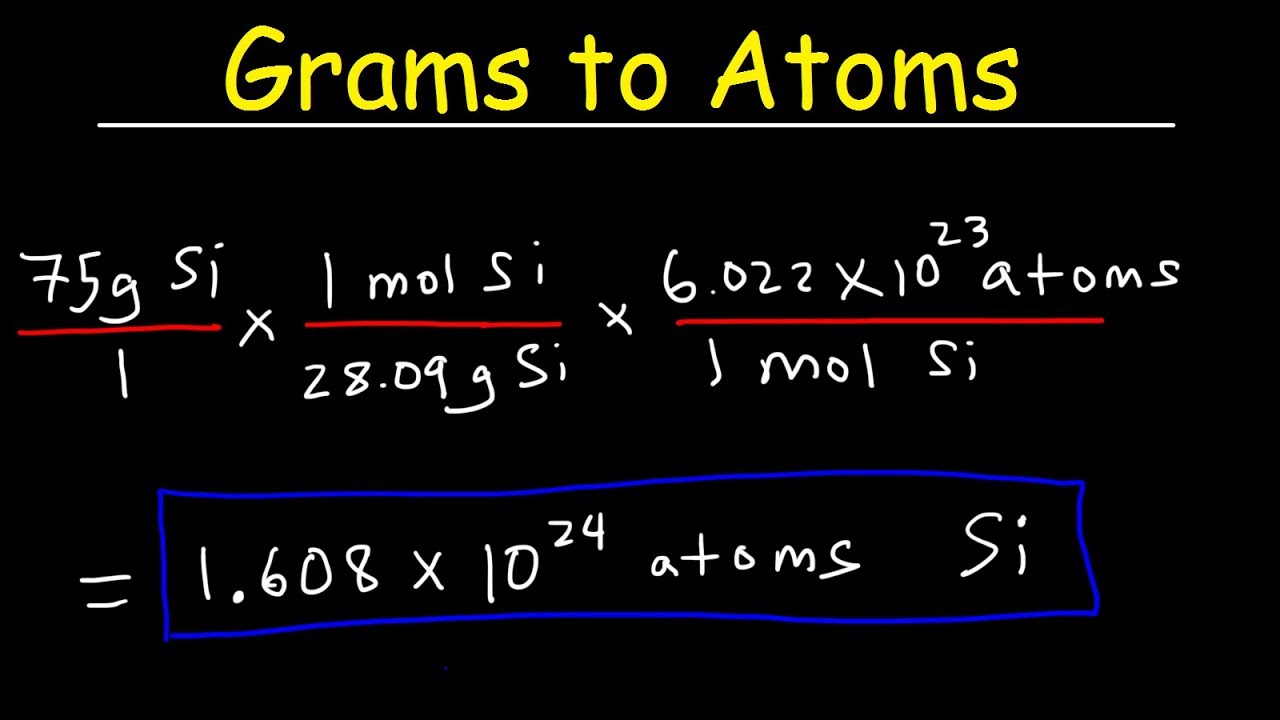
Converting grams to atoms involves understanding the relationship between mass and the number of atoms in a substance. This guide will provide a detailed explanation of the steps involved in performing accurate conversions, including an interactive calculator tool for quick and easy calculations.
Converting Grams to Atoms
To convert grams to atoms, follow these steps:
- Determine the molar mass of the substance:The molar mass is the mass of one mole of the substance, expressed in grams per mole (g/mol). You can find the molar mass in a periodic table or reference book.
- Convert grams to moles:Divide the mass of the substance in grams by its molar mass. This will give you the number of moles of the substance.
- Convert moles to atoms:Multiply the number of moles by Avogadro’s number (6.022 x 10 23atoms/mol). This will give you the number of atoms in the substance.
Formula:
Number of atoms = Mass (g) / Molar mass (g/mol) x Avogadro’s number (6.022 x 10 23atoms/mol)
Example:Convert 10 grams of carbon to atoms.
Step 1:Molar mass of carbon = 12.01 g/mol
Step 2:Number of moles = 10 g / 12.01 g/mol = 0.832 moles
Step 3:Number of atoms = 0.832 moles x 6.022 x 10 23atoms/mol = 5.00 x 10 23atoms
Therefore, 10 grams of carbon contain approximately 5.00 x 10 23atoms.
Interactive Calculator Tool:
For quick and easy conversions, use our interactive calculator tool below:
Input:
Mass (g):
Molar mass (g/mol):
Output:
Number of atoms:
Instructions:Enter the mass in grams and molar mass in g/mol. Click the “Calculate” button to get the number of atoms.
Understand Atomic Structure and Mass: Grams To Atoms Calculator
To delve into the intricacies of weight conversions, grasping the fundamental concepts of atomic structure and mass is paramount. This knowledge will illuminate the significance of atomic mass and its role in determining the weight of substances.
Atomic Mass
Atomic mass, denoted as “mₐ”, represents the mass of an individual atom. It is expressed in atomic mass units (amu), where one amu is defined as 1/12th of the mass of a carbon-12 atom. Atomic mass provides a fundamental understanding of the relative heaviness of different atoms.
Avogadro’s Number
Avogadro’s number, represented by “Nₐ”, is a colossal number: 6.022 × 10 23. It signifies the number of atoms present in 12 grams of carbon-12. This number serves as a bridge between the microscopic world of atoms and the macroscopic world of grams.
Relationship between Atomic Mass and Weight
The relationship between atomic mass and weight is exemplified by the following formula:
Mass (in grams) = Atomic mass (in amu) × Avogadro’s number (6.022 × 10²³)
This formula elucidates that the weight of a substance is directly proportional to its atomic mass. For instance, an atom of oxygen has an atomic mass of 16 amu. Therefore, the mass of 6.022 × 10 23oxygen atoms, or one mole of oxygen, is 16 grams.
Explore Practical Applications

Conversions between grams and atoms play a crucial role in various industries and scientific disciplines, ensuring accurate measurements and calculations.
Scientific Research
- In chemistry, grams-to-atoms conversions are essential for determining the molar mass of compounds, which is used in stoichiometric calculations to predict reaction yields and analyze chemical reactions.
- In physics, atomic masses are used to calculate the atomic number, which is fundamental to understanding the structure and properties of elements.
- In biology, grams-to-atoms conversions help determine the molecular weight of proteins and nucleic acids, crucial for understanding their structure and function.
Medicine, Grams to atoms calculator
- In pharmacy, precise grams-to-atoms conversions are critical for determining the correct dosage of medications, ensuring patient safety and efficacy.
- In medical research, grams-to-atoms conversions are used to analyze the concentration of elements in biological samples, such as blood or tissue, providing insights into disease processes and treatment responses.
Manufacturing
- In the semiconductor industry, grams-to-atoms conversions are used to control the purity and composition of materials, ensuring the production of high-quality electronic devices.
- In the automotive industry, grams-to-atoms conversions are used to determine the weight of alloy components, ensuring the proper functioning and durability of vehicles.
Wrap-Up

Whether you’re a scientist, researcher, or simply curious about the fundamental building blocks of matter, this guide has got you covered. Utilize the interactive calculator, delve into the comprehensive resource section, and expand your knowledge with credible references. Embrace the power of accurate weight conversions and unlock the secrets of the atomic realm.