Geometric distribution calculator, a powerful tool in the realm of probability, empowers you to unravel the mysteries of success and failure. Delve into the fascinating world of geometric distribution, where the probability of success remains constant but the number of trials varies, unveiling valuable insights into real-world applications.
With our user-friendly calculator, you can effortlessly determine the likelihood of events occurring in various scenarios, from quality control to financial modeling. Embrace the power of geometric distribution and uncover the secrets of probability.
Understanding Geometric Distribution: Geometric Distribution Calculator
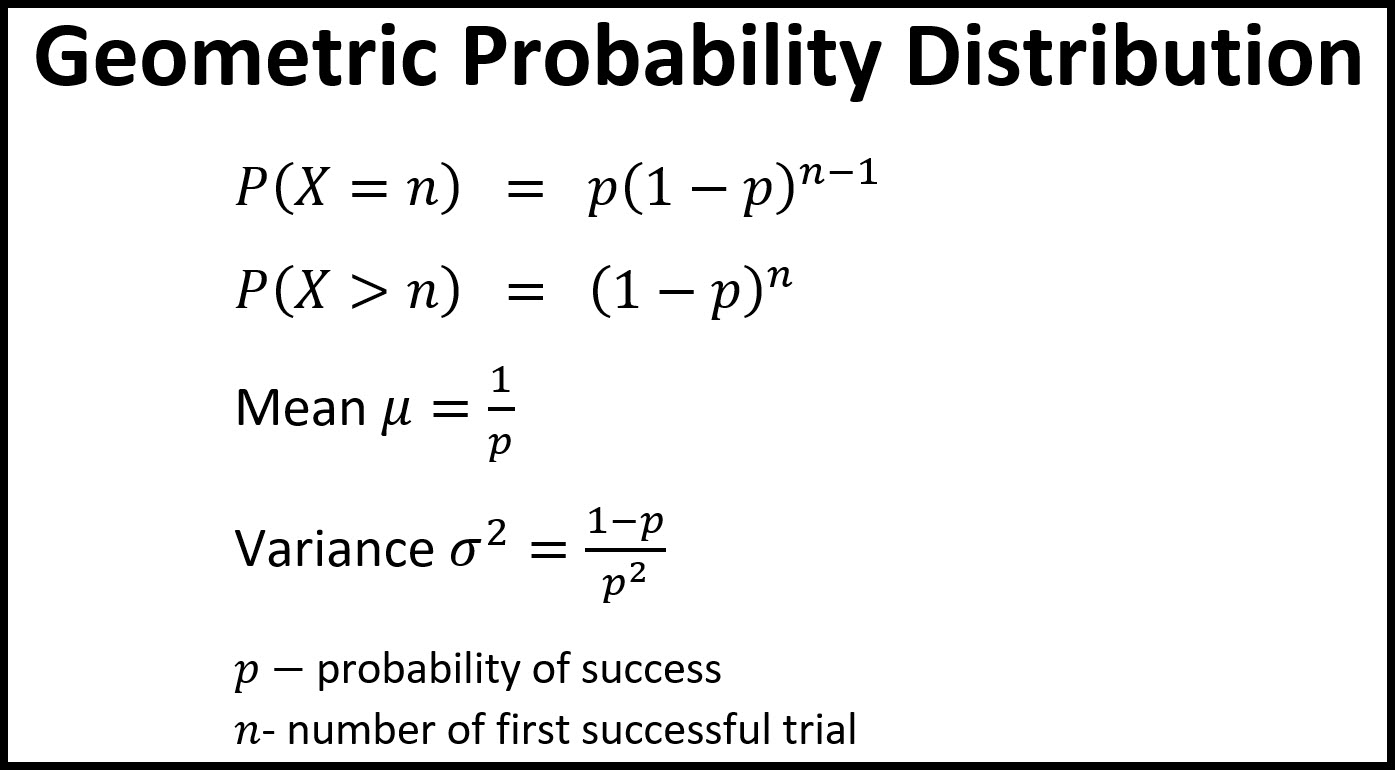
Geometric distribution is a discrete probability distribution that describes the number of trials needed to obtain the first success in a sequence of independent and identically distributed Bernoulli trials.
In simpler terms, it models the probability of observing a certain number of failures before encountering the first success in a series of independent experiments, each with a constant probability of success.
Applications of Geometric Distribution
- Determining the number of coin flips until the first head appears.
- Calculating the number of days until a specific stock price is reached.
- Estimating the time until a customer makes their first purchase on an e-commerce website.
Formula for Geometric Distribution
The probability mass function of the geometric distribution is given by:
P(X = k) = (1
- p)^k
- p
where:
- X is the random variable representing the number of trials until the first success.
- k is the number of failures before the first success.
- p is the probability of success on each trial.
Calculator for Geometric Distribution
A geometric distribution calculator is a tool that allows you to compute probabilities and other metrics related to the geometric distribution. It can be useful in various fields, including quality control, reliability engineering, and finance.
Using the Calculator
- Enter the probability of success (p) in the designated field. This represents the probability of an event occurring on any given trial.
- Enter the number of trials (n) in the designated field. This represents the number of independent trials until the first success.
- Click on the “Calculate” button to obtain the desired results.
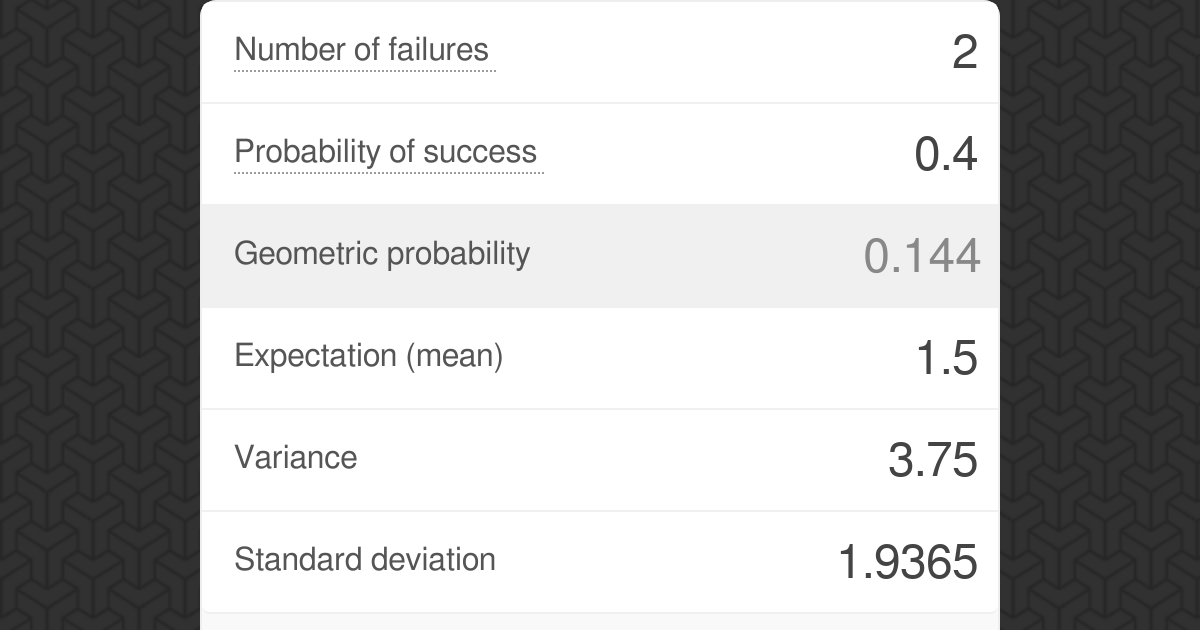
The calculator will provide you with the following outputs:
- Probability of success (p)
- Number of trials (n)
- Probability of x successes
- Mean (expected value)
- Variance
- Standard deviation
These results can be used to analyze the distribution and make informed decisions based on the data.
Applications in Real-Life Scenarios
The geometric distribution finds widespread applications in various fields, including quality control, reliability engineering, and financial modeling. It provides a robust framework for modeling and analyzing phenomena that exhibit a discrete, success-oriented nature.
The key feature of geometric distribution lies in its ability to describe the number of trials required until the first success occurs in a sequence of independent and identically distributed Bernoulli trials. This characteristic makes it particularly useful in scenarios where the focus is on the time or number of attempts needed to achieve a desired outcome.
Quality Control
In quality control, geometric distribution is employed to model the number of defective items encountered in a production process before the first non-defective item is produced. By analyzing the distribution of defects, manufacturers can gain insights into the effectiveness of their quality control measures and identify areas for improvement.
Reliability Engineering
Reliability engineering utilizes geometric distribution to assess the time until a system fails. By considering the probability of failure on each trial and the independence of failures, engineers can estimate the reliability of systems and components, enabling proactive maintenance and optimization of performance.
Financial Modeling
In financial modeling, geometric distribution is used to model the number of periods required for an investment to reach a target return. This distribution helps analysts estimate the risk and potential rewards associated with investments, allowing for informed decision-making.
Advanced Concepts and Extensions
Beyond the fundamental concepts of geometric distribution, there are advanced topics that extend its applications and provide deeper insights.
Negative Binomial Distribution
The negative binomial distribution is a generalization of the geometric distribution that models the number of failures until a specified number of successes. It finds applications in reliability engineering, queuing theory, and other areas where multiple independent trials are involved.
The probability mass function of the negative binomial distribution is given by:
P(X = k) = (n+k-1 choose k)
- p^n
- (1-p)^k
where:* n is the number of successes required
- k is the number of failures
- p is the probability of success on each trial
Poisson Distribution
The Poisson distribution is another important distribution that is related to the geometric distribution. It models the number of events occurring within a fixed interval of time or space. The Poisson distribution finds applications in various fields, including physics, biology, and economics.
The probability mass function of the Poisson distribution is given by:
P(X = k) = (e^-λ
λ^k) / k!
where:* λ is the mean number of events occurring within the interval
Parameter Estimation
Estimating the parameters of a geometric distribution from experimental data is crucial for practical applications. One common method is the method of moments, which involves equating the sample mean and variance to their theoretical counterparts.
Another method is the maximum likelihood estimation, which involves finding the values of parameters that maximize the likelihood function.
Extensions and Applications, Geometric distribution calculator
Geometric distribution has been extended to model various real-life scenarios, including:
- The distribution of the number of accidents in a given time period
- The distribution of the number of defective items in a production process
- The distribution of the number of customers arriving at a service station within a specified time interval
Ultimate Conclusion

Through the exploration of geometric distribution, we have gained a deeper understanding of probability and its practical applications. The calculator provided serves as a valuable tool for unraveling complex scenarios, empowering us to make informed decisions. As we continue to delve into the realm of probability, the geometric distribution will undoubtedly remain a cornerstone of our analytical toolkit.