Step into the realm of gas laws with our captivating Gas Laws Calculator, a tool that empowers you to unravel the intricacies of gas behavior. Embark on a journey where pressure, volume, temperature, and moles dance together, revealing the fundamental principles that govern the gaseous world.
From the Ideal Gas Law to the intricacies of real gas behavior, our calculator serves as your guide, illuminating the complexities of gas mixtures and partial pressures. Witness the practical applications of gas laws unfold in fields like chemistry, physics, and engineering, as you gain a profound understanding of gas systems and their profound impact on our world.
Gas Law Calculations: Gas Laws Calculator
Gas law calculations involve using the Ideal Gas Law equation (PV = nRT) to determine the relationship between pressure (P), volume (V), temperature (T), and moles of gas (n). This equation is crucial for understanding the behavior of gases in various conditions.
Ideal Gas Law Equation
The Ideal Gas Law equation, PV = nRT, is a mathematical expression that describes the behavior of an ideal gas. An ideal gas is a hypothetical gas that obeys the assumptions of the kinetic molecular theory. These assumptions include:
- Gas particles are point masses with no volume.
- Gas particles are in constant random motion and collide with each other and the container walls elastically.
- There are no attractive or repulsive forces between gas particles.
The Ideal Gas Law equation can be used to calculate any of the four variables (P, V, T, or n) if the other three are known. For example, if you know the pressure, volume, and temperature of a gas, you can use the Ideal Gas Law to calculate the number of moles of gas present.
Assumptions and Limitations of the Ideal Gas Law, Gas laws calculator
The Ideal Gas Law is a good approximation for the behavior of many gases under a wide range of conditions. However, it is important to note that the Ideal Gas Law is only an approximation and there are some limitations to its accuracy.
The Ideal Gas Law assumes that gas particles are point masses with no volume. This assumption is not strictly true, as all particles have some volume. However, for most gases, the volume of the particles is negligible compared to the volume of the gas as a whole.
The Ideal Gas Law also assumes that gas particles are in constant random motion and collide with each other and the container walls elastically. This assumption is also not strictly true, as gas particles can interact with each other and the container walls in a variety of ways.
However, for most gases, the elastic collision assumption is a good approximation.
The Ideal Gas Law does not take into account the attractive or repulsive forces between gas particles. These forces can become significant at high pressures or low temperatures. When these forces are significant, the Ideal Gas Law will not be an accurate predictor of the behavior of the gas.
Real Gas Behavior

Real gases deviate from the ideal gas law due to intermolecular forces and the finite size of gas particles. These deviations become significant at high pressures and low temperatures.
The van der Waals equation corrects for non-ideal gas behavior by introducing two correction terms:
- The pressure correction term (a/V2) accounts for the attractive forces between gas molecules, which reduce the pressure exerted on the container walls.
- The volume correction term (b)accounts for the finite size of gas molecules, which reduces the available volume for gas molecules to move.
The van der Waals equation is:
P + (a/V2) = (RT) / (V
b)
where:
- P is the pressure
- V is the volume
- T is the temperature
- R is the ideal gas constant
- a and b are van der Waals constants that depend on the gas
The van der Waals equation can be used to correct for non-ideal gas behavior in various calculations, such as:
- Determining the pressure of a gas at a given volume and temperature
- Calculating the volume of a gas at a given pressure and temperature
- Predicting the behavior of gases at high pressures and low temperatures
Gas Mixtures and Partial Pressures
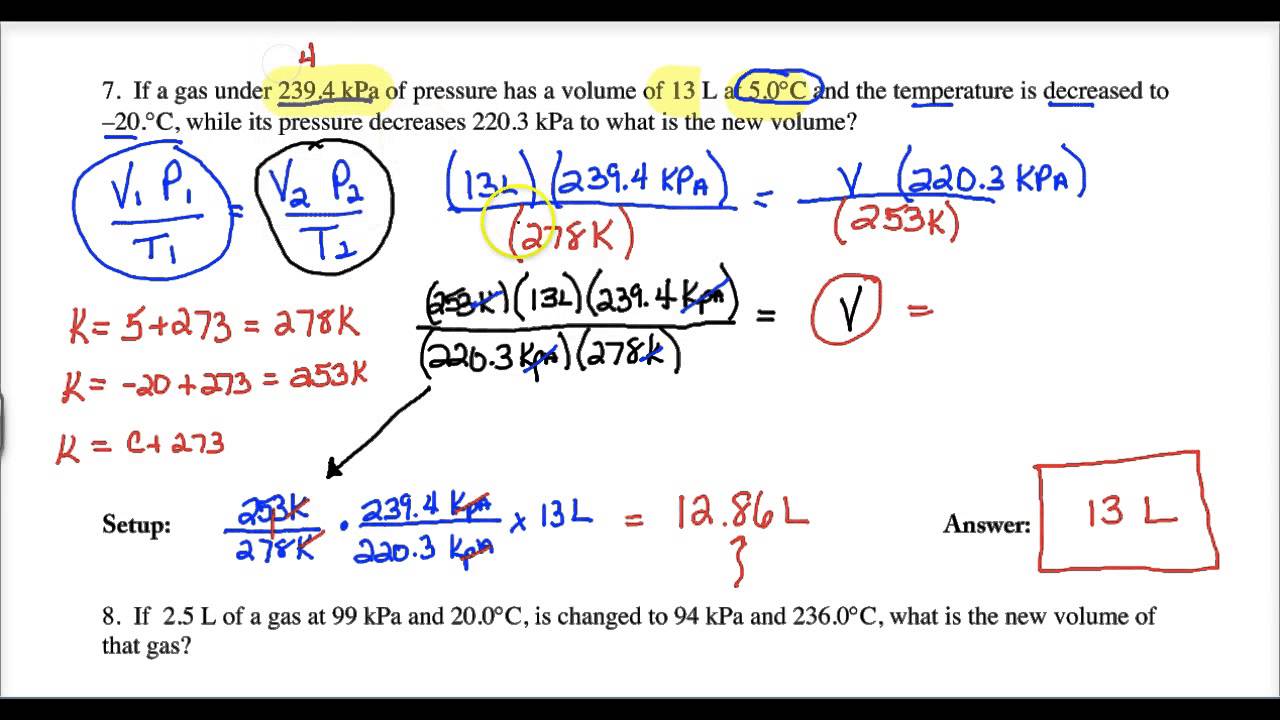
Gas mixtures are composed of two or more gases that occupy the same space. Each gas in a mixture exerts its own pressure, known as its partial pressure. The total pressure of the mixture is the sum of the partial pressures of all the gases present.
Dalton’s Law of Partial Pressures
Dalton’s Law of Partial Pressures states that the total pressure exerted by a mixture of non-reacting gases is equal to the sum of the partial pressures of each individual gas. Mathematically, this can be expressed as:
$$P_\texttotal = P_1 + P_2 + … + P_n$$
where $P_\texttotal$ is the total pressure, and $P_1$, $P_2$, …, $P_n$ are the partial pressures of the individual gases.
Applications of Dalton’s Law
- Determining the partial pressure of a specific gas in a mixture.
- Calculating the total pressure of a gas mixture.
- Predicting the behavior of gas mixtures in various applications, such as scuba diving and weather forecasting.
Example
A gas mixture contains nitrogen, oxygen, and helium with partial pressures of 0.75 atm, 0.20 atm, and 0.05 atm, respectively. What is the total pressure of the mixture?
Using Dalton’s Law, we can calculate the total pressure as:
$$P_\texttotal = P_\textN_2 + P_\textO_2 + P_\textHe$$
$$P_\texttotal = 0.75 \text atm + 0.20 \text atm + 0.05 \text atm = 1.00 \text atm$$
Therefore, the total pressure of the gas mixture is 1.00 atm.
Applications of Gas Laws
Gas laws are fundamental principles that govern the behavior of gases. These laws have wide-ranging applications in various fields, including chemistry, physics, and engineering.
In chemistry, gas laws play a crucial role in understanding the behavior of gases in chemical reactions. They help predict the volume, pressure, temperature, and composition of gases involved in chemical reactions, enabling chemists to design and optimize chemical processes.
Engineering Applications
In engineering, gas laws are essential for designing and operating gas systems, such as gas cylinders, pipelines, and combustion engines. Engineers use gas laws to calculate the volume and pressure of gases in these systems, ensuring safe and efficient operation.
- Gas Cylinders:Gas laws are used to determine the safe operating pressure of gas cylinders, ensuring they can withstand the internal pressure of the gas without rupturing.
- Pipelines:Engineers use gas laws to calculate the flow rate and pressure drop of gases in pipelines, optimizing the design and operation of gas distribution networks.
- Combustion Engines:Gas laws are applied in the design of combustion engines to determine the optimal air-fuel ratio for efficient combustion, minimizing emissions and maximizing engine performance.
Conclusion
As you delve deeper into the world of gases, you’ll discover the profound impact gas laws have on our everyday lives. From designing gas cylinders to predicting gas behavior in chemical reactions, the principles you’ve explored will empower you to navigate the gaseous realm with confidence and precision.
Let our Gas Laws Calculator be your steadfast companion, unlocking the secrets of gas behavior and inspiring you to explore the fascinating world of chemistry and beyond.