
Discover the fascinating world of friction force with our comprehensive friction force calculator. This essential tool empowers you to effortlessly determine the magnitude of friction acting on various surfaces, providing invaluable insights into the mechanics of motion.
From understanding the nuances of static and kinetic friction to exploring the practical applications of friction in everyday life, our guide unveils the intricate interplay between surfaces and the forces that govern their interactions.
Types of Friction Force

Friction force, a resisting force that opposes the relative motion of two surfaces in contact, manifests itself in various forms. Understanding the different types of friction force is crucial in comprehending the dynamics of everyday phenomena.
Static Friction
Static friction, as its name suggests, arises when two surfaces are in contact but not moving relative to each other. It prevents the onset of motion, acting as a force that opposes any potential sliding or rolling. Examples of static friction include the force that keeps a book stationary on a table or the grip that prevents a car from skidding on a dry road.
Kinetic Friction
Kinetic friction, in contrast to static friction, comes into play when two surfaces are in relative motion. It opposes the continued motion, acting as a force that resists sliding or rolling. Examples of kinetic friction include the force that slows down a moving car on a flat road or the resistance encountered when dragging an object across a rough surface.
Rolling Friction
Rolling friction, a specialized form of kinetic friction, occurs when an object rolls over a surface. It is generally less significant than sliding friction due to the smaller contact area between the two surfaces. Examples of rolling friction include the resistance encountered when rolling a ball on a flat surface or the force that slows down a bicycle tire on the road.
Factors Affecting Friction Force
The magnitude of friction force is determined by several factors, including the coefficient of friction, surface roughness, and contact area. Understanding these factors is crucial for comprehending and controlling friction in various applications.
Coefficient of Friction
The coefficient of friction (μ) is a dimensionless quantity that represents the inherent resistance to sliding between two surfaces in contact. It is a material property that depends on the nature of the interacting surfaces. A higher coefficient of friction indicates greater resistance to motion.
Surface Roughness, Friction force calculator
Surface roughness refers to the microscopic irregularities on the surfaces in contact. Rougher surfaces tend to have higher friction forces due to increased interlocking and resistance to movement. Conversely, smoother surfaces exhibit lower friction forces as there are fewer obstacles to sliding.
Contact Area
The contact area between two surfaces also affects friction force. A larger contact area typically results in a higher friction force because there are more points of interaction and resistance to movement. However, the relationship between contact area and friction force is not always linear, and it can vary depending on the specific materials and surface conditions.
| Factor | Effect on Friction Force |
|---|---|
| Coefficient of Friction (μ) | Increases with higher μ |
| Surface Roughness | Increases with rougher surfaces |
| Contact Area | Typically increases with larger contact area |
Applications of Friction Force
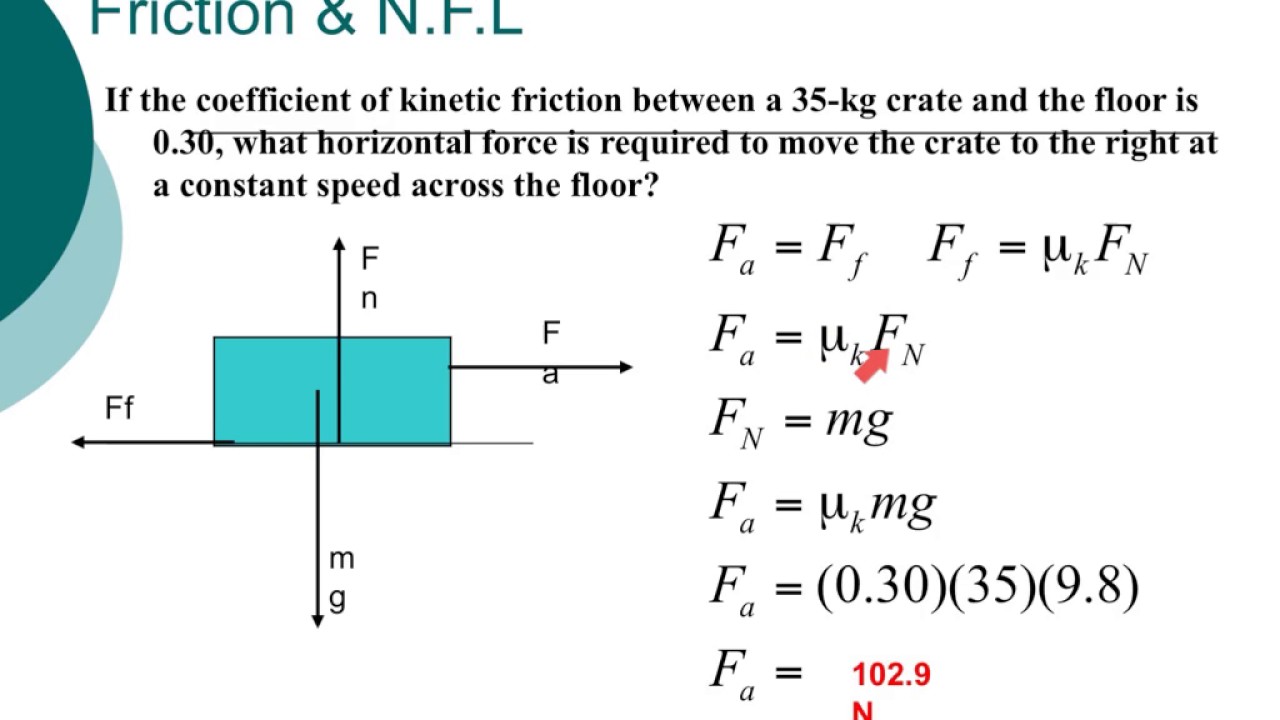
Friction force plays a crucial role in various aspects of our daily lives. It enables us to perform everyday activities and has numerous applications in different industries.
Friction force is essential for braking systems in vehicles. When brakes are applied, friction between the brake pads and the rotors or drums generates the force that slows down or stops the vehicle.
Tires
Tires rely on friction force to provide grip on the road surface. This grip allows vehicles to accelerate, turn, and brake effectively. Without friction, tires would slip and slide, making it difficult to control vehicles.
Sports Equipment
Friction force is utilized in sports equipment to enhance performance and safety. For example, the dimples on golf balls create friction with the air, increasing lift and distance. Cleats on soccer shoes provide friction with the ground, allowing players to change direction and accelerate quickly.
In industries, friction force is harnessed in various applications. For example, friction welding joins metal components by generating heat through friction. Conveyor belts rely on friction to transport materials, and friction clutches transmit power in machinery.
Calculating Friction Force
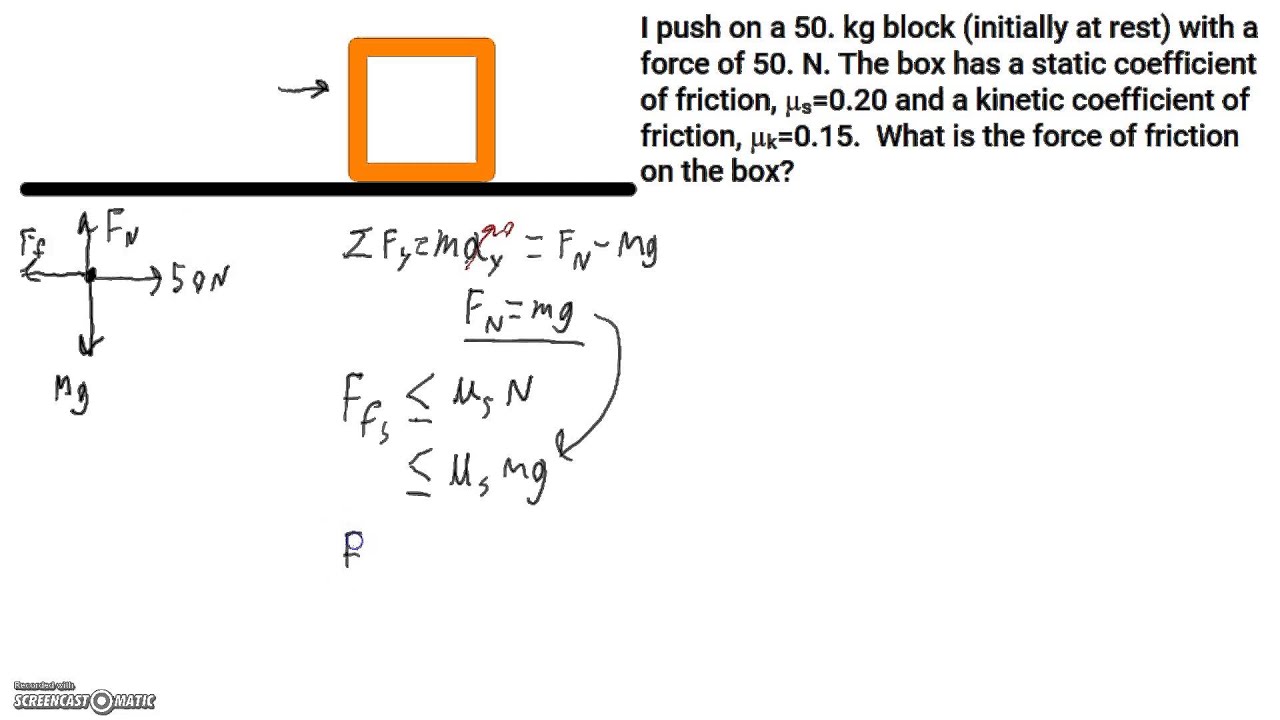
Friction force is calculated using the formula F = μN, where μ is the coefficient of friction and N is the normal force.
Step-by-Step Guide
- Identify the coefficient of friction (μ) for the surfaces in contact. This value can be found in tables or estimated based on the materials involved.
- Determine the normal force (N) acting on the surfaces. This is the force perpendicular to the surfaces in contact.
- Multiply the coefficient of friction (μ) by the normal force (N) to obtain the friction force (F).
Units Used in Friction Force Calculations
*
-*Friction force (F)
Newtons (N)
-
-*Coefficient of friction (μ)
Unitless
-*Normal force (N)
Newtons (N)
Conversions
* 1 N = 0.2248 pounds-force (lbf)1 lbf = 4.448 N
End of Discussion: Friction Force Calculator
Delving into the complexities of friction force, we’ve illuminated its profound impact on our physical world. Whether it’s the grip of tires on the road or the resistance encountered by moving objects, friction shapes our interactions with the environment. Embrace the power of our friction force calculator and unlock a deeper understanding of this fundamental force that governs motion.
