Embark on a journey into the realm of wireless communication with our comprehensive guide to free space path loss calculators. These indispensable tools empower you to accurately predict signal attenuation, paving the way for optimal system design and enhanced network performance.
Delve into the intricacies of free space path loss, unraveling its significance in wireless systems. Understand the formula and parameters that govern path loss calculations, and witness practical applications that demonstrate its real-world impact.
Free Space Path Loss Calculator Overview
Free space path loss (FSPL) is a fundamental concept in wireless communication systems. It refers to the reduction in signal power as it propagates through free space, which is the absence of any obstacles or reflective surfaces. Understanding FSPL is crucial for designing and optimizing wireless communication systems, as it helps determine the signal strength at the receiver and the required transmit power to achieve a desired signal-to-noise ratio (SNR).
FSPL Formula and Parameters
The FSPL formula is given by:
FSPL (dB) = 20 log10(f) + 20 log 10(d) + 32.45
where:
- f is the frequency in MHz
- d is the distance in km
This formula takes into account the frequency of the signal and the distance it travels, which are the primary factors affecting FSPL. Higher frequencies and longer distances result in greater path loss.
FSPL Scenarios and Applications
FSPL calculations are essential in various scenarios, including:
- Coverage planning:Determining the coverage area of a wireless transmitter and identifying areas with poor signal strength.
- Link budget analysis:Calculating the required transmit power to achieve a desired SNR at the receiver.
- Antenna design:Optimizing antenna characteristics, such as gain and beamwidth, to mitigate path loss effects.
- Interference analysis:Predicting the impact of FSPL on interference between multiple transmitters.
Understanding FSPL is crucial for engineers and technicians involved in the design, deployment, and optimization of wireless communication systems. Accurate FSPL calculations ensure reliable and efficient wireless connectivity.
Factors Influencing FSPL Calculations

Free Space Path Loss (FSPL) calculations are influenced by various factors that impact the propagation of radio waves through free space. These factors include frequency, distance, antenna heights, atmospheric conditions, and obstacles.
Frequency
Frequency plays a crucial role in FSPL calculations. Higher frequencies experience greater path loss compared to lower frequencies. This is because higher frequency waves have shorter wavelengths, making them more susceptible to absorption and scattering by atmospheric gases and other obstacles.
Distance and Antenna Heights
The distance between the transmitting and receiving antennas significantly affects FSPL. Path loss increases as the distance increases, as the radio waves have to travel a longer distance and encounter more obstacles. Similarly, higher antenna heights reduce FSPL, as the radio waves have a clearer line of sight and are less obstructed by terrain.
Atmospheric Conditions and Obstacles
Atmospheric conditions such as rain, fog, and snow can increase FSPL by absorbing and scattering radio waves. Obstacles like buildings, trees, and hills can also cause diffraction and reflection, leading to increased path loss.
Using FSPL Calculator Tools: Free Space Path Loss Calculator
Online and software-based FSPL calculators provide convenient and efficient ways to determine path loss values. These tools incorporate various parameters, including frequency, distance, and antenna characteristics, to accurately estimate signal attenuation.
Using FSPL calculators is straightforward. Here’s a step-by-step guide:
Input Parameters
- Frequency:Enter the operating frequency in MHz, GHz, or Hz.
- Distance:Specify the distance between the transmitter and receiver in meters, kilometers, or miles.
- Antenna Heights:Input the heights of both transmitting and receiving antennas in meters.
- Antenna Gains:Enter the gains of the transmitting and receiving antennas in dBi.
- Atmospheric Conditions:Select the appropriate atmospheric conditions, such as clear air or rain.
Selecting a Calculator
Various FSPL calculators are available online and as software applications. Some popular options include:
- Radio Mobile:A comprehensive software tool for predicting path loss and signal coverage.
- Path Loss Calculator:An online tool from RF Cafe that offers quick and simple path loss calculations.
- RFTools:A mobile application that provides path loss calculations along with other RF tools.
The choice of calculator depends on factors such as accuracy requirements, ease of use, and additional features offered.
Applications of FSPL in Wireless System Design
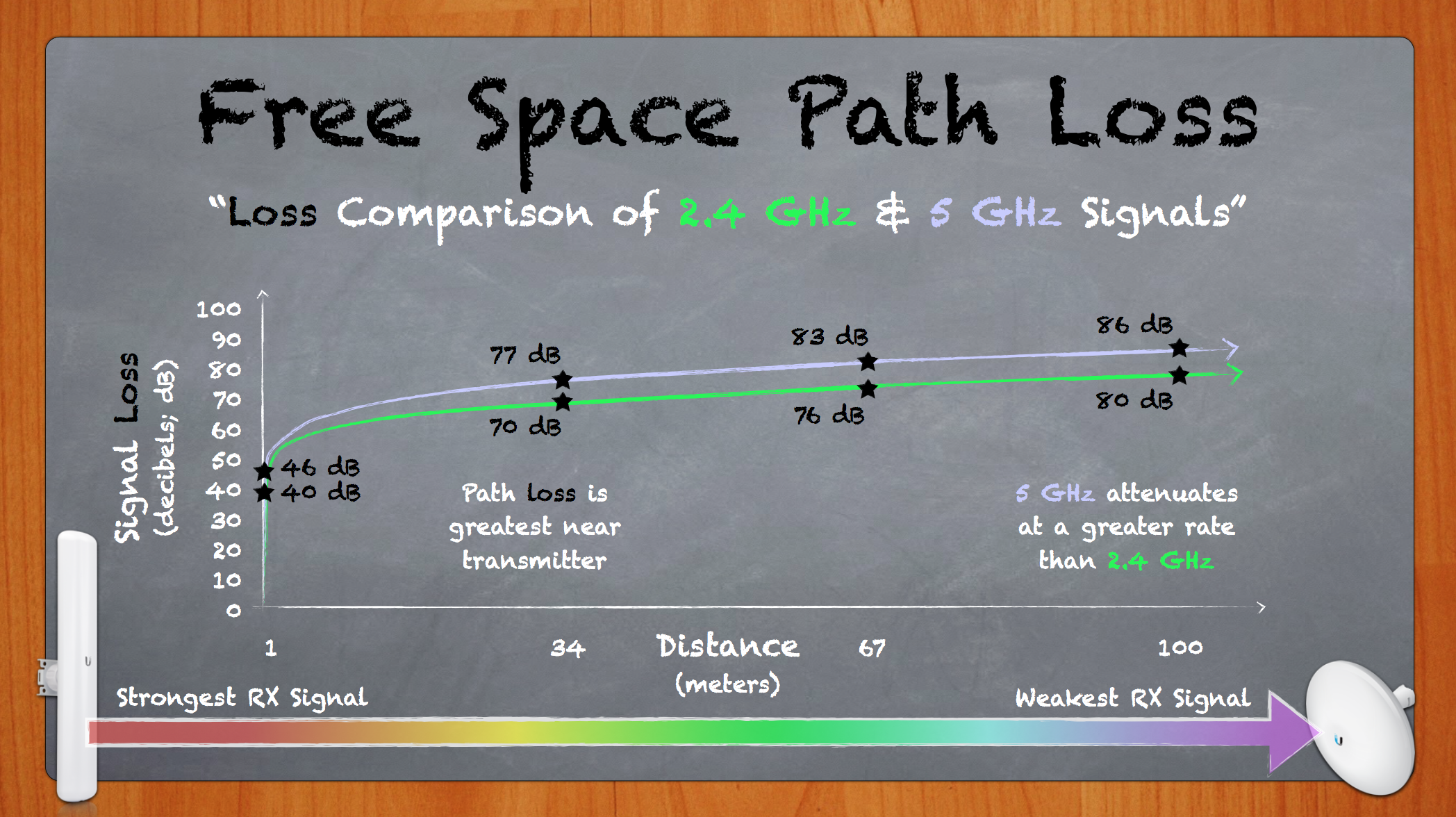
Understanding FSPL is essential for wireless system design as it provides a basis for link budget calculations and system planning. It helps engineers predict the signal strength at a receiver given the transmit power, antenna gains, and distance between the transmitter and receiver.
FSPL calculations are also crucial for optimizing antenna placement and coverage areas. By considering the FSPL, engineers can determine the optimal antenna height, tilt, and azimuth to maximize signal coverage and minimize interference.
Link Budget Calculations and System Planning
- FSPL is a key parameter in link budget calculations, which determine the feasibility of a wireless link.
- By knowing the FSPL, engineers can calculate the received signal power and compare it to the receiver sensitivity to determine if the link is viable.
- FSPL calculations help in system planning, such as determining the number of base stations required for a given coverage area and the optimal transmit power levels.
Antenna Placement and Coverage Optimization
- FSPL calculations guide antenna placement to ensure adequate signal coverage and minimize interference.
- By considering FSPL, engineers can determine the optimal antenna height to maximize coverage and minimize signal loss due to obstacles.
- FSPL calculations help optimize antenna tilt and azimuth to focus the signal in the desired direction, reducing interference and improving coverage.
Examples of FSPL Applications in Wireless Network Design, Free space path loss calculator
- Cellular network planning: FSPL calculations are used to determine the number and placement of cell towers to provide adequate coverage and capacity.
- Wi-Fi network design: FSPL calculations help optimize access point placement to ensure reliable and consistent Wi-Fi coverage in homes, offices, and public areas.
- Satellite communication: FSPL calculations are essential for determining the transmit power and antenna gain required to establish a reliable link between satellites and ground stations.
Closing Notes
As we conclude our exploration of free space path loss calculators, let us emphasize their crucial role in wireless system design. By leveraging these tools, engineers can optimize antenna placement, maximize coverage areas, and ensure efficient network operation. Embrace the power of free space path loss calculators and elevate your wireless communication systems to new heights.