
The Exterior Angle Theorem Calculator is a versatile tool that simplifies the task of determining exterior angles in triangles. By providing an intuitive interface and precise calculations, this calculator empowers users to delve into the intricacies of geometry with confidence.
The theorem states that the exterior angle of a triangle is equal to the sum of the opposite interior angles. This fundamental principle serves as the cornerstone of the calculator, enabling users to swiftly compute exterior angles with remarkable accuracy.
Exterior Angle Theorem
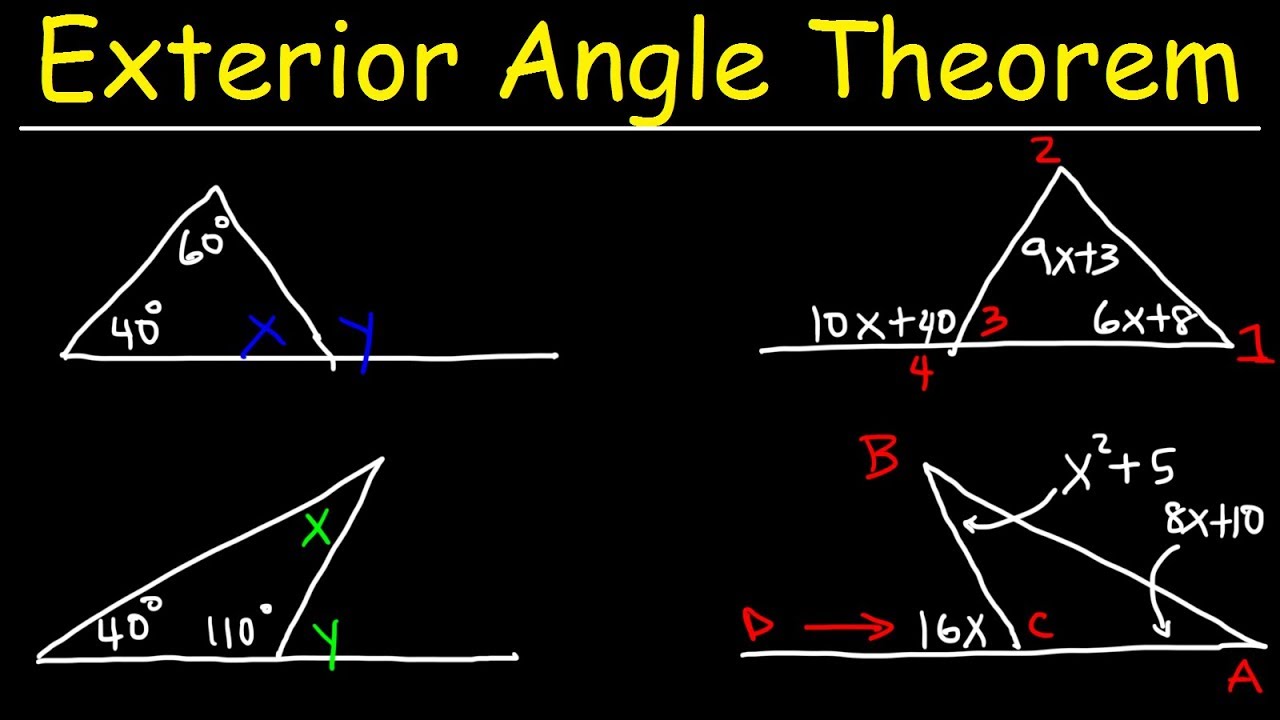
The Exterior Angle Theorem states that the exterior angle of a triangle is equal to the sum of the opposite, non-adjacent interior angles.
In other words, if you extend one side of a triangle, the angle formed outside the triangle is equal to the sum of the two interior angles on the opposite side of the triangle.
Exterior Angles in a Triangle
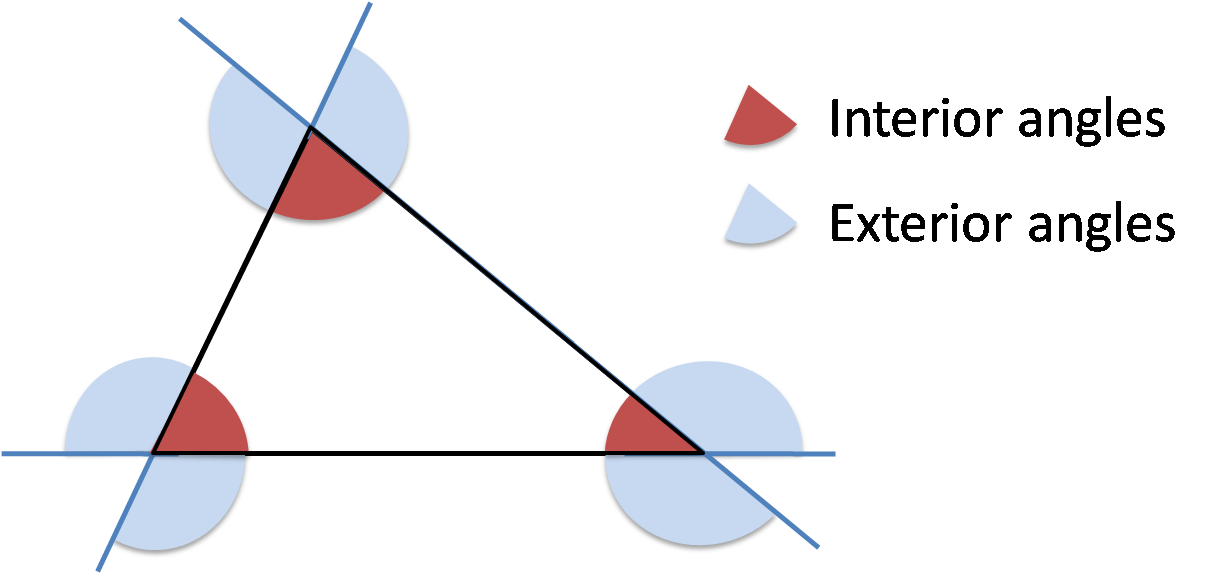
Exterior angles are angles formed when one side of a triangle is extended. There are two exterior angles for each side of a triangle, and they are always supplementary (add up to 180 degrees).
Relationship between Exterior Angles and Interior Opposite Angles
The Exterior Angle Theorem tells us that the exterior angle of a triangle is equal to the sum of the opposite, non-adjacent interior angles. This means that the exterior angle is always greater than either of the opposite interior angles.
Exterior angle = Interior angle 1 + Interior angle 2
Exterior Angle Theorem Calculator

An Exterior Angle Theorem calculator is a tool that helps you determine the measure of an exterior angle of a triangle. The exterior angle of a triangle is the angle formed by one side of the triangle and the extension of the adjacent side.
Input and Output Parameters
To use the calculator, you need to input the measures of the two interior angles that are adjacent to the exterior angle you want to find. The calculator will then output the measure of the exterior angle.
- Input: The measures of the two interior angles that are adjacent to the exterior angle you want to find.
- Output: The measure of the exterior angle.
Applications of the Exterior Angle Theorem
The Exterior Angle Theorem is a fundamental concept in geometry, providing a valuable tool for solving problems related to angles in triangles and polygons. Its applications extend to various geometric shapes, making it an indispensable theorem in the study of geometry.
Applications in Triangles
- Finding Missing Angles:If two angles of a triangle are known, the Exterior Angle Theorem can be used to find the third angle. This is particularly useful when solving problems involving triangles with unknown angles.
- Determining Angle Sum:The Exterior Angle Theorem can be applied to establish that the sum of the interior angles of a triangle is always 180 degrees. This fundamental property of triangles is crucial for understanding angle relationships in various geometric figures.
Applications in Polygons
- Calculating Exterior Angles:The Exterior Angle Theorem allows for the calculation of exterior angles in regular polygons. By dividing the polygon into triangles, the exterior angle at each vertex can be determined, providing insights into the properties of regular polygons.
- Determining Angle Measures:In irregular polygons, the Exterior Angle Theorem can be used to find the measure of any interior angle. By extending one side of the polygon and applying the theorem, the interior angle can be calculated, facilitating the analysis of irregular polygons.
Applications in Determining Angles
- Identifying Parallel Lines:The Exterior Angle Theorem can be used to identify parallel lines. If the exterior angle formed by two lines is equal to 180 degrees, then the lines are parallel, providing a convenient method for determining parallelism.
- Verifying Angle Properties:The theorem aids in verifying various angle properties, such as the relationship between alternate interior angles and corresponding angles. By applying the theorem, these angle relationships can be established, strengthening the understanding of angle properties.
Extensions and Variations: Exterior Angle Theorem Calculator
The Exterior Angle Theorem is not limited to triangles. It can be extended to other geometric figures and has various applications in mathematical proofs and constructions.
Converse of the Exterior Angle Theorem
The converse of the Exterior Angle Theorem states that if an angle outside a triangle is equal to the sum of the opposite non-adjacent interior angles, then the angle is an exterior angle of the triangle. This converse is useful in proving other theorems and solving geometric problems.
Extension to Other Geometric Figures
The Exterior Angle Theorem can be extended to any polygon with n sides. The exterior angle at any vertex is equal to the sum of the (n-2) interior angles that do not share a side with the exterior angle. This extension is used in proving properties of polygons and solving geometric problems involving non-triangular shapes.
Advanced Applications, Exterior angle theorem calculator
The Exterior Angle Theorem is used in various advanced mathematical proofs and constructions. For example, it is used in proving the Pythagorean Theorem, constructing regular polygons, and solving geometric problems involving circles and other curves. The theorem provides a fundamental understanding of angle relationships in geometric figures, which is essential for solving complex geometric problems and exploring advanced mathematical concepts.
Concluding Remarks

In conclusion, the Exterior Angle Theorem Calculator stands as an invaluable resource for students, educators, and professionals alike. Its user-friendly design and accurate calculations make it an indispensable tool for exploring the fascinating world of geometry.
