
Step into the realm of electromagnetism with our electric force calculator, an indispensable tool that unlocks the mysteries of electric force and empowers you to delve into the fascinating world of electrical interactions. This comprehensive guide will illuminate the fundamental principles, practical applications, and intricacies of electric force calculations, equipping you with the knowledge to navigate this captivating field with confidence.
Prepare to embark on an electrifying journey as we explore Coulomb’s Law, electric fields, and the myriad applications of electric force calculators. Discover how these tools empower engineers, scientists, and hobbyists alike to design, troubleshoot, and optimize electrical systems with precision and efficiency.
Coulomb’s Law and Electric Force Calculations
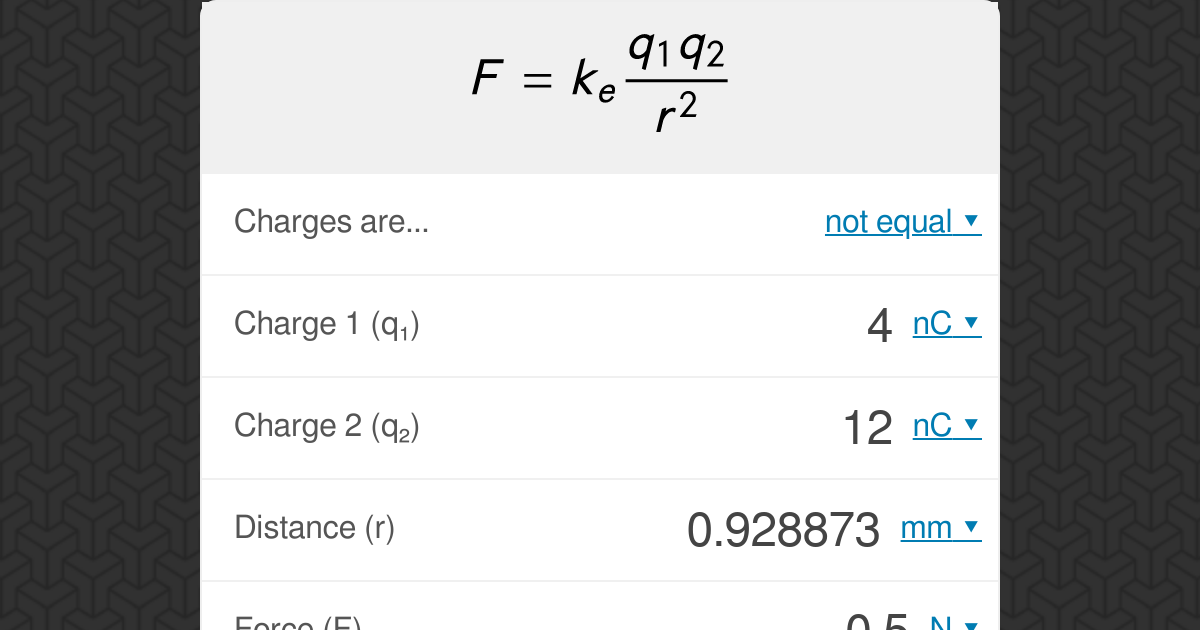
Coulomb’s Law is a fundamental law of electromagnetism that describes the electrostatic force between two charged particles. It states that the force between two point charges is directly proportional to the product of the charges and inversely proportional to the square of the distance between them.
The mathematical formula for Coulomb’s Law is:
$$F = k \fracq_1 q_2d^2$$
where:
- F is the electrostatic force in newtons (N)
- k is Coulomb’s constant, which is approximately 8.98755 × 10 9N⋅m 2/C 2
- q 1and q 2are the charges of the two particles in coulombs (C)
- d is the distance between the two particles in meters (m)
Coulomb’s Law can be used to calculate the electric force between any two charged particles, regardless of their sign or magnitude. For example, the electric force between two protons is positive, indicating that the protons repel each other. The electric force between a proton and an electron is negative, indicating that the proton and electron attract each other.
The relationship between charge, distance, and electric force is important to understand when designing electrical circuits and devices. By controlling the charge and distance between charged particles, it is possible to create a desired electric force.
Electric Field and Electric Force

The electric field is a region of space around a charged object where other charged objects experience an electric force. It is a vector quantity that has both magnitude and direction. The magnitude of the electric field is proportional to the charge of the object creating the field and inversely proportional to the square of the distance from the object.
The electric force is the force that acts on a charged object due to the presence of an electric field. The electric force is directly proportional to the charge of the object and the strength of the electric field.
Calculating Electric Field
The electric field due to a point charge can be calculated using the following formula:
E = k
q / r^2
where:
- E is the electric field strength in newtons per coulomb (N/C)
- k is Coulomb’s constant, which is approximately 8.98755 x 10^9 N m^2/C^2
- q is the charge of the point charge in coulombs (C)
- r is the distance from the point charge to the point where the electric field is being calculated in meters (m)
Superposition Principle
The superposition principle states that the electric field due to a system of charges is the vector sum of the electric fields due to each individual charge.
Applications of Electric Force Calculator
Electric force calculators find widespread applications in various fields, particularly in electrical engineering, physics, and research. These tools simplify complex calculations and provide accurate results, aiding in the design, analysis, and troubleshooting of electrical systems.
One of the primary applications of electric force calculators is in the design of electrical circuits and components. By inputting specific parameters, such as charge, distance, and permittivity, engineers can determine the electric force acting between charged objects. This information is crucial for optimizing circuit performance, ensuring component compatibility, and preventing potential hazards.
Circuit Design and Analysis
- Calculate electric forces between components to determine circuit behavior.
- Design circuits with desired electric field strengths and charge distributions.
- Analyze the effects of electric forces on circuit performance and component placement.
Troubleshooting Electrical Systems
- Identify and locate faults in electrical systems by analyzing electric forces.
- Determine the cause of electrical failures due to excessive electric forces.
- Recommend corrective actions to mitigate electric force-related issues.
Limitations and Considerations
Electric force calculators provide a convenient tool for estimating electric forces, but it’s important to understand their limitations and considerations for accurate and reliable use.
One limitation is that these calculators typically assume point charges, which is an idealization that doesn’t always reflect the real-world scenario. In reality, charges are distributed over a finite volume, which can affect the electric force calculation.
Environmental Factors
Environmental factors can also influence the accuracy of electric force calculations. For instance, humidity and temperature can affect the dielectric constant of the medium, which in turn affects the electric force. It’s important to consider these factors when using calculators to ensure reliable results.
Guidelines for Accurate Use, Electric force calculator
To ensure accurate and reliable use of electric force calculators, consider the following guidelines:
- Verify the assumptions made by the calculator, such as point charges and the medium’s properties.
- Be aware of the limitations of the calculator and interpret the results accordingly.
- Consider environmental factors that may affect the electric force calculation.
- Use the calculator as a tool to estimate electric forces, but always verify the results with experimental measurements or other methods when possible.
Final Conclusion: Electric Force Calculator
Our exploration of electric force calculators concludes with a deeper appreciation for the intricate interplay of electric charges and their impact on our world. These versatile tools have revolutionized the way we understand and harness electricity, enabling advancements in fields as diverse as electronics, energy production, and medical technology.
As we continue to push the boundaries of electrical engineering, electric force calculators will undoubtedly remain an indispensable companion, empowering us to unlock even greater possibilities in the realm of electromagnetism.
