
Welcome to the world of direct variation, where the Direct Variation Calculator reigns supreme. This interactive tool empowers you to effortlessly solve complex equations and unravel the mysteries of proportional relationships.
Delve into the intricacies of direct variation, its equation, and the interplay between variables. Witness the practical applications of this concept in diverse fields, and unlock the secrets of making predictions and solving problems with precision.
Direct Variation Equation: Direct Variation Calculator

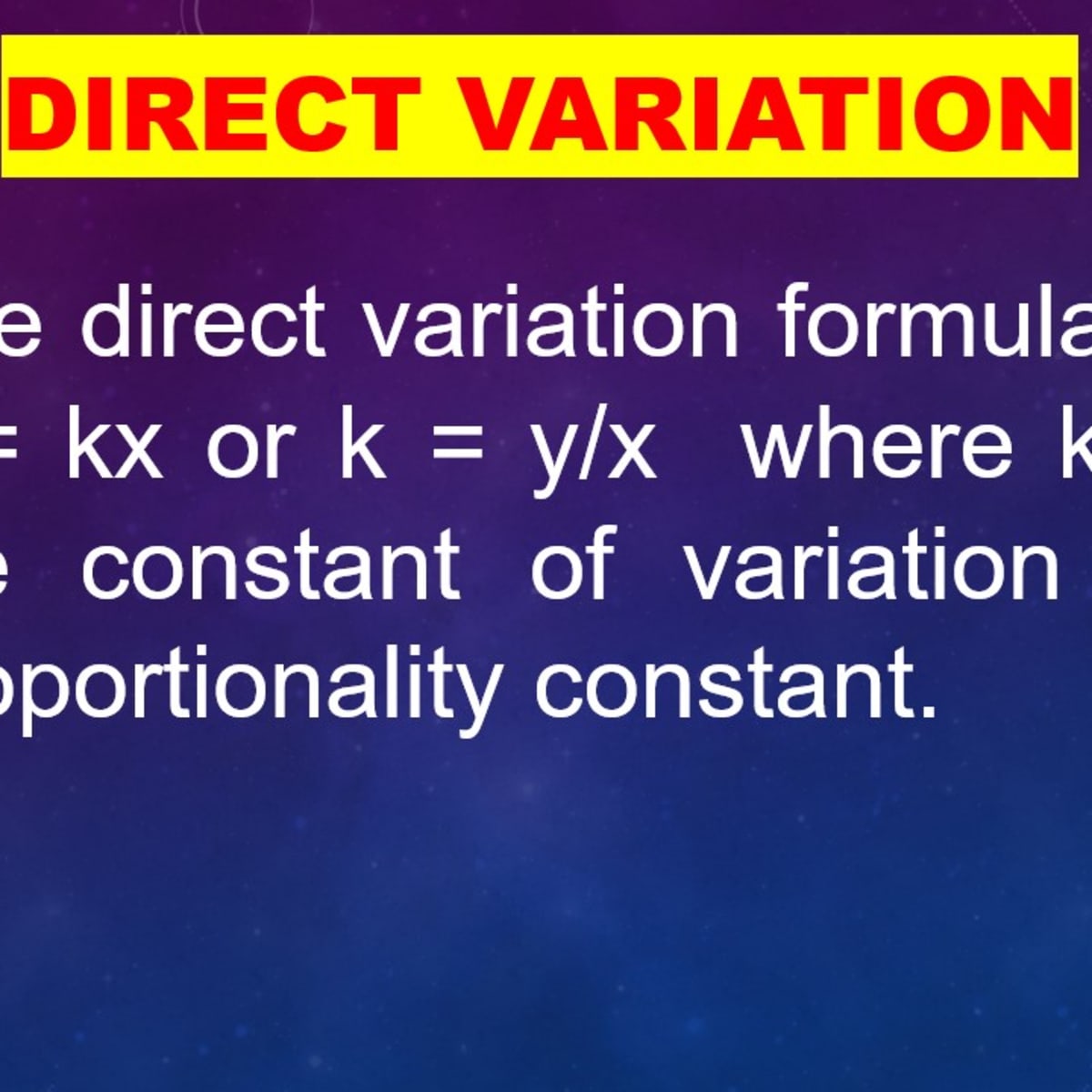
In mathematics, direct variation is a relationship between two variables where one variable is a constant multiple of the other. This means that as one variable increases, the other variable increases proportionally.
The mathematical equation for direct variation is:
y = kx
where:
- y is the dependent variable
- x is the independent variable
- k is the constant of variation
The constant of variation, k, determines the rate at which y changes in relation to x. If k is positive, then y will increase as x increases. If k is negative, then y will decrease as x increases.
Relationship Between the Variables
The relationship between the variables in the direct variation equation is linear. This means that the graph of y versus x will be a straight line. The slope of the line will be equal to the constant of variation, k.
Direct variation is a common relationship in many real-world situations. For example, the distance an object travels is directly proportional to the time it travels. The amount of money earned is directly proportional to the number of hours worked. These are just a few examples of the many applications of direct variation.
Solving for Variables
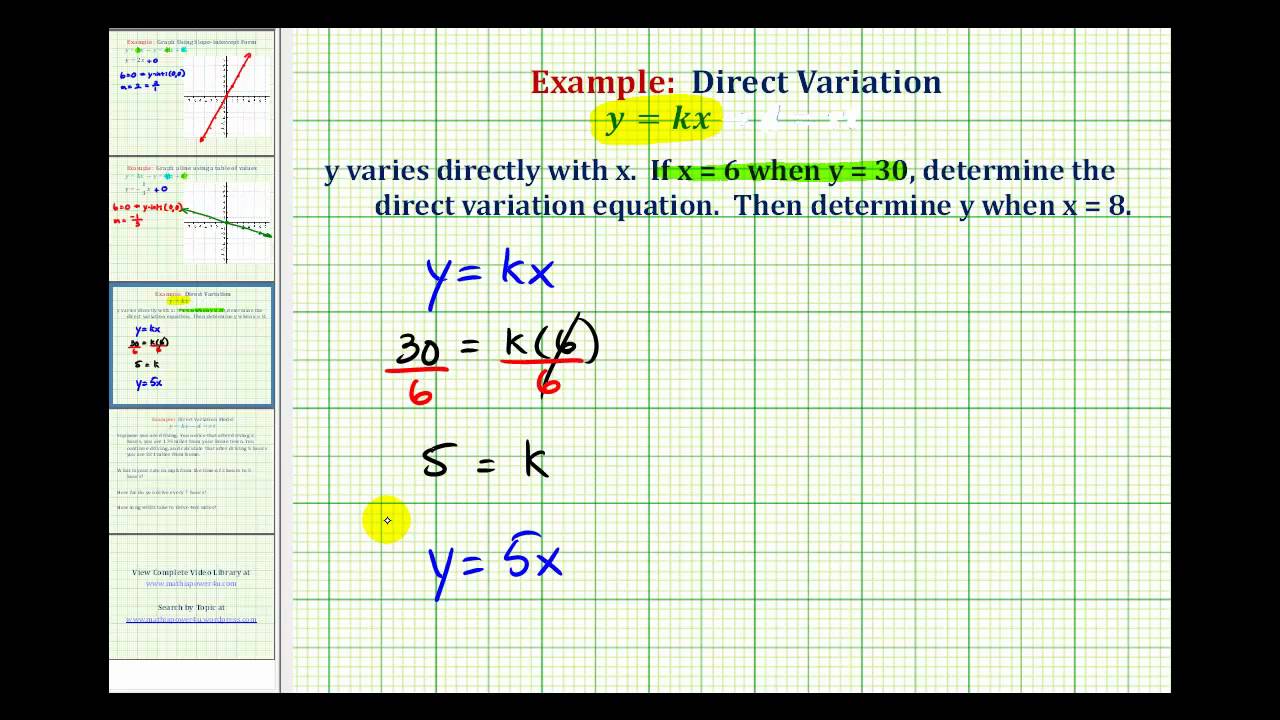
Solving for variables in a direct variation equation involves finding the value of the constant of variation (k) or the unknown variable (x or y) when the other variable and the constant are known.
Solving for the Constant of Variation (k)
To solve for the constant of variation (k), we can substitute the given values of x and y into the direct variation equation:“`y = kx“`Then, solve for k by dividing both sides of the equation by x:“`k = y/x“`For example, if we know that y = 12 and x = 4, then the constant of variation is:“`k = y/x = 12/4 = 3“`
Solving for the Unknown Variable (x or y), Direct variation calculator
To solve for the unknown variable (x or y), we can substitute the given values of the constant of variation (k) and one of the variables into the direct variation equation.For example, if we know that k = 3 and y = 12, then we can solve for x:“`y = kx
= 3x
x = 12/3 = 4“`Similarly, if we know that k = 3 and x = 4, then we can solve for y:“`y = kxy = 3
4 = 12
“`
Applications of Direct Variation
Direct variation is a fundamental mathematical concept with extensive applications in various fields, including physics, engineering, economics, and everyday life. It provides a powerful tool for understanding and predicting relationships between variables that are directly proportional to each other.
Real-World Examples
Direct variation finds practical applications in numerous real-world scenarios:
- Physics:The force of gravity is directly proportional to the mass of an object. Doubling the mass doubles the force of gravity.
- Engineering:The stress on a beam is directly proportional to the load it carries. Increasing the load by a certain factor increases the stress by the same factor.
- Economics:The price of a product is often directly proportional to its quantity. If the quantity of a product doubles, its price typically doubles as well.
- Everyday Life:The distance traveled by a car is directly proportional to its speed. Doubling the speed doubles the distance traveled.
Predictions and Problem Solving
Direct variation plays a crucial role in making predictions and solving problems. By understanding the direct relationship between variables, we can estimate unknown values or predict future outcomes:
- Estimating Distance:If we know the speed of a car and the time it takes to travel a certain distance, we can use direct variation to estimate the distance traveled.
- Predicting Force:Given the mass of an object and the gravitational acceleration, we can use direct variation to predict the force of gravity acting on it.
li> Determining Cost:If we know the price per unit of a product and the quantity we need, we can use direct variation to determine the total cost.
Interactive Direct Variation Calculator
Interactive Calculator
The interactive calculator below allows you to calculate the unknown variable in a direct variation equation.
Enter the values for two variables and the constant of variation in the fields provided. The calculator will automatically calculate the unknown variable and display the result.
| Variable 1 | |
|---|---|
| Variable 2 | |
| Constant of Variation | |
| Result | |
Closing Notes
As you embark on this mathematical journey, remember that the Direct Variation Calculator is your steadfast companion. Embrace its simplicity and let it guide you towards a deeper understanding of proportional relationships. May your calculations be swift, your solutions accurate, and your knowledge boundless.
