Prepare to delve into the fascinating world of mathematics with our comprehensive guide to De Moivre’s theorem calculator. This powerful tool simplifies the intricacies of De Moivre’s theorem, enabling you to effortlessly explore its applications in various fields, from electrical engineering to computer science.
Unravel the mathematical foundations of De Moivre’s theorem, gaining insights into complex numbers and their intricate operations. Witness the geometric elegance of the theorem as it unveils the secrets of complex number multiplication.
De Moivre’s Theorem: De Moivre’s Theorem Calculator
De Moivre’s theorem is a fundamental theorem in complex analysis that provides a powerful tool for working with complex numbers. It establishes a connection between the exponential form of a complex number and its powers, enabling us to simplify complex number operations and gain insights into their geometric properties.
Mathematical Explanation
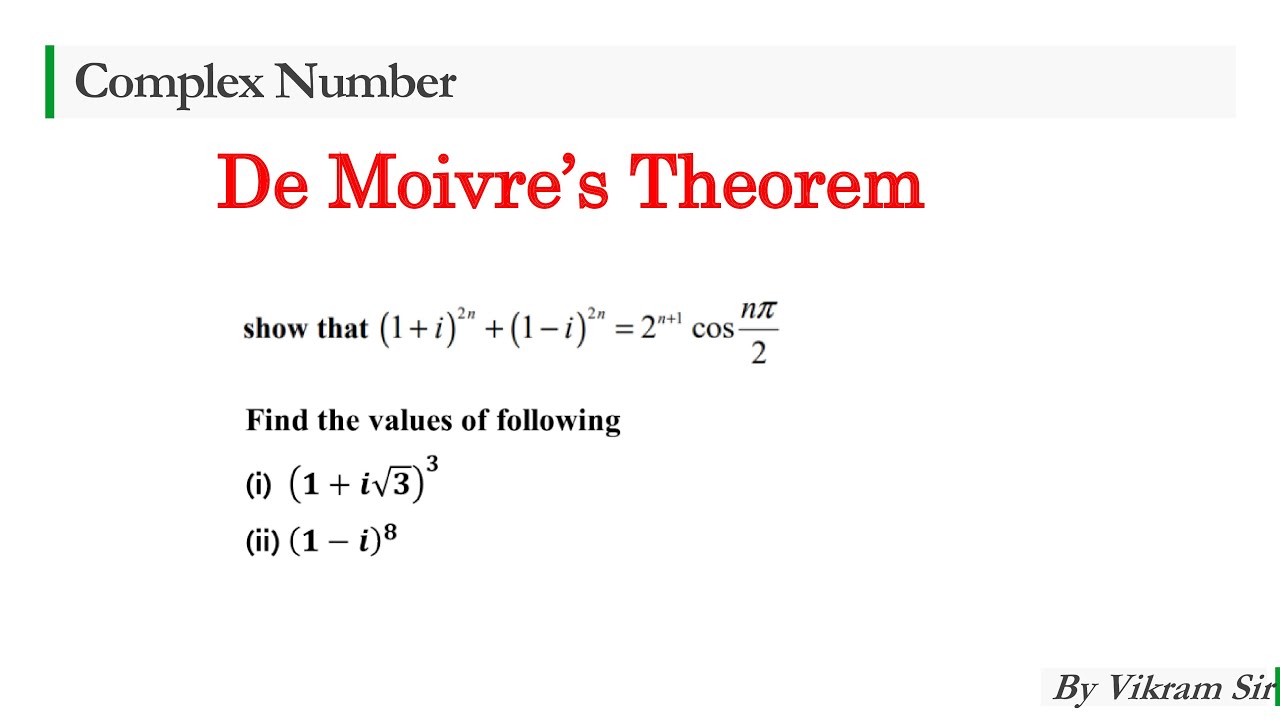
Mathematically, De Moivre’s theorem states that for any complex number \(z = r(\cos \theta + i \sin \theta)\) and any integer \(n\), we have:“`z^n = r^n(\cos n\theta + i \sin n\theta)“`where \(r\) is the modulus (magnitude) of \(z\), and \(\theta\) is the argument (angle) of \(z\).
Geometric Interpretation, De moivre’s theorem calculator
Geometrically, De Moivre’s theorem can be interpreted as follows: multiplying a complex number \(z\) by itself \(n\) times corresponds to rotating the vector representing \(z\) in the complex plane by \(n\) times the angle \(\theta\), while scaling it by \(r^n\).This
geometric interpretation provides a powerful tool for visualizing and understanding complex number operations, such as finding roots of unity, solving trigonometric equations, and representing rotations in the complex plane.
Applications of De Moivre’s Theorem in Electrical Engineering

De Moivre’s Theorem finds significant applications in electrical engineering, particularly in the analysis of alternating current (AC) circuits. It enables engineers to simplify complex calculations involving complex numbers, which represent sinusoidal waveforms commonly encountered in AC systems.
Impedance Calculations
In AC circuits, impedance (Z) is a complex quantity that represents the total opposition to the flow of current. It consists of both resistance (R) and reactance (X), which can be inductive (XL) or capacitive (XC). De Moivre’s Theorem allows engineers to calculate the impedance of complex circuits by combining these components using the following formula:
Z = R + j(XL
XC)
where j is the imaginary unit.
Solving Complex Number Problems
De Moivre’s Theorem also simplifies the solution of complex number problems related to AC systems. For example, it can be used to determine the phase angle between voltage and current, calculate power factor, and analyze the behavior of resonant circuits.
Electrical Engineering Applications
- AC Circuit Analysis:De Moivre’s Theorem is used to analyze the behavior of AC circuits, including voltage, current, and impedance.
- Power System Analysis:It is employed in power system analysis to calculate power flow, voltage regulation, and stability.
- Control Systems:De Moivre’s Theorem is used in control systems to design and analyze feedback loops and compensators.
- Signal Processing:It is applied in signal processing to analyze and manipulate complex signals, such as those found in audio and communication systems.
De Moivre’s Theorem and its Impact on Computer Science
De Moivre’s theorem, a cornerstone of complex number theory, has played a pivotal role in the advancement of computer science, particularly in the field of digital signal processing.
Significance in Digital Signal Processing
Digital signal processing algorithms rely heavily on the ability to perform complex number operations efficiently. De Moivre’s theorem provides a fundamental framework for understanding and manipulating complex numbers, enabling the development of algorithms that can process and analyze digital signals with ease and precision.
Applications in Fourier Analysis and Frequency Domain Analysis
De Moivre’s theorem is instrumental in Fourier analysis, a technique used to decompose signals into their frequency components. The theorem allows for the representation of complex numbers in polar form, which simplifies the analysis of frequency-domain characteristics. This capability has revolutionized the fields of audio and image processing, as well as many other applications where frequency analysis is essential.
Examples in Computer Science
The applications of De Moivre’s theorem extend beyond digital signal processing into various other areas of computer science:
- Computer Graphics:De Moivre’s theorem is used in 3D graphics to rotate and transform objects in space.
- Cryptography:The theorem plays a crucial role in the development of cryptographic algorithms that ensure data security.
- Quantum Computing:De Moivre’s theorem is essential for understanding and manipulating quantum states in quantum computing.
Calculator Functionality and Algorithm Design
A De Moivre’s theorem calculator is a tool that allows users to perform complex number operations based on De Moivre’s theorem. It simplifies the process of calculating powers and roots of complex numbers, which is particularly useful in various fields such as electrical engineering and computer science.
Basic Functionality
The basic functionality of a De Moivre’s theorem calculator includes:
- Calculating the power of a complex number
- Extracting the nth root of a complex number
- Converting a complex number from rectangular to polar form
- Converting a complex number from polar to rectangular form
Mathematical Algorithms
The mathematical algorithms used in a De Moivre’s theorem calculator are based on the following formulas:
De Moivre’s Theorem:
(cos θ + i sin θ)n= cos nθ + i sin nθ
Power of a Complex Number:
(r(cos θ + i sin θ))n= r n(cos nθ + i sin nθ)
Root of a Complex Number:
(r(cos θ + i sin θ))1/n= r 1/n(cos (θ + 2πk)/n + i sin (θ + 2πk)/n), k = 0, 1, …, n-1
Step-by-Step Guide
To use a De Moivre’s theorem calculator effectively, follow these steps:
- Enter the complex number in either rectangular (a + bi) or polar (r(cos θ + i sin θ)) form.
- Select the operation you want to perform (power or root).
- Enter the value of the exponent or root.
- Click on the “Calculate” button.
- The result will be displayed in both rectangular and polar forms.
Last Point
In conclusion, De Moivre’s theorem calculator emerges as an indispensable tool, empowering engineers, computer scientists, and mathematicians alike. Its versatility and ease of use make it a cornerstone for solving complex problems across disciplines. Embrace the power of De Moivre’s theorem, and unlock the doors to a world of mathematical exploration.