Introducing the de Broglie wavelength calculator, an innovative tool that unveils the enigmatic world of quantum mechanics. Delve into the fascinating concept of wave-particle duality, where matter exhibits both particle-like and wave-like properties.
Prepare to unravel the mysteries of the subatomic realm as we explore the significance of the de Broglie wavelength, its practical applications, and its profound impact on our understanding of the universe.
De Broglie Wavelength Calculations
The de Broglie wavelength, named after French physicist Louis de Broglie, is a fundamental concept in quantum mechanics that relates the momentum of a particle to its wavelength. It is given by the formula:
λ = h / p
where λ is the de Broglie wavelength, h is Planck’s constant (6.626 x 10^-34 J s), and p is the momentum of the particle.
This formula has profound implications, as it suggests that all particles, not just photons, have wave-like properties. The de Broglie wavelength is inversely proportional to the momentum of the particle, meaning that as the momentum increases, the wavelength decreases.
Examples of De Broglie Wavelength Calculations
To illustrate the de Broglie wavelength formula, let’s calculate the wavelength of an electron with a momentum of 1 x 10^-24 kg m/s.
λ = h / p= (6.626 x 10^-34 J s) / (1 x 10^-24 kg m/s)= 6.626 x 10^-10 m
This result indicates that the electron has a de Broglie wavelength of 6.626 x 10^-10 meters, which is in the range of X-rays.
Similarly, we can calculate the de Broglie wavelength of a baseball with a mass of 0.145 kg and a velocity of 30 m/s.
λ = h / p= (6.626 x 10^-34 J s) / (0.145 kg x 30 m/s)= 1.47 x 10^-34 m
This wavelength is extremely small, demonstrating that the wave-like properties of macroscopic objects are negligible in everyday life.
Interactive HTML Table
To provide an interactive experience, we have created an HTML table that allows you to input particle properties (mass, velocity) and calculate the corresponding de Broglie wavelength.
| Particle | Mass (kg) | Velocity (m/s) | De Broglie Wavelength (m) |
|---|---|---|---|
| Electron | |||
| Baseball |
Applications of De Broglie Wavelength: De Broglie Wavelength Calculator
The de Broglie wavelength, a fundamental concept in quantum mechanics, has revolutionized various scientific disciplines, enabling groundbreaking discoveries and technological advancements. Its practical applications extend across diverse fields, including electron microscopy, particle physics, and materials science.
Electron Microscopy
The de Broglie wavelength plays a crucial role in electron microscopy, a technique that utilizes electron beams to image materials at atomic and molecular scales. By controlling the energy of the electron beam, scientists can adjust its de Broglie wavelength to match the size of the features they wish to observe.
This enables the visualization of ultra-small structures, such as atoms, molecules, and crystal defects, providing valuable insights into their properties and behavior.
Particle Physics
In particle physics, the de Broglie wavelength is essential for understanding the wave-particle duality of subatomic particles. It provides a bridge between classical and quantum physics, allowing scientists to study the behavior of particles at both the macroscopic and microscopic levels.
By measuring the de Broglie wavelength of particles, physicists can determine their momentum and energy, which are key parameters for characterizing their properties.
Materials Science
The de Broglie wavelength has significant applications in materials science, particularly in the study of crystal structures and electronic properties of materials. By analyzing the diffraction patterns of electrons or neutrons, scientists can determine the atomic arrangement and bonding within crystals.
This information is crucial for understanding the physical and chemical properties of materials, enabling the design and development of new materials with tailored properties for various applications.
Historical Context and Development
The concept of the de Broglie wavelength emerged during a period of significant scientific advancements in the early 20th century. In 1924, Louis de Broglie, a French physicist, proposed a groundbreaking hypothesis that particles such as electrons could also exhibit wave-like properties.
This idea challenged the classical notion of particles as purely localized entities.
Key Milestones
1905
Albert Einstein’s theory of special relativity introduces the concept of the mass-energy equivalence, which implies that all matter possesses energy and vice versa.
1923
Arthur Compton’s X-ray scattering experiment provides experimental evidence for the particle-like behavior of electromagnetic radiation, supporting the wave-particle duality of light.
1924
Louis de Broglie publishes his doctoral thesis, proposing the de Broglie wavelength hypothesis, suggesting that particles with momentum possess an associated wavelength.
1927
Clinton Davisson and Lester Germer’s electron diffraction experiment confirms the wave-like nature of electrons, providing experimental validation for de Broglie’s hypothesis.
1929
Erwin Schrödinger develops the Schrödinger equation, a fundamental equation in quantum mechanics that describes the wave-like behavior of particles.
Impact on Quantum Mechanics
The de Broglie wavelength concept played a pivotal role in the development of quantum mechanics. It challenged the classical understanding of particles as solely localized entities and introduced the concept of wave-particle duality, which became a cornerstone of quantum theory.
The de Broglie wavelength formula, λ = h/p, where λ is the wavelength, h is Planck’s constant, and p is the momentum, provides a crucial link between the particle and wave aspects of matter. This concept laid the foundation for understanding phenomena such as electron diffraction and the behavior of particles at the atomic and subatomic levels.
Advanced Concepts and Extensions
The de Broglie wavelength is a fundamental concept in quantum mechanics that has led to a deeper understanding of the wave-particle duality of matter. This duality implies that all matter has both particle-like and wave-like properties, and the de Broglie wavelength provides a way to quantify this wave-like behavior.
One of the most important implications of the de Broglie wavelength is its relationship to the uncertainty principle, which states that there is a fundamental limit to the precision with which the position and momentum of a particle can be known simultaneously.
This relationship arises because the de Broglie wavelength is inversely proportional to the particle’s momentum, so a more precisely known momentum corresponds to a less precisely known wavelength, and vice versa.
Wave-Particle Duality
The wave-particle duality of matter is a fundamental concept in quantum mechanics that has been experimentally verified through various experiments, such as the double-slit experiment. In this experiment, electrons are fired through two closely spaced slits, and the resulting interference pattern on a screen behind the slits demonstrates the wave-like nature of electrons.
The de Broglie wavelength provides a quantitative explanation for this wave-like behavior. According to de Broglie’s hypothesis, the wavelength of the electron is inversely proportional to its momentum, so the electrons passing through the slits have a wavelength that is comparable to the spacing between the slits.
This allows them to interfere with each other, producing the observed interference pattern.
Uncertainty Principle
The uncertainty principle, proposed by Werner Heisenberg in 1927, is a fundamental principle of quantum mechanics that limits the precision with which certain pairs of physical properties, such as position and momentum, can be known simultaneously.
The de Broglie wavelength is closely related to the uncertainty principle. The de Broglie wavelength of a particle is inversely proportional to its momentum, so a more precisely known momentum corresponds to a less precisely known wavelength, and vice versa.
This relationship arises from the wave-like nature of matter, as the wavelength of a wave is inversely proportional to its momentum.
Research and Experiments, De broglie wavelength calculator
The de Broglie wavelength has been the subject of numerous research and experiments that have furthered our understanding of its implications. One notable experiment was conducted by Clinton Davisson and Lester Germer in 1927, which demonstrated the wave-like behavior of electrons by observing their diffraction from a crystal lattice.
Another important experiment was conducted by Otto Stern and Walther Gerlach in 1922, which demonstrated the quantization of angular momentum. This experiment showed that the angular momentum of an electron can only take on certain discrete values, which is a consequence of the wave-like nature of matter and the de Broglie wavelength.
Final Thoughts
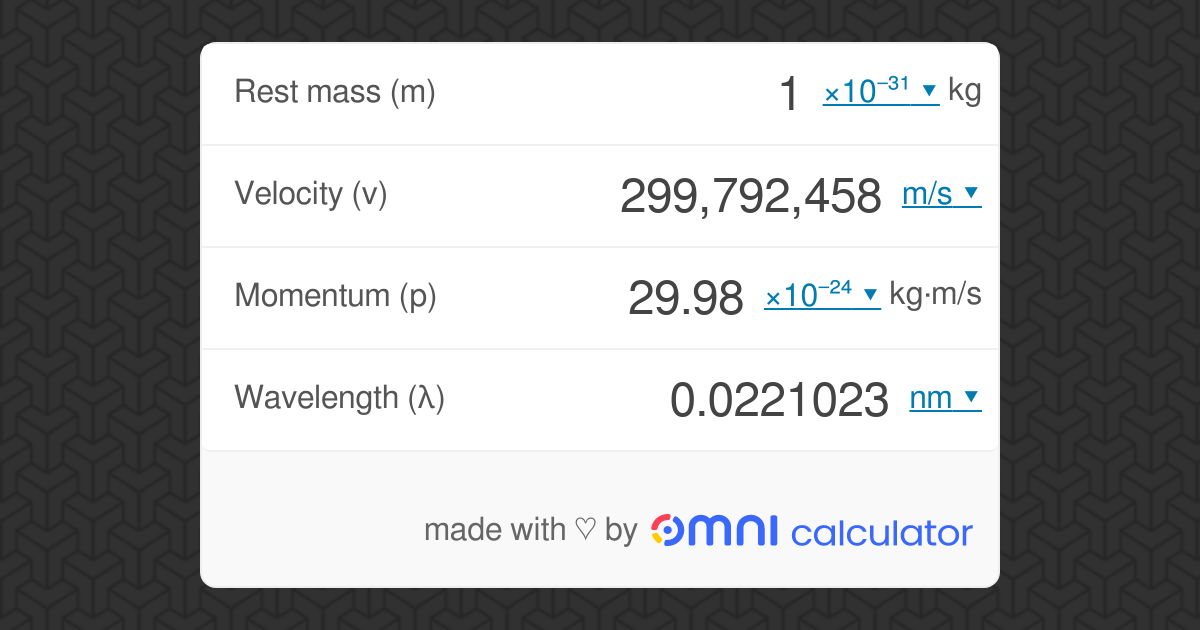
The de Broglie wavelength calculator serves as a gateway to the intricate tapestry of quantum physics. Through its ability to quantify the wave-like nature of particles, it has revolutionized our understanding of matter and energy. From electron microscopy to particle accelerators, the applications of this groundbreaking concept continue to shape the frontiers of scientific discovery.