Unveiling the Cylindrical Shells Calculator, a revolutionary tool that empowers you to unravel the mysteries of volume calculations with unparalleled precision. Dive into a captivating journey where we explore the depths of this remarkable technique, unlocking its secrets and revealing its boundless applications.
Cylindrical shells, a cornerstone of integral calculus, provide an ingenious method for determining the volume of solids of revolution. With its intuitive formula and straightforward steps, this method has become a cornerstone for engineers, architects, and anyone seeking to master the art of volume calculations.
Cylindrical Shells Method Overview

The cylindrical shells method is a calculus-based technique used to calculate the volume of solids of revolution. It involves dividing the solid into infinitesimally thin cylindrical shells, each with a radius equal to the distance from the axis of revolution to the shell’s surface and a height equal to the height of the solid at that radius.
The volume of each shell is then calculated as the product of its surface area and thickness. By integrating the volume of each shell over the range of radii, we can obtain the total volume of the solid.
Example
Consider the solid of revolution generated by rotating the region bounded by the curves y = x^2 and y = 4 about the y-axis. This solid can be analyzed using the cylindrical shells method.
Steps Involved
- Determine the limits of integration for the radius of the cylindrical shells. In this example, the limits are 0 and 2 (the x-coordinates of the points of intersection of the curves y = x^2 and y = 4).
- For each value of the radius, determine the height of the cylindrical shell. In this example, the height is given by the difference between the upper and lower curves, which is 4 – x^2.
- Calculate the surface area of the cylindrical shell. The surface area of a cylindrical shell with radius r and height h is 2πrh.
- Calculate the volume of the cylindrical shell. The volume of a cylindrical shell is the product of its surface area and thickness. The thickness is dr, so the volume is 2πrh dr.
- Integrate the volume of each shell over the range of radii to obtain the total volume of the solid.
Integration and Formula for Cylindrical Shells
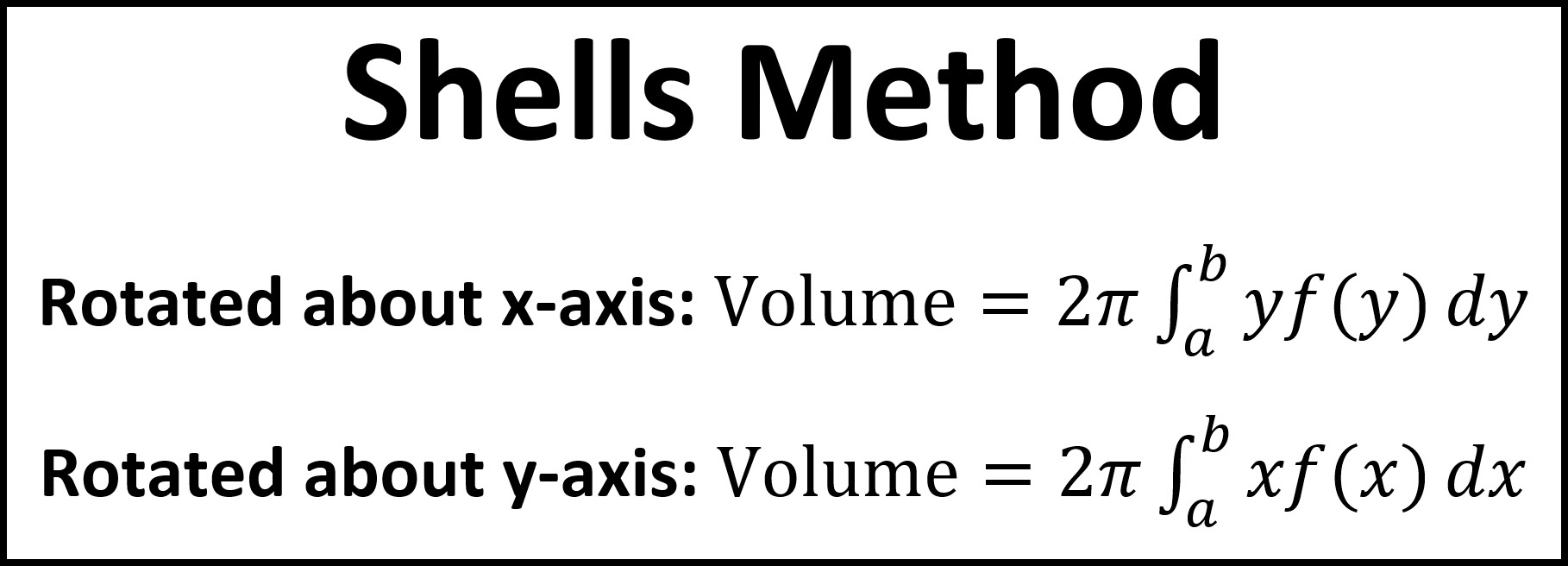
The cylindrical shells method is a calculus-based technique for calculating the volume of a solid of revolution. It involves integrating the volume of infinitesimally thin cylindrical shells that make up the solid.
Formula for Volume Using Cylindrical Shells
The formula for calculating the volume of a solid of revolution using cylindrical shells is:
V = 2π∫[a,b] r(x) h(x) dx
where:
- V is the volume of the solid of revolution
- r(x) is the radius of the cylindrical shell at height x
- h(x) is the height of the cylindrical shell at height x
- a and b are the lower and upper limits of integration, respectively
Setting Up the Integral for Cylindrical Shells
To set up the integral for the cylindrical shells method, follow these steps:
- Identify the axis of revolution.
- Express the radius of the cylindrical shell, r(x), in terms of x.
- Express the height of the cylindrical shell, h(x), in terms of x.
- Determine the limits of integration, a and b.
- Substitute r(x), h(x), a, and b into the formula for volume.
Example
Consider the solid of revolution generated by rotating the region bounded by the curve y = x^2 and the x-axis from x = 0 to x = 2 about the y-axis.
To find the volume of this solid using cylindrical shells, we can set up the integral as follows:
V = 2π∫[0,2] x(2-x^2) dx
where r(x) = x and h(x) = 2-x^2.
Applications of Cylindrical Shells
Cylindrical shells are a powerful tool for calculating the volume of solids of revolution, offering several advantages over other methods.
The key advantage of using cylindrical shells is their ability to handle complex solids of revolution with irregular cross-sections. This method simplifies the calculation process by breaking down the solid into infinitesimally thin cylindrical shells, each with a known volume.
Types of Solids of Revolution
Cylindrical shells can be used to analyze a wide range of solids of revolution, including:
- Cones
- Cylinders
- Spheres
- Ellipsoids
- Torus
Advantages of Cylindrical Shells
- Simplicity: The cylindrical shells method involves straightforward calculations, making it accessible to students and practitioners alike.
- Accuracy: Cylindrical shells provide accurate volume calculations, especially for solids with complex cross-sections.
- Versatility: This method can be applied to a wide range of solids of revolution, including those with irregular shapes.
Limitations of Cylindrical Shells
- Limited to Solids of Revolution: Cylindrical shells are only applicable to solids generated by rotating a function around an axis, limiting their use for other types of solids.
- Potential for Error: Improper integration or incorrect limits of integration can lead to inaccurate volume calculations.
Real-World Applications, Cylindrical shells calculator
Cylindrical shells have numerous real-world applications, including:
- Engineering: Calculating the volume of storage tanks, pipes, and other cylindrical structures.
- Architecture: Determining the volume of domes, vaults, and other curved architectural elements.
- Physics: Analyzing the volume of rotating objects, such as flywheels and gyroscopes.
Advanced Techniques for Cylindrical Shells: Cylindrical Shells Calculator
Cylindrical shells can be used to find the volume of solids of revolution with holes or other complexities. To do this, we need to divide the solid into thin cylindrical shells and then integrate the volume of each shell.
Using Technology
Technology, such as graphing calculators or computer software, can be used to assist in cylindrical shell calculations. These tools can be used to graph the function that defines the solid of revolution and to calculate the integral that gives the volume.
Non-Standard Applications
Cylindrical shells can also be used to find the volume of non-standard solids. For example, they can be used to find the volume of a solid that is formed by rotating a curve around an axis that is not parallel to the axis of rotation.
Closure
As we conclude our exploration of cylindrical shells, we recognize its immense power in unraveling the complexities of volume calculations. From simple solids of revolution to intricate structures with cavities and varying cross-sections, cylindrical shells prove their versatility and effectiveness.
Harnessing the potential of technology, we can further enhance our understanding and applications of cylindrical shells. Graphing calculators and computer software empower us to tackle even the most challenging volume problems, expanding the boundaries of our knowledge and enabling us to push the limits of innovation.