Complex number polar form calculator, a tool that unravels the intricacies of imaginary numbers, takes center stage in this discourse. Delve into the fascinating world of polar form, where complex numbers dance in a symphony of magnitude and argument, revealing their hidden elegance.
Embark on a journey through the conversion process from rectangular to polar form, unraveling the significance of magnitude and argument. Witness the power of polar form in simplifying complex number operations, and explore its invaluable applications in electrical engineering, navigation, and trigonometry.
Polar Form Conversion

The polar form of a complex number is a way of representing it using its magnitude (the length of the line connecting the number to the origin) and its argument (the angle that line makes with the positive real axis).
Converting a complex number from rectangular form (a + bi) to polar form (r(cos θ + i sin θ)) involves finding the magnitude and argument of the number.
Magnitude
The magnitude of a complex number is the distance from the origin to the point representing the number on the complex plane. It is calculated using the Pythagorean theorem: |z| = √(a^2 + b^2), where a and b are the real and imaginary parts of the complex number, respectively.
Argument, Complex number polar form calculator
The argument of a complex number is the angle between the positive real axis and the line connecting the number to the origin. It is calculated using the arctangent function: arg(z) = arctan(b/a), where a and b are the real and imaginary parts of the complex number, respectively.
Examples
To convert the complex number 3 + 4i to polar form:
- Find the magnitude: |z| = √(3^2 + 4^2) = 5
- Find the argument: arg(z) = arctan(4/3) ≈ 0.927 radians
Therefore, the polar form of 3 + 4i is 5(cos 0.927 + i sin 0.927).
Complex Number Operations in Polar Form
In this section, we will explore the operations of addition, subtraction, multiplication, and division of complex numbers in polar form. We will also introduce Euler’s formula and demonstrate its application in these operations.
Polar form is a convenient representation of complex numbers that separates the magnitude and the angle. It is often used in electrical engineering, physics, and other fields where the magnitude and phase of complex numbers are important.
Addition and Subtraction
To add or subtract complex numbers in polar form, we convert them to rectangular form, perform the operation, and then convert the result back to polar form.
Let’s consider two complex numbers in polar form:
- z1 = r1(cos θ1 + i sin θ1)
- z2 = r2(cos θ2 + i sin θ2)
Their sum is:
- z1 + z2 = (r1 cos θ1 + r2 cos θ2) + i(r1 sin θ1 + r2 sin θ2)
And their difference is:
- z1 – z2 = (r1 cos θ1 – r2 cos θ2) + i(r1 sin θ1 – r2 sin θ2)
Multiplication and Division
Multiplication and division of complex numbers in polar form are more straightforward.
To multiply two complex numbers in polar form, we multiply their magnitudes and add their angles:
- z1 – z2 = (r1 – r2)(cos (θ1 + θ2) + i sin (θ1 + θ2))
To divide two complex numbers in polar form, we divide their magnitudes and subtract their angles:
- z1 / z2 = (r1 / r2)(cos (θ1 – θ2) + i sin (θ1 – θ2))
Euler’s Formula
Euler’s formula is a powerful tool that can be used to convert complex numbers between polar and rectangular forms:
- e^(iθ) = cos θ + i sin θ
Using Euler’s formula, we can convert a complex number in polar form to rectangular form as follows:
- z = r(cos θ + i sin θ) = r – e^(iθ)
And we can convert a complex number in rectangular form to polar form as follows:
- z = x + iy = r(cos θ + i sin θ), where r = sqrt(x^2 + y^2) and θ = arctan(y/x)
Examples
Let’s consider some examples of complex number operations in polar form:
- Add z1 = 2(cos 30° + i sin 30°) and z2 = 3(cos 60° + i sin 60°):
- z1 + z2 = (2 cos 30° + 3 cos 60°) + i(2 sin 30° + 3 sin 60°) = 4.243 + 2.606i
- Multiply z1 = 2(cos 30° + i sin 30°) by z2 = 3(cos 60° + i sin 60°):
- z1 – z2 = (2 – 3)(cos (30° + 60°) + i sin (30° + 60°)) = 6(cos 90° + i sin 90°) = 6i
Applications of Polar Form
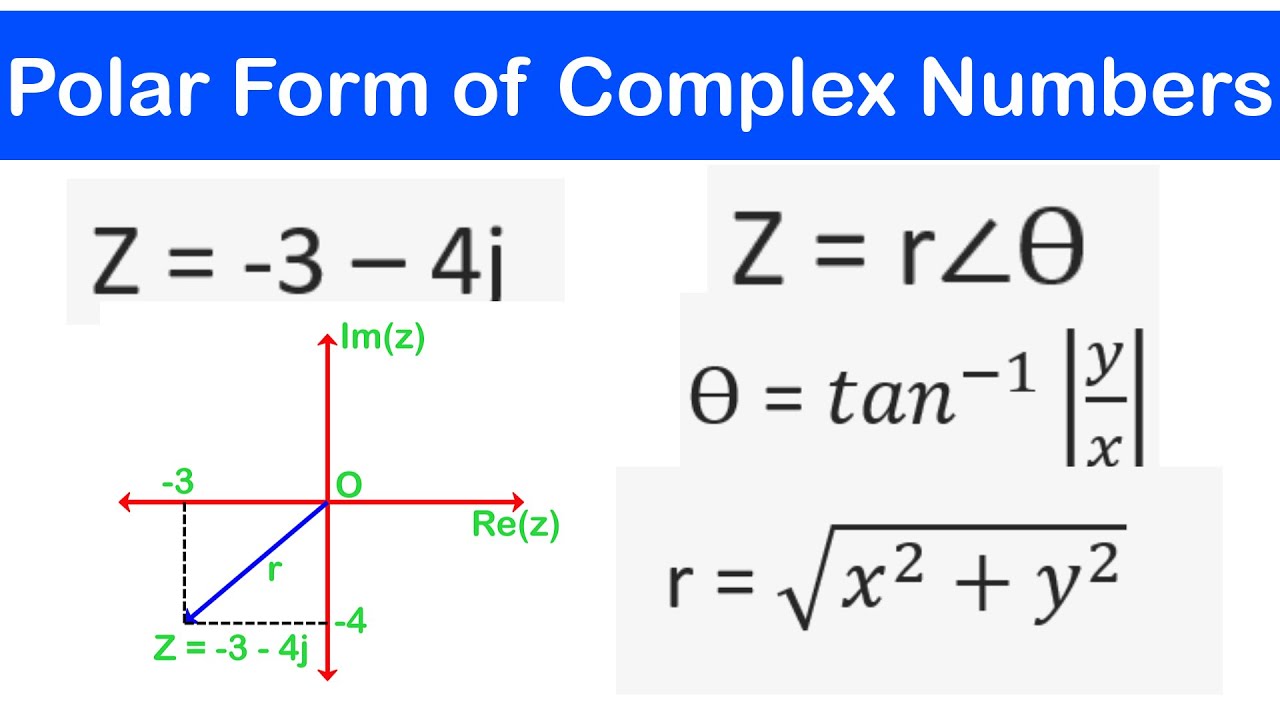
Polar form finds widespread applications in various fields, including electrical engineering, navigation, and trigonometry. Its ability to represent complex numbers in terms of magnitude and angle makes it a powerful tool for solving problems involving vectors and rotations.
Electrical Engineering
In electrical engineering, polar form is particularly useful in the analysis of AC circuits. Complex numbers are used to represent impedance, which is a measure of the opposition to the flow of current. The magnitude of the complex number represents the resistance, while the angle represents the phase shift between the voltage and current.
Polar form simplifies the calculation of impedance and allows for easy analysis of circuit behavior.
For example, consider a circuit with a resistor and a capacitor in series. The impedance of the circuit is given by:
Z = R + jXc
where R is the resistance, Xc is the capacitive reactance, and j is the imaginary unit.
Using polar form, we can write:
Z = |Z|∠θ
where |Z| is the magnitude of the impedance and θ is the phase angle.
The magnitude of the impedance is given by:
|Z| = √(R^2 + Xc^2)
and the phase angle is given by:
θ = arctan(Xc/R)
Using polar form, we can easily calculate the impedance of the circuit and analyze its behavior.
Navigation and Trigonometry
Polar form is also widely used in navigation and trigonometry. In navigation, it is used to represent the position of a ship or aircraft in terms of its distance from a reference point and the angle from a reference direction.
This allows for easy calculation of the ship’s course and distance traveled.
In trigonometry, polar form is used to represent complex numbers on the complex plane. This allows for easy visualization and manipulation of complex numbers. For example, the sum of two complex numbers can be found by adding their magnitudes and angles.
The product of two complex numbers can be found by multiplying their magnitudes and adding their angles.
For example, consider two complex numbers:
z1 = 3∠30°
z2 = 4∠60°
The sum of these two complex numbers is:
z1 + z2 = (3∠30°) + (4∠60°)
= 7∠45°
The product of these two complex numbers is:
z1- z2 = (3∠30°) – (4∠60°)
= 12∠90°
Polar form simplifies calculations in these fields by providing a convenient way to represent and manipulate complex numbers. Its ability to represent both magnitude and angle makes it a powerful tool for solving problems involving vectors and rotations.
Polar Form Calculator Design

The polar form calculator is designed with user-friendliness in mind, allowing for seamless input of complex numbers in both rectangular and polar forms.
The interface is equipped with dedicated fields for real and imaginary parts when entering in rectangular form, while the polar form input involves specifying the magnitude and angle.
Conversion and Operation Functions
Upon input, the calculator instantly converts the number to the other form, displaying both representations simultaneously.
The calculator is also equipped with a range of operations that can be performed on complex numbers in polar form, including addition, subtraction, multiplication, and division.
Responsive Design
To ensure optimal viewing and usability, the calculator features a responsive design that adapts to different screen sizes and devices.
Whether accessed on a desktop computer, laptop, tablet, or smartphone, the calculator’s interface adjusts dynamically to provide a consistent and intuitive user experience.
Final Summary: Complex Number Polar Form Calculator

Polar form, with its inherent beauty and practicality, stands as a testament to the elegance of mathematics. Its applications span diverse fields, from electrical circuits to celestial navigation, showcasing the versatility and power of complex numbers. This discourse has illuminated the intricacies of polar form, equipping readers with a deeper understanding of this captivating mathematical concept.