Boyles law calculator – The Boyle’s Law calculator, an indispensable tool in the realm of physics, unveils the intriguing relationship between pressure and volume. By harnessing the principles of Boyle’s Law, this calculator empowers users to delve into the dynamics of gases and uncover the secrets that govern their behavior.
From scuba diving to engineering marvels and meteorological phenomena, Boyle’s Law finds myriad applications in the real world. Its ability to predict the behavior of gases under varying conditions makes it a cornerstone of scientific inquiry and technological advancements.
Boyle’s Law Calculations
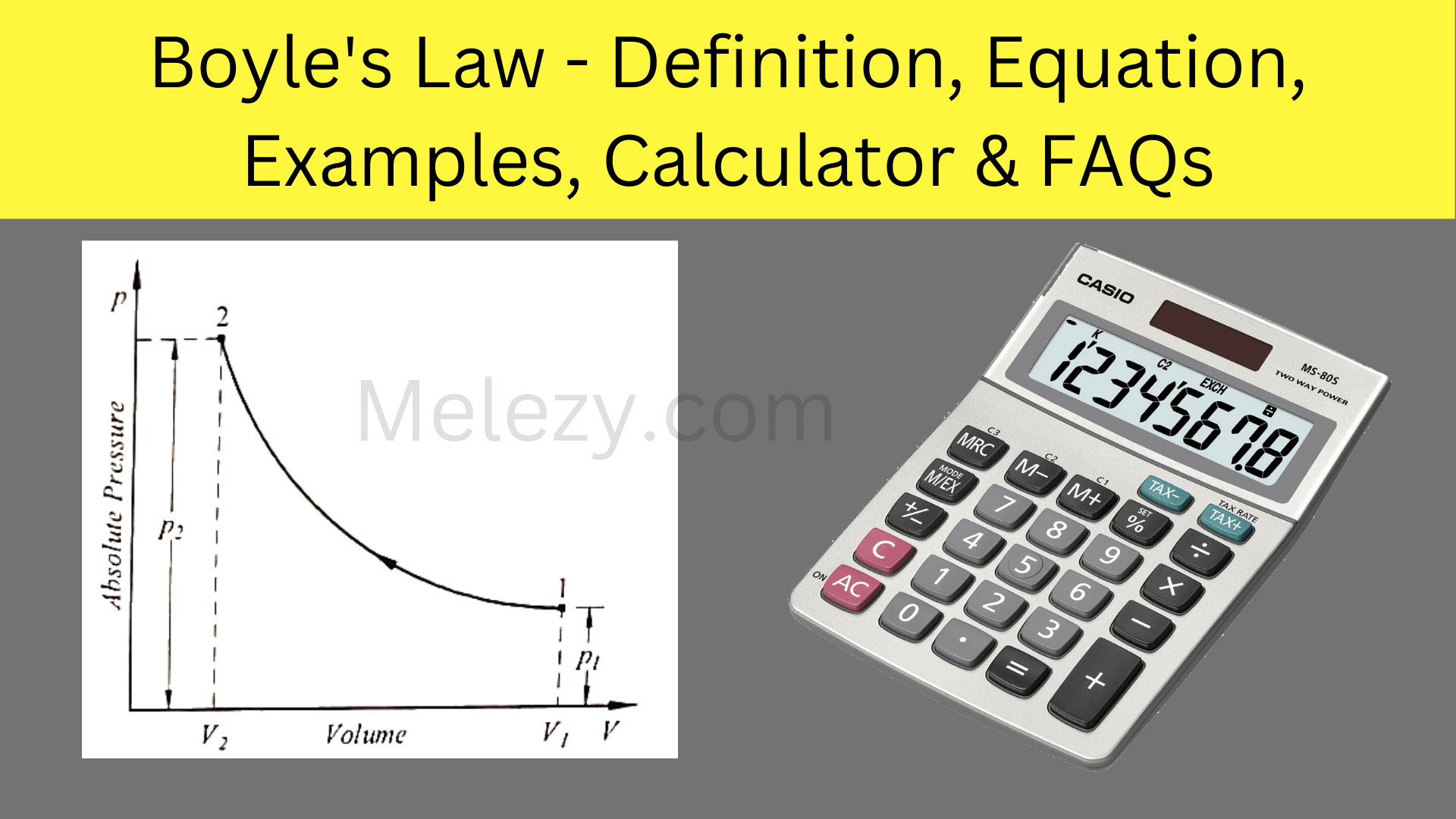
Boyle’s Law describes the inverse relationship between the pressure and volume of a gas at constant temperature. Mathematically, it is expressed as:
P₁V₁ = P₂V₂
Where P₁ and V₁ represent the initial pressure and volume, and P₂ and V₂ represent the final pressure and volume, respectively.
Using the Boyle’s Law Calculator
The Boyle’s Law calculator simplifies the process of determining the relationship between pressure and volume. To use the calculator:
- Enter the initial pressure (P₁)
- Enter the initial volume (V₁)
- Enter the final pressure (P₂) or volume (V₂)
- Click “Calculate”
The calculator will then display the unknown variable (either P₂ or V₂).
Applications of Boyle’s Law

Boyle’s Law finds widespread application in various industries, from engineering to meteorology.
It provides a framework for understanding and predicting gas behavior under changing pressure and volume conditions.
Scuba Diving
Scuba divers rely on Boyle’s Law to calculate the depth at which they can safely ascend without experiencing decompression sickness.
As they descend, the pressure increases, causing the volume of air in their lungs to decrease. Upon ascending, the pressure decreases, and the air in their lungs expands.
Boyle’s Law helps divers determine the depth at which they must begin ascending slowly to avoid expanding the air in their lungs too rapidly.
Engineering
In engineering, Boyle’s Law is used in the design of engines, compressors, and other systems that involve gas flow.
For example, in a reciprocating engine, the volume of the combustion chamber changes as the piston moves. Boyle’s Law helps engineers calculate the pressure changes that occur during the compression and expansion strokes.
Meteorology
Meteorologists use Boyle’s Law to understand atmospheric pressure and its impact on weather patterns.
As air rises in the atmosphere, the pressure decreases, causing it to expand and cool. This cooling can lead to the formation of clouds and precipitation.
Boyle’s Law helps meteorologists predict the weather by understanding how changes in pressure and volume affect the behavior of air in the atmosphere.
Limitations of Boyle’s Law

Boyle’s Law is a useful tool for understanding the behavior of gases under certain conditions. However, it is important to note that Boyle’s Law has certain limitations and assumptions that must be met for it to apply accurately.One limitation of Boyle’s Law is that it assumes that the temperature of the gas remains constant.
If the temperature of the gas changes, then the relationship between pressure and volume will not be linear. Another limitation is that Boyle’s Law assumes that the gas behaves ideally. In reality, gases deviate from ideal behavior at high pressures and low temperatures.
Non-Ideal Gas Behavior
At high pressures and low temperatures, gas molecules experience stronger intermolecular forces, causing them to deviate from ideal gas behavior. Under these conditions, the volume of the gas is not inversely proportional to the pressure.
Chemical Reactions
Boyle’s Law assumes that the gas is not undergoing any chemical reactions. If a chemical reaction occurs within the gas, the number of moles of gas will change, affecting the pressure-volume relationship.
Phase Transitions
Boyle’s Law does not apply when a gas undergoes a phase transition, such as condensation or vaporization. During a phase transition, the volume and pressure of the gas change significantly, violating the assumptions of Boyle’s Law.
Boyle’s Law Calculator Features: Boyles Law Calculator
The Boyle’s Law calculator is a tool that allows users to perform calculations related to Boyle’s Law, which describes the inverse relationship between the pressure and volume of a gas at constant temperature.
The calculator features a user-friendly interface that makes it easy to input values and obtain results. It also includes a variety of features that enhance its functionality and accuracy.
Input Fields
The calculator includes the following input fields:
- Initial pressure (P1)
- Initial volume (V1)
- Final pressure (P2)
- Final volume (V2)
Units of Measurement
The calculator supports a variety of units of measurement for pressure and volume, including:
- Pressure: atm, kPa, mmHg, Pa
- Volume: L, mL, cm 3
Calculation Options, Boyles law calculator
The calculator offers the following calculation options:
- Calculate final pressure (P2) from initial pressure (P1), initial volume (V1), and final volume (V2)
- Calculate final volume (V2) from initial pressure (P1), initial volume (V1), and final pressure (P2)
- Calculate initial pressure (P1) from final pressure (P2), initial volume (V1), and final volume (V2)
- Calculate initial volume (V1) from final pressure (P2), final volume (V2), and initial pressure (P1)
Closure
As we conclude our exploration of Boyle’s Law, we gain a profound appreciation for its significance in understanding the behavior of gases. The Boyle’s Law calculator serves as a testament to the power of scientific tools, enabling us to unravel the mysteries of the physical world and harness its principles for countless applications.