Embark on a journey into the realm of rotational motion with the angular acceleration calculator, a tool that unlocks the secrets of objects spinning and twirling. This calculator empowers you to delve into the intricate world of angular acceleration, a fundamental concept that governs the rate at which objects rotate.
As we delve deeper, we’ll explore the practical applications of angular acceleration in engineering and physics, unraveling its significance in rotational motion. Prepare to be captivated as we unveil the methods for measuring and analyzing angular acceleration, empowering you to comprehend the dynamic world of rotating objects.
Angular Acceleration Calculations
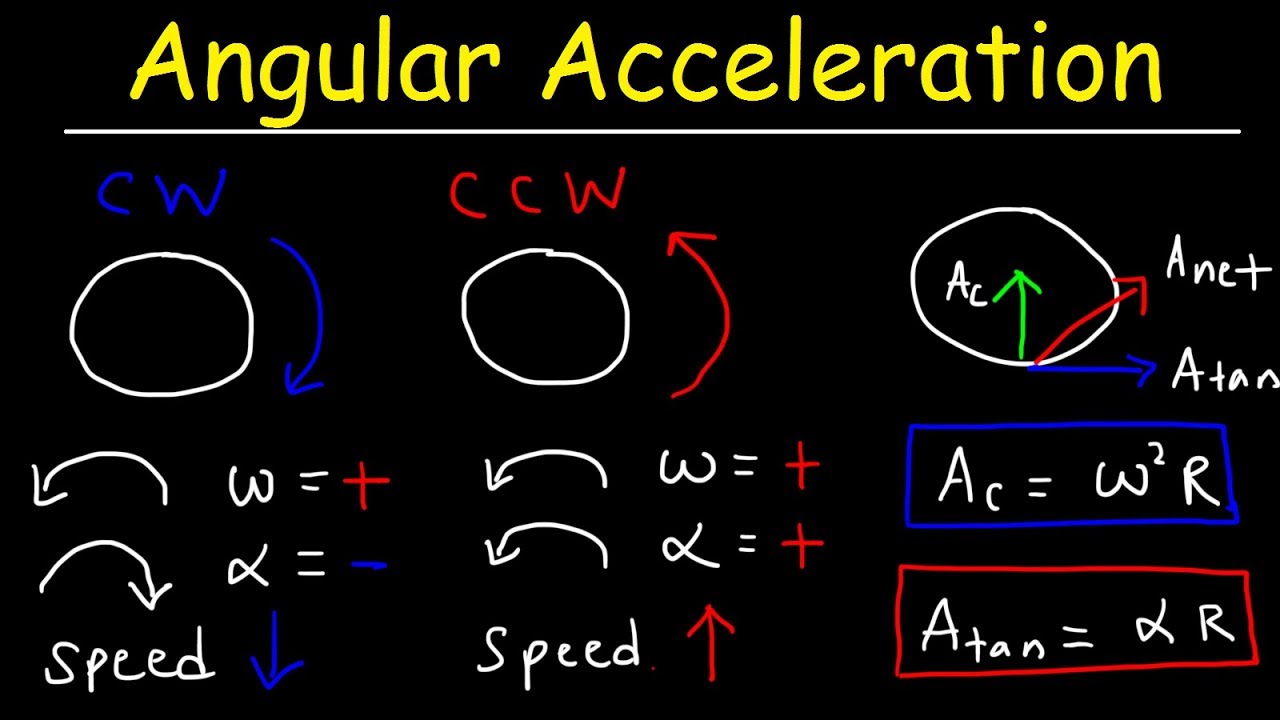
Angular acceleration, denoted by the Greek letter alpha (α), measures the rate at which an object’s angular velocity changes over time. It is a vector quantity, meaning it has both magnitude and direction.
Formula for Angular Acceleration
The formula for calculating angular acceleration is:
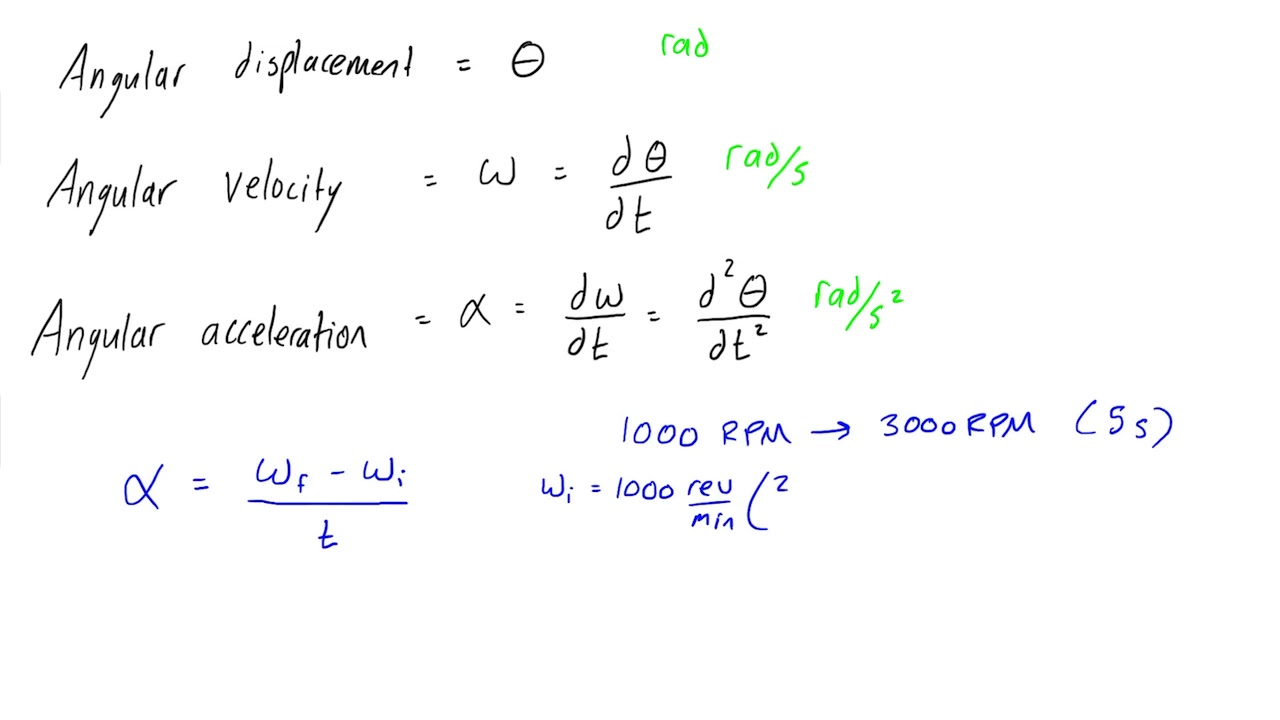
α = Δω / Δt
Where:
- α is angular acceleration in radians per second squared (rad/s^2)
- Δω is the change in angular velocity in radians per second (rad/s)
- Δt is the change in time in seconds (s)
Units of Measurement
The SI unit of angular acceleration is radians per second squared (rad/s^2). Other units include degrees per second squared (°/s^2) and revolutions per minute squared (rpm/s^2).
Comparison of Angular Acceleration, Velocity, and Displacement
The following table compares angular acceleration, angular velocity, and angular displacement:
| Quantity | Symbol | Unit | Definition |
|---|---|---|---|
| Angular acceleration | α | rad/s^2 | Rate of change of angular velocity |
| Angular velocity | ω | rad/s | Rate of change of angular displacement |
| Angular displacement | θ | rad | Angle through which an object has rotated |
Applications of Angular Acceleration
Angular acceleration finds widespread applications in various fields, including engineering and physics, playing a pivotal role in the study and design of systems involving rotational motion.
In engineering, angular acceleration is crucial for analyzing and optimizing the performance of rotating machinery, such as engines, turbines, and generators. It helps engineers understand the dynamic behavior of these systems and design them to operate efficiently and reliably.
Devices and Systems Utilizing Angular Acceleration
- Centrifuges: These devices utilize high angular acceleration to separate particles based on their density. The centrifugal force generated by the spinning motion causes denser particles to move outward, while lighter particles remain closer to the center.
- Gyroscopes: Gyroscopes are devices that measure angular velocity and acceleration. They are used in navigation systems, inertial guidance systems, and stabilization systems to provide accurate orientation and stability.
- Rotating Electrical Machines: Angular acceleration is a key factor in the design of rotating electrical machines, such as motors and generators. The acceleration and deceleration of the rotor during start-up and shutdown affect the efficiency and lifespan of the machine.
In physics, angular acceleration is essential for understanding rotational motion and solving problems related to rotating objects. It is used to describe the rate at which an object’s angular velocity changes over time.
Measurement and Analysis of Angular Acceleration

Angular acceleration is a critical parameter in various scientific and engineering applications, and its accurate measurement and analysis are essential. This section delves into the methods for measuring angular acceleration, the principles behind angular acceleration sensors, and guidance on analyzing angular acceleration data.
Methods for Measuring Angular Acceleration, Angular acceleration calculator
There are several methods for measuring angular acceleration, each with its own advantages and limitations. Common techniques include:
- Gyroscopes:These devices use the principle of conservation of angular momentum to measure angular velocity and acceleration. By sensing the precession of a rotating mass, gyroscopes can provide accurate measurements of angular acceleration.
- Accelerometers:Accelerometers measure linear acceleration, but they can also be used to measure angular acceleration by attaching them to a rotating object. The measured linear acceleration can be resolved into tangential and radial components, which can then be used to calculate angular acceleration.
- Optical Encoders:Optical encoders measure the angular position of a rotating object by detecting the passage of light through a series of slits or gratings. By measuring the change in angular position over time, angular acceleration can be calculated.
Principles Behind Angular Acceleration Sensors
Angular acceleration sensors are devices that convert angular acceleration into an electrical signal. The most common type of angular acceleration sensor is the MEMS (Microelectromechanical Systems) accelerometer. MEMS accelerometers use a small, movable mass suspended on a spring. When the sensor is subjected to angular acceleration, the mass deflects from its equilibrium position, which is detected by a capacitive or piezoresistive sensor.
Analysis of Angular Acceleration Data
The analysis of angular acceleration data involves understanding the characteristics of the data and extracting meaningful information from it. Common techniques for analyzing angular acceleration data include:
- Time-Domain Analysis:This involves plotting the angular acceleration data as a function of time. Time-domain analysis can reveal patterns and trends in the data, such as the onset and duration of angular acceleration events.
- Frequency-Domain Analysis:This involves converting the angular acceleration data into the frequency domain using Fourier transform. Frequency-domain analysis can identify the frequency components present in the data, which can provide insights into the underlying dynamics of the system.
- Statistical Analysis:This involves calculating statistical parameters such as mean, standard deviation, and skewness of the angular acceleration data. Statistical analysis can help characterize the overall distribution of the data and identify outliers.
Angular Acceleration in Real-World Scenarios

Angular acceleration plays a crucial role in our everyday lives, affecting the motion and behavior of various objects. From spinning tops to amusement park rides, understanding angular acceleration helps us appreciate the intricate dynamics of the world around us.
Applications in Everyday Life
- Spinning Toys:Angular acceleration is responsible for the spinning motion of toys like tops and fidget spinners. The faster the angular acceleration, the higher the spin rate.
- Sports Equipment:Baseball pitchers and tennis players use angular acceleration to generate spin on the ball, affecting its trajectory and performance.
- Machinery:Industrial machinery, such as centrifuges and turbines, rely on angular acceleration to achieve high rotational speeds.
Implications for Safety and Performance
Angular acceleration has significant implications for safety and performance in various scenarios:
- Vehicle Dynamics:Angular acceleration is crucial for controlling the stability and handling of vehicles, especially during turns and maneuvers.
- Human Motion:Angular acceleration plays a role in balance, coordination, and athletic performance. Gymnasts and dancers use angular acceleration to execute complex maneuvers.
- Safety Precautions:Excessive angular acceleration can lead to dizziness, nausea, and even injury. Amusement park rides and other activities involving high angular acceleration require safety measures to minimize risks.
Ending Remarks: Angular Acceleration Calculator
Angular acceleration, a concept that may seem abstract at first, reveals its profound impact on our world as we uncover its applications in everyday life. From the mesmerizing spin of a figure skater to the intricate workings of a gyroscope, angular acceleration shapes the motion of countless objects around us.
Understanding this concept not only enhances our comprehension of the physical world but also opens doors to countless possibilities in engineering, physics, and beyond.