The acid test ratio calculator is an indispensable tool for financial analysts, providing a quick and accurate assessment of a company’s liquidity. Unlike other liquidity ratios, the acid test ratio focuses on the most liquid assets, offering a more conservative measure of a company’s ability to meet short-term obligations.
By utilizing the acid test ratio calculator, you can gain valuable insights into a company’s financial health and make informed decisions about its stability and solvency.
Overview of Acid Test Ratio Calculator
/dotdash_Final_How_Is_the_Acid-Test_Ratio_Calculated_2020-01-e78bcddeb1dc41d29bcacaa0072bc773.jpg "Acid Test Ratio Calculator")
The acid test ratio, also known as the quick ratio, is a measure of a company’s ability to meet its short-term obligations. It is calculated by dividing the company’s total liquid assets by its current liabilities. Liquid assets are defined as cash, cash equivalents, and marketable securities.
Current liabilities are defined as debts that are due within one year.The acid test ratio is a more conservative measure of liquidity than the current ratio. This is because it excludes inventory from the calculation of liquid assets. Inventory can be difficult to sell quickly, so it is not as reliable a source of liquidity as cash or marketable securities.
*Importance of the Acid Test Ratio
The acid test ratio is an important measure of financial health for several reasons. First, it can help investors to assess a company’s ability to meet its short-term obligations. Second, it can help creditors to assess the risk of lending money to a company.
Third, it can help companies to identify areas where they can improve their liquidity.
*How the Acid Test Ratio Differs from Other Liquidity Ratios
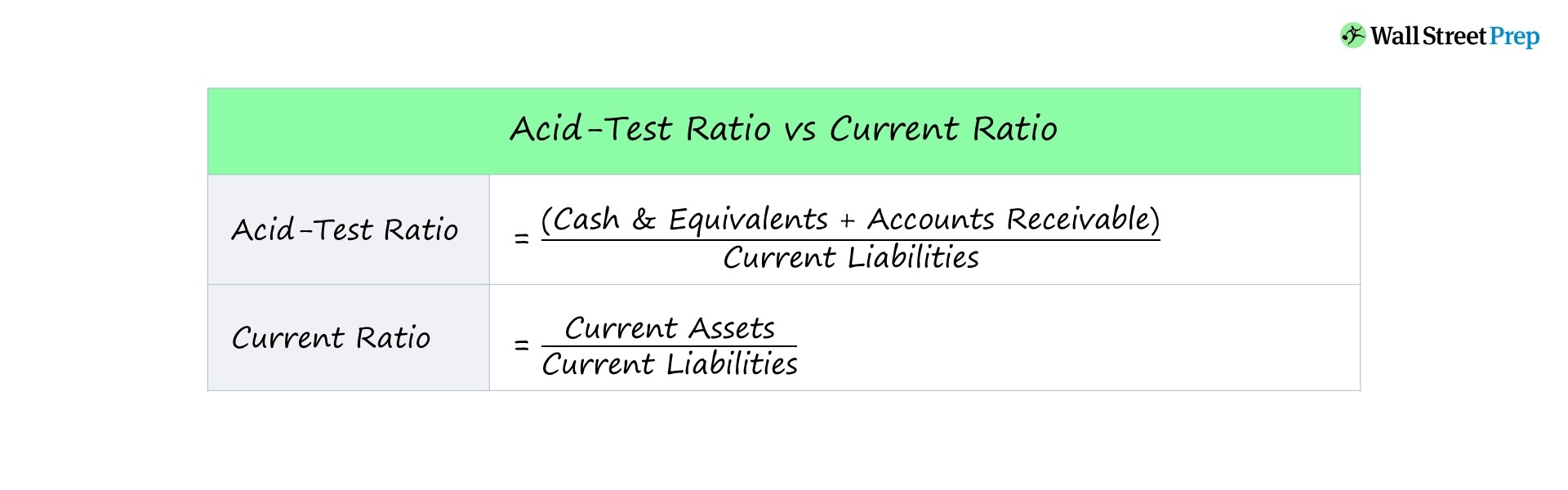
The acid test ratio differs from other liquidity ratios in two ways. First, it excludes inventory from the calculation of liquid assets. Second, it uses a more conservative definition of current liabilities. This makes the acid test ratio a more conservative measure of liquidity than other liquidity ratios, such as the current ratio.
Formula and Calculation
The acid test ratio, also known as the quick ratio, measures a company’s ability to meet its short-term obligations using its most liquid assets.
The formula for calculating the acid test ratio is as follows:
Acid Test Ratio = (Cash + Cash Equivalents + Marketable Securities) / Current Liabilities
Where:
- Cashincludes physical cash on hand and demand deposits.
- Cash Equivalentsare highly liquid investments that can be easily converted into cash, such as money market accounts and short-term government securities.
- Marketable Securitiesare publicly traded securities that can be quickly sold for cash, such as stocks and bonds.
- Current Liabilitiesare short-term obligations due within one year, such as accounts payable, short-term loans, and accrued expenses.
Example Calculation
Suppose a company has the following financial data:
- Cash: $100,000
- Cash Equivalents: $50,000
- Marketable Securities: $25,000
- Current Liabilities: $150,000
The acid test ratio for this company would be:
Acid Test Ratio = ($100,000 + $50,000 + $25,000) / $150,000 = 1.17
Interpretation and Analysis
Interpreting the acid test ratio provides valuable insights into a company’s short-term liquidity and ability to meet its immediate financial obligations.
The ideal acid test ratio range typically falls between 1.0 and 2.0. A ratio below 1.0 indicates difficulty meeting current liabilities, while a ratio above 2.0 suggests excessive liquidity, potentially tying up capital unnecessarily.
Factors Affecting the Ratio
- Industry norms: Different industries have varying levels of acceptable acid test ratios.
- Business model: Companies with significant inventory or accounts receivable may have lower acid test ratios.
- Seasonality: Businesses with seasonal fluctuations may experience variations in their acid test ratios.
- Management practices: Prudent financial management can positively impact the acid test ratio.
Uses in Financial Analysis
- Evaluating a company’s ability to meet short-term obligations.
- Comparing liquidity across companies within the same industry.
- Identifying potential liquidity risks or opportunities.
Advantages and Limitations
:max_bytes(150000):strip_icc()/dotdash_Final_How_Is_the_Acid-Test_Ratio_Calculated_2020-01-e78bcddeb1dc41d29bcacaa0072bc773.jpg "Acid calculated calculate investopedia jiang")
The acid test ratio is a valuable tool for assessing a company’s liquidity, but it has both advantages and limitations.
Advantages, Acid test ratio calculator
- Simplicity:The acid test ratio is easy to calculate, making it accessible to businesses of all sizes.
- Objectivity:The ratio uses only objective financial data, reducing the risk of bias or subjectivity.
- Early Warning:The acid test ratio can provide an early warning of potential liquidity problems, allowing businesses to take corrective action.
Limitations
- Exclusion of Inventory:The acid test ratio excludes inventory from its calculation, which can overstate liquidity for companies with large inventory holdings.
- Dependence on Historical Data:The ratio uses historical financial data, which may not accurately reflect current or future liquidity.
- Not a Comprehensive Measure:The acid test ratio only measures a company’s short-term liquidity and does not consider other factors that may affect liquidity.
Alternative Liquidity Ratios
To address the limitations of the acid test ratio, businesses may also consider using alternative liquidity ratios, such as:
- Current Ratio:This ratio includes inventory in its calculation, providing a broader measure of liquidity.
- Cash Ratio:This ratio only considers cash and cash equivalents, providing the most conservative measure of liquidity.
- Days Sales Outstanding (DSO):This ratio measures how long it takes a company to collect its accounts receivable, providing insight into its cash flow.
Ending Remarks: Acid Test Ratio Calculator
The acid test ratio calculator is a powerful tool that empowers financial professionals and investors alike to make informed decisions. By incorporating it into your financial analysis, you can gain a deeper understanding of a company’s liquidity position and mitigate potential risks associated with short-term obligations.