Euler’s method calculator is a powerful tool that simplifies the process of approximating solutions to differential equations. By leveraging Euler’s method, these calculators provide accurate numerical approximations, making them invaluable in various fields.
This guide delves into the intricacies of Euler’s method calculators, exploring their features, applications, and advanced capabilities. Whether you’re a student seeking to understand numerical methods or a professional seeking to solve complex differential equations, this comprehensive overview will equip you with the knowledge you need.
Euler’s Method

Euler’s method is a numerical approximation technique used to find solutions to differential equations. It is a first-order method, which means that it uses the value of the solution at the previous point in time to approximate the value at the current point in time.
Applying Euler’s Method
To apply Euler’s method, we need to know the differential equation we want to solve and the initial condition. The differential equation is an equation that relates the derivative of the solution to the solution itself and possibly other variables.
The initial condition is the value of the solution at a specific point in time.
Once we have the differential equation and the initial condition, we can use Euler’s method to approximate the solution at any other point in time. The formula for Euler’s method is:
$$y_n+1 = y_n + h f(x_n, y_n)$$
where:
- $y_n+1$ is the approximation of the solution at time $x_n+1$
- $y_n$ is the approximation of the solution at time $x_n$
- $h$ is the step size
- $f(x_n, y_n)$ is the value of the differential equation at time $x_n$ and solution $y_n$
We can use this formula to iteratively approximate the solution to the differential equation. We start with the initial condition and use the formula to find the approximation at the next point in time. We then use that approximation to find the approximation at the next point in time, and so on.
Euler’s method is a simple and easy-to-use method for approximating solutions to differential equations. However, it is important to note that it is only an approximation, and the accuracy of the approximation depends on the step size. The smaller the step size, the more accurate the approximation will be.
Euler’s Method Calculator: Design and Features
Euler’s method calculators are designed to provide an accessible and efficient way to approximate the solutions of ordinary differential equations. These calculators typically feature a user-friendly interface that allows users to input the differential equation, initial conditions, and desired step size.
The calculator then uses Euler’s method to compute and display the approximate solution.
User-Friendly Interface
An effective Euler’s method calculator should prioritize user-friendliness. This can be achieved by providing clear instructions, intuitive controls, and a well-organized layout. The calculator should also handle errors gracefully and provide helpful feedback to users.
Algorithms and Methods
Euler’s method calculators employ various algorithms and methods to approximate the solutions of differential equations. The most common algorithm is the forward Euler method, which uses the current value of the solution to estimate the next value. Other methods include the backward Euler method and the modified Euler method, which offer improved accuracy and stability.
Applications of Euler’s Method Calculator
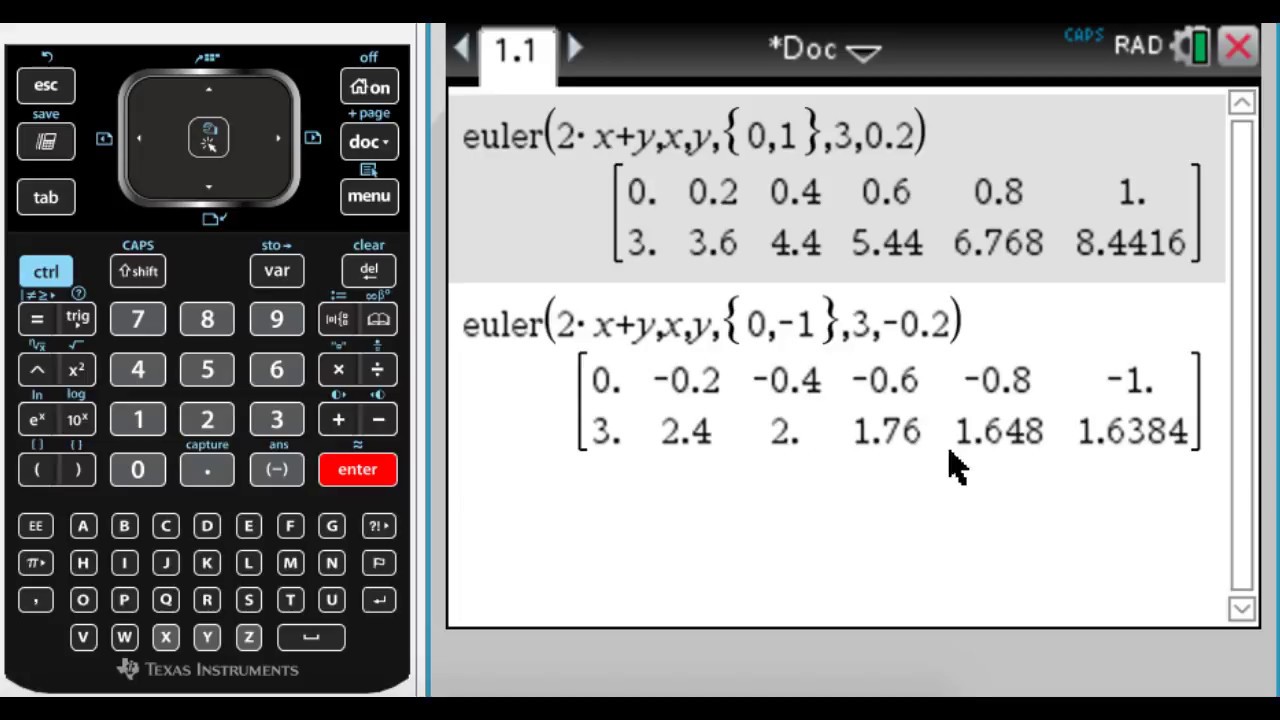
Euler’s method calculators are versatile tools used in various fields to solve differential equations numerically. These calculators provide approximate solutions to complex problems, making them invaluable in scientific, engineering, and economic applications.
In science, Euler’s method calculators are used to model and simulate physical phenomena. For instance, in astrophysics, they can be employed to calculate the trajectory of celestial bodies or predict the behavior of fluids in complex systems.
Engineering
In engineering, Euler’s method calculators are used for solving differential equations arising in various disciplines, such as mechanical, electrical, and civil engineering. They can be used to analyze the behavior of structures under dynamic loads, design control systems, and model fluid flow in pipelines.
Economics
In economics, Euler’s method calculators are used to solve differential equations that describe economic models. For example, they can be used to predict the growth of an economy, analyze the effects of government policies, or model the behavior of financial markets.
Advanced Features and Extensions
Euler’s method calculators can be enhanced with advanced features that improve their accuracy and versatility. These features include error estimation and adaptive step size control.
Additionally, Euler’s method can be extended to create more sophisticated numerical methods, such as the modified Euler method and the Runge-Kutta method.
Error Estimation
Error estimation techniques can be incorporated into Euler’s method calculators to provide an estimate of the error in the numerical solution. This allows users to assess the accuracy of their results and adjust the step size accordingly.
Adaptive Step Size Control, Euler’s method calculator
Adaptive step size control algorithms can be used to automatically adjust the step size based on the error estimate. This ensures that the step size is small enough to maintain accuracy while being large enough to achieve efficiency.
Modified Euler Method
The modified Euler method, also known as the improved Euler method, is a variant of Euler’s method that uses a weighted average of the slopes at the beginning and end of the interval to calculate the next value. This modification improves the accuracy of the method.
Runge-Kutta Method
The Runge-Kutta method is a family of numerical methods for solving ordinary differential equations. The most common Runge-Kutta method is the fourth-order Runge-Kutta method, also known as the RK4 method. The RK4 method is a one-step method that uses four evaluations of the derivative to calculate the next value.
This method is more accurate than Euler’s method and the modified Euler method.
Closure

Euler’s method calculators have revolutionized the way we approach differential equations, providing accessible and efficient solutions. As computational power continues to advance, we can expect even more sophisticated and versatile calculators that further enhance our ability to tackle complex mathematical problems.