Welcome to the realm of the Cooper Test Calculator, where fitness meets precision. Dive into the fascinating world of this renowned assessment tool and discover how it empowers you to measure your cardiovascular endurance and embark on a journey towards optimal health.
Within these pages, you’ll find a comprehensive guide to the Cooper Test, from its inception to its myriad applications. Let’s delve into the details and unlock the secrets to unlocking your fitness potential.
Cooper Test Overview
The Cooper Test is a simple and popular fitness test that measures a person’s aerobic capacity, which is the ability of the body to use oxygen efficiently during exercise. It was developed by Dr. Kenneth H. Cooper in the 1960s as a way to assess the physical fitness of military personnel.
The test involves running a set distance in a specific amount of time, and the results are used to estimate a person’s VO2 max, which is the maximum amount of oxygen the body can use during exercise.There are several different variations of the Cooper Test, but the most common is the 12-minute run.
In this test, participants run as far as they can in 12 minutes. The distance covered is then used to estimate VO2 max using a formula developed by Dr. Cooper. Other variations of the test include the 2.4-kilometer run and the 3000-meter run.The
Cooper Test is a simple and inexpensive test that can be performed by people of all ages and fitness levels. It is a valid and reliable measure of aerobic capacity, and it can be used to track progress over time.
However, the test does have some limitations. For example, it is not as accurate as a laboratory-based VO2 max test, and it can be affected by factors such as weather conditions and terrain.
Cooper Test Calculation: Cooper Test Calculator
Calculating your Cooper Test results is straightforward and involves just a few simple steps:
- Record the distance covered in meters (m) during the 12-minute run.
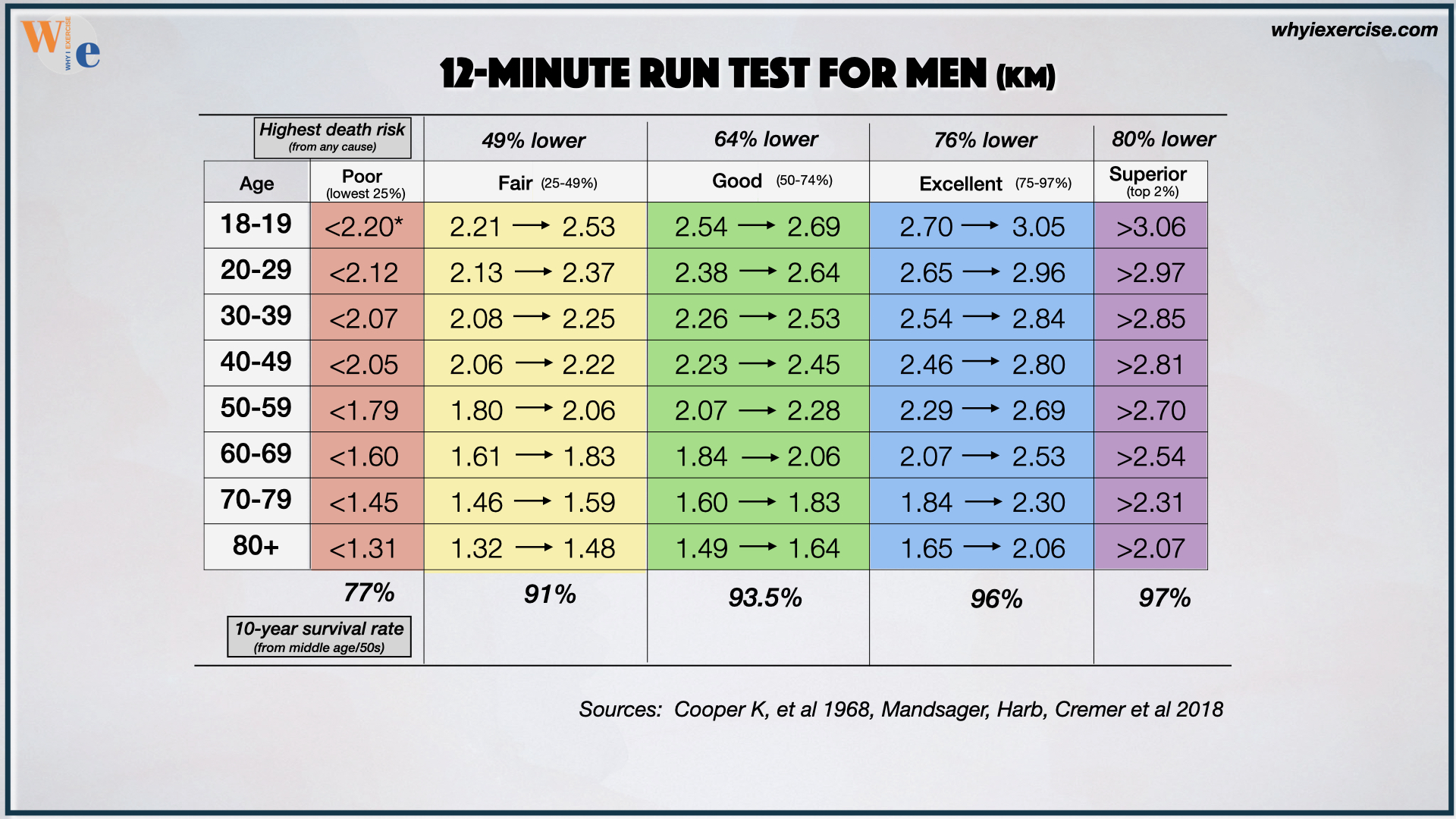
- Use the appropriate age-adjusted score table (provided below) to find the corresponding fitness level for your age and gender.
- Compare your distance covered to the score in the table to determine your fitness level.
Age-Adjusted Scores for the Cooper Test
The following table provides age-adjusted scores for both men and women, categorized into different fitness levels:
| Age Group | Fitness Level | Men (m) | Women (m) |
|---|---|---|---|
| 13-19 | Excellent | 2800 | 2300 |
| 13-19 | Good | 2400 | 2000 |
| 13-19 | Fair | 2000 | 1700 |
| 13-19 | Poor | <2000 | <1700 |
| 20-29 | Excellent | 2700 | 2200 |
| 20-29 | Good | 2300 | 1900 |
| 20-29 | Fair | 1900 | 1600 |
| 20-29 | Poor | <1900 | <1600 |
| 30-39 | Excellent | 2600 | 2100 |
| 30-39 | Good | 2200 | 1800 |
| 30-39 | Fair | 1800 | 1500 |
| 30-39 | Poor | <1800 | <1500 |
| 40-49 | Excellent | 2500 | 2000 |
| 40-49 | Good | 2100 | 1700 |
| 40-49 | Fair | 1700 | 1400 |
| 40-49 | Poor | <1700 | <1400 |
| 50-59 | Excellent | 2400 | 1900 |
| 50-59 | Good | 2000 | 1600 |
| 50-59 | Fair | 1600 | 1300 |
| 50-59 | Poor | <1600 | <1300 |
| 60-69 | Excellent | 2300 | 1800 |
| 60-69 | Good | 1900 | 1500 |
| 60-69 | Fair | 1500 | 1200 |
| 60-69 | Poor | <1500 | <1200 |
Examples of Cooper Test Results and Fitness Levels
For example, if a 35-year-old man runs 2400 meters in the Cooper Test, according to the age-adjusted score table, he would be considered to have a “Good” fitness level for his age group.Similarly, if a 45-year-old woman runs 1900 meters, she would be considered to have an “Excellent” fitness level for her age group.
Cooper Test Training
The Cooper Test is a widely used assessment for cardiovascular fitness, especially among military personnel. To improve your Cooper Test performance, a personalized training plan is crucial. This involves incorporating regular exercise, proper warm-up and cool-down routines, and adequate rest days into your regimen.
Exercise Selection, Cooper test calculator
To enhance endurance and running speed, include exercises that target these specific fitness components:
- Endurance-building exercises:
- Running (continuous and interval training)
- Cycling
- Swimming
- Elliptical training
- Speed-enhancing exercises:
- Sprints (short, intense bursts of running)
- Hill repeats (running uphill)
- Fartlek training (alternating between high- and low-intensity running)
Training Plan
Design your training plan based on your current fitness level and goals. Gradually increase the intensity and duration of your workouts over time. Incorporate a variety of exercises to avoid boredom and target different muscle groups.
Warm-up and Cool-down
Warming up before exercise prepares your body for the activity by increasing blood flow and muscle temperature. This helps prevent injuries. Cooling down after exercise helps reduce muscle soreness and stiffness.
Rest Days
Rest days are essential for recovery and muscle growth. Schedule rest days throughout your training plan to allow your body to repair itself and prevent overtraining.
Cooper Test Applications
The Cooper Test is a valuable tool for assessing cardiovascular fitness and has diverse applications across various fields.
Assessing Cardiovascular Fitness
The Cooper Test is widely used to evaluate the overall health and fitness of individuals. It provides an objective measure of cardiovascular endurance, which is a key indicator of overall health and longevity. By measuring the distance covered in 12 minutes, the test provides valuable insights into an individual’s ability to sustain physical activity, recover from exertion, and maintain a healthy heart and circulatory system.
Incorporating into Sports Training Programs
The Cooper Test is an essential component of sports training programs, particularly for endurance-based activities such as running, cycling, and swimming. It helps coaches and athletes assess an individual’s current fitness level, track progress over time, and tailor training plans accordingly.
The test’s simplicity and ease of administration make it an ideal tool for regular monitoring and adjustment of training intensity and duration.
Uses in Military and Law Enforcement Settings
The Cooper Test is commonly employed in military and law enforcement settings to evaluate the physical fitness of recruits and personnel. It provides an objective measure of an individual’s ability to perform strenuous activities, withstand physical challenges, and meet the demanding requirements of these professions.
The test’s accuracy and reliability make it a valuable tool for assessing the suitability of candidates and ensuring they possess the necessary physical capabilities for their roles.
Last Word
As we conclude our exploration of the Cooper Test Calculator, remember that fitness is a lifelong pursuit. Embrace the insights gained from this tool, tailor your training regimen accordingly, and witness the transformative power of sustained effort. The path to enhanced endurance and overall well-being lies before you.
Take the first step today and elevate your fitness journey to new heights.