Delving into the fascinating world of thermal expansion, our thermal expansion calculator emerges as an invaluable tool for engineers, designers, and anyone seeking to understand the intriguing behavior of materials as they respond to temperature changes.
Thermal expansion, a phenomenon that governs the alteration of a material’s dimensions under varying temperatures, holds immense significance in various fields, from engineering marvels to everyday applications. Our calculator empowers you to delve into this intriguing realm, unlocking the secrets of material expansion and contraction.
Thermal Expansion Calculator Basics

Thermal expansion is the phenomenon where a material’s dimensions change in response to a change in temperature. It is caused by the increased vibration of atoms and molecules as they absorb heat, leading to a larger average distance between them.
The extent of thermal expansion is determined by the material’s coefficient of thermal expansion, which is a measure of how much the material expands per unit change in temperature. Different materials have different coefficients of thermal expansion, which can have significant implications in various applications.
Factors Affecting Thermal Expansion
The coefficient of thermal expansion of a material is influenced by several factors:
- Material Composition:Different materials have different atomic structures and bonding strengths, which affect their response to temperature changes.
- Temperature Range:The coefficient of thermal expansion can vary with temperature, especially at extreme temperatures.
- Physical State:The same material can exhibit different coefficients of thermal expansion in different physical states (e.g., solid, liquid, gas).
Examples of Materials with Different Thermal Expansion Coefficients
Some common materials and their approximate coefficients of thermal expansion (in µm/m/°C) at room temperature include:
- Steel:12
- Aluminum:24
- Concrete:10
- Glass:9
- Water:21
Understanding thermal expansion is crucial in various fields, including engineering, construction, and materials science. It helps in designing structures and components that can withstand temperature variations without compromising their integrity.
Using a Thermal Expansion Calculator
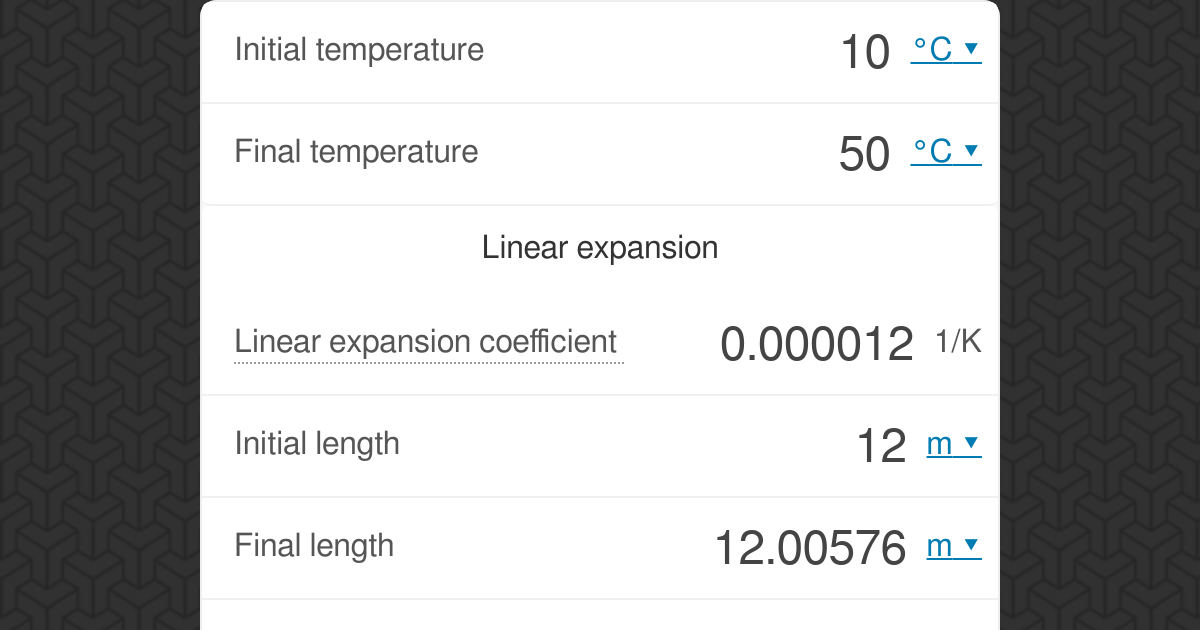
Thermal expansion calculators are useful tools for determining the change in length of an object due to temperature changes. These calculators are available in various types, including online calculators, spreadsheet-based calculators, and dedicated software.
To use a thermal expansion calculator, you will need to input the following information:
- The original length of the object
- The change in temperature
- The coefficient of thermal expansion for the material
Once you have entered this information, the calculator will calculate the change in length of the object.
Examples of Using a Thermal Expansion Calculator
Thermal expansion calculators can be used in a variety of real-world applications, such as:
- Determining the expansion of bridges and other structures due to temperature changes
- Calculating the change in length of pipelines due to temperature fluctuations
li>Estimating the expansion of electrical wires and cables due to heat
Applications of Thermal Expansion
Thermal expansion finds diverse applications in engineering and design, offering unique solutions to various challenges. From regulating temperature to actuating mechanisms, the phenomenon plays a crucial role in shaping the functionality of numerous devices and systems.
One prominent application of thermal expansion lies in the construction of bimetallic strips. These strips, composed of two dissimilar metals bonded together, exhibit different rates of expansion upon temperature changes. As a result, the strip bends in one direction when heated and in the opposite direction when cooled, enabling their use in thermostats, temperature switches, and other sensing devices.
Thermometers
Thermal expansion is also harnessed in the design of thermometers, which measure temperature by utilizing the expansion and contraction of a liquid or gas. As temperature increases, the substance expands, causing a rise in the liquid column or gas pressure, which is then calibrated to indicate the corresponding temperature.
Construction and Manufacturing
In the construction industry, thermal expansion is considered during the design of bridges, buildings, and other structures. By incorporating expansion joints or using materials with low coefficients of thermal expansion, engineers can minimize the effects of temperature fluctuations on the structural integrity of these constructions.
Similarly, in manufacturing processes, thermal expansion plays a role in precision engineering and mold design. By accounting for the thermal expansion of materials, manufacturers can ensure accurate dimensions and minimize distortions during the production process.
Design Considerations for Thermal Expansion: Thermal Expansion Calculator
Thermal expansion is a critical factor to consider in design, as it can lead to various risks and challenges. Understanding these risks and implementing appropriate mitigation strategies is essential for ensuring the safety, reliability, and performance of structures and systems.
Identifying Potential Risks
Thermal expansion can cause significant changes in the dimensions and properties of materials, leading to:
Structural instability
Expansion and contraction can induce stresses and deformations, potentially compromising structural integrity.
Joint failure
Thermal expansion can lead to misalignment or separation of joints, affecting their functionality and reducing system efficiency.
Equipment damage
Thermal expansion can damage sensitive equipment or components, causing malfunctions or even catastrophic failures.
Methods for Mitigating Thermal Expansion
To mitigate the effects of thermal expansion, several methods can be employed:
Material selection
Choosing materials with low coefficients of thermal expansion can minimize dimensional changes.
Design flexibility
Incorporating flexible elements, such as expansion joints or bellows, allows for accommodation of thermal expansion without compromising system integrity.
Thermal insulation
Reducing heat transfer can minimize temperature fluctuations and limit thermal expansion.
Controlled cooling
Gradual cooling processes can reduce thermal stresses and minimize the risk of damage.
Design Strategies for Thermal Expansion
Incorporating thermal expansion considerations into design requires careful planning and implementation. Some common strategies include:
Providing clearance
Leaving sufficient space around components to accommodate expansion and contraction.
Using slotted holes
Allowing for movement by using slotted holes or elongated bolt holes.
Incorporating expansion joints
Installing expansion joints at strategic locations to absorb thermal expansion.
Employing thermal insulation
Utilizing insulation to minimize temperature variations and reduce thermal expansion effects.
Implementing cooling systems
Implementing cooling systems to maintain desired temperatures and minimize thermal expansion.
Last Point
Embarking on a journey through the intricacies of thermal expansion, we’ve explored its fundamental principles, delved into the factors influencing material behavior, and uncovered its wide-ranging applications. Equipping yourself with our thermal expansion calculator, you now possess a powerful tool to navigate the complexities of material expansion, ensuring precision and accuracy in your designs and projects.