
Lagrange multipliers calculator is an invaluable tool for solving constrained optimization problems, empowering users to find maxima and minima of functions with ease. These multipliers provide a geometric interpretation, enabling a deeper understanding of the problem’s constraints.
In economics, Lagrange multipliers optimize utility subject to budget constraints, while in physics, they determine the equilibrium shape of a soap film. The applications of Lagrange multipliers are vast and extend to numerous fields.
Lagrange Multipliers for Optimization
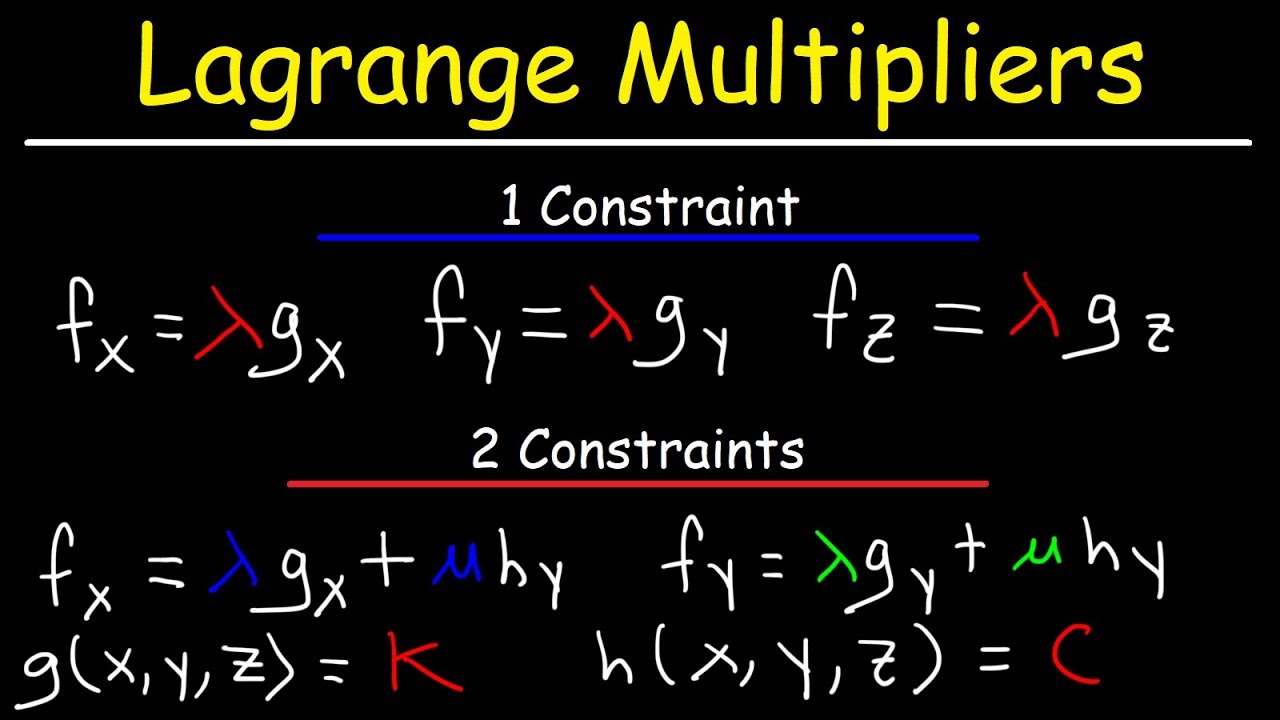
Lagrange multipliers provide a powerful tool for solving constrained optimization problems, where we seek to maximize or minimize a function subject to one or more constraints.
The method involves introducing a new variable, called the Lagrange multiplier, for each constraint. These multipliers represent the sensitivity of the objective function to changes in the constraints.
Using Lagrange Multipliers
To use Lagrange multipliers, we form the Lagrangian function, which is the original objective function plus the constraints multiplied by the Lagrange multipliers.
$$L(x, \lambda) = f(x) + \sum_i=1^m \lambda_i g_i(x)$$
where:
- $f(x)$ is the objective function
- $g_i(x)$ are the constraint functions
- $\lambda_i$ are the Lagrange multipliers
We then find the critical points of the Lagrangian by solving the system of equations:
$$\nabla L(x, \lambda) = 0$$
These critical points represent potential solutions to the constrained optimization problem.
Geometric Interpretation
Geometrically, Lagrange multipliers can be interpreted as the slopes of the tangent plane to the constraint surface at the optimal point.
If the objective function is a plane, then the optimal point occurs where the plane is tangent to the constraint surface. The Lagrange multipliers represent the slopes of the tangent plane in the directions of the constraints.
Applications of Lagrange Multipliers
Lagrange multipliers are not only useful in mathematical optimization, but they also have various applications in economics, physics, and other fields. They provide a powerful tool for solving complex optimization problems with constraints.
Economics
In economics, Lagrange multipliers are used to maximize utility subject to budget constraints. Consumers seek to maximize their satisfaction or utility from consuming goods and services while staying within their budget. The Lagrange multiplier represents the marginal utility of income, indicating the additional satisfaction gained from having an extra unit of money.
By setting the Lagrange multiplier equal to the ratio of the marginal utilities of the goods, consumers can determine the optimal consumption bundle that maximizes their utility given their budget.
Another application of Lagrange multipliers in economics is in the analysis of production. Firms aim to minimize their production costs while producing a certain level of output. Lagrange multipliers are used to incorporate constraints such as resource availability and technological limitations.
By setting the Lagrange multiplier equal to the marginal cost of production, firms can determine the optimal combination of inputs that minimizes their costs.
Physics
In physics, Lagrange multipliers are used to find the equilibrium shape of a soap film. A soap film is a thin layer of liquid that forms a surface with minimal surface area. The Lagrange multiplier represents the pressure difference between the two sides of the film.
By setting the Lagrange multiplier equal to the surface tension of the film, physicists can determine the shape that minimizes the surface area and thus the energy of the film.
Lagrange multipliers are also used in other areas of physics, such as fluid dynamics, elasticity, and electromagnetism. They provide a powerful tool for solving complex optimization problems involving constraints, such as conservation laws or boundary conditions.
Additional Examples
Lagrange multipliers have a wide range of applications beyond economics and physics. Here are a few additional examples:
- In engineering, Lagrange multipliers are used to optimize the design of structures and machines, considering constraints such as strength, weight, and efficiency.
- In biology, Lagrange multipliers are used to model the growth and competition of populations, taking into account constraints such as resource availability and environmental factors.
- In computer science, Lagrange multipliers are used in optimization algorithms, such as linear programming and nonlinear programming, to find optimal solutions to complex problems with constraints.
The versatility of Lagrange multipliers makes them a valuable tool in various fields, providing a systematic approach to solving optimization problems with constraints.
Numerical Methods for Solving Lagrange Multiplier Problems: Lagrange Multipliers Calculator

Lagrange multiplier problems can be solved using numerical methods, such as the gradient descent method and the Newton-Raphson method. These methods are iterative, meaning that they start with an initial guess and then repeatedly update the guess until it converges to the solution.
Gradient Descent Method
- Start with an initial guess for the solution.
- Calculate the gradient of the Lagrangian function at the current guess.
- Update the guess by moving in the direction of the negative gradient.
- Repeat steps 2 and 3 until the guess converges to the solution.
Newton-Raphson Method, Lagrange multipliers calculator
- Start with an initial guess for the solution.
- Calculate the Hessian matrix of the Lagrangian function at the current guess.
- Update the guess by moving in the direction of the negative of the inverse of the Hessian times the gradient of the Lagrangian function.
- Repeat steps 2 and 3 until the guess converges to the solution.
Convergence and Accuracy
The convergence and accuracy of numerical methods for solving Lagrange multiplier problems depend on several factors, including the choice of the initial guess, the step size, and the tolerance for convergence. The gradient descent method is generally more robust than the Newton-Raphson method, but the Newton-Raphson method can be faster if the initial guess is close to the solution.
Lagrange Multipliers Calculator
The Lagrange multipliers calculator is a valuable tool for solving optimization problems with constraints. It allows users to input the objective function, constraints, and initial guesses for the Lagrange multipliers, and then calculates the optimal values of the variables and Lagrange multipliers.
User-Friendly Interface
The calculator features a user-friendly interface that makes it easy to enter the problem data. Users can simply enter the objective function, constraints, and initial guesses for the Lagrange multipliers into the corresponding fields. The calculator then automatically calculates the optimal values and displays the results.
Functionality
The calculator uses the method of Lagrange multipliers to solve optimization problems. This method involves introducing new variables, called Lagrange multipliers, to convert the constrained optimization problem into an unconstrained optimization problem. The calculator then uses numerical methods to solve the unconstrained optimization problem and find the optimal values of the variables and Lagrange multipliers.
Examples
The calculator can be used to solve a wide variety of optimization problems with constraints. Here are a few examples:
- Finding the maximum value of a function subject to a constraint
- Finding the minimum value of a function subject to a constraint
- Finding the optimal values of variables in a system of equations with constraints
The calculator can be a valuable tool for solving optimization problems in a variety of fields, including engineering, economics, and finance.
End of Discussion
Numerical methods, such as gradient descent and Newton-Raphson, efficiently solve Lagrange multiplier problems. The Lagrange multipliers calculator simplifies the process, providing a user-friendly interface to tackle real-world optimization challenges.
