
Cramers rule calculator – Cramer’s rule calculator takes center stage, a powerful tool that empowers users to effortlessly conquer systems of linear equations. Its mathematical precision and ease of use make it an indispensable companion for students, researchers, and professionals alike.
Cramer’s rule, a fundamental theorem in linear algebra, provides a systematic method for solving systems of equations with unique solutions. This introductory passage will delve into the intricacies of Cramer’s rule, exploring its applications, advantages, and limitations.
Cramer’s Rule Basics
Cramer’s Rule is a mathematical technique used to solve systems of linear equations. It is particularly useful when dealing with systems that have a unique solution.
The rule states that if a system of n linear equations in n unknowns has a unique solution, then the value of each unknown can be calculated using a formula involving determinants. The formula for the ith unknown is:
xi= det(A i) / det(A)
where A is the coefficient matrix of the system, A iis the matrix obtained by replacing the ith column of A with the column vector of constants, and det(A) is the determinant of A.
Assumptions and Limitations
Cramer’s Rule has certain assumptions and limitations:
- The coefficient matrix A must be square (i.e., it must have the same number of rows and columns).
- The determinant of A must be non-zero. If det(A) = 0, the system has either no solution or infinitely many solutions.
- Cramer’s Rule can be computationally inefficient for large systems of equations.
Applications of Cramer’s Rule
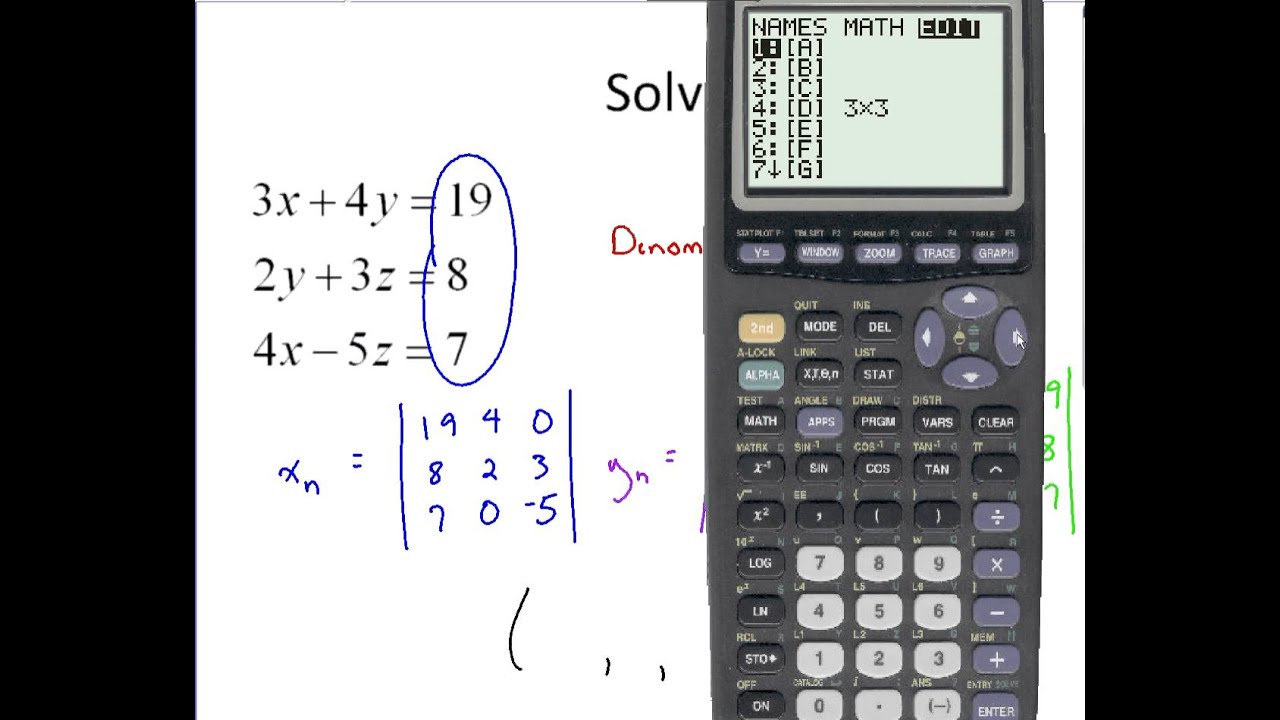
Cramer’s Rule is a powerful tool for solving systems of linear equations. It is particularly useful when the equations are expressed in matrix form and the determinant of the coefficient matrix is nonzero. Here are some common applications of Cramer’s Rule:
Solving Systems of Linear Equations
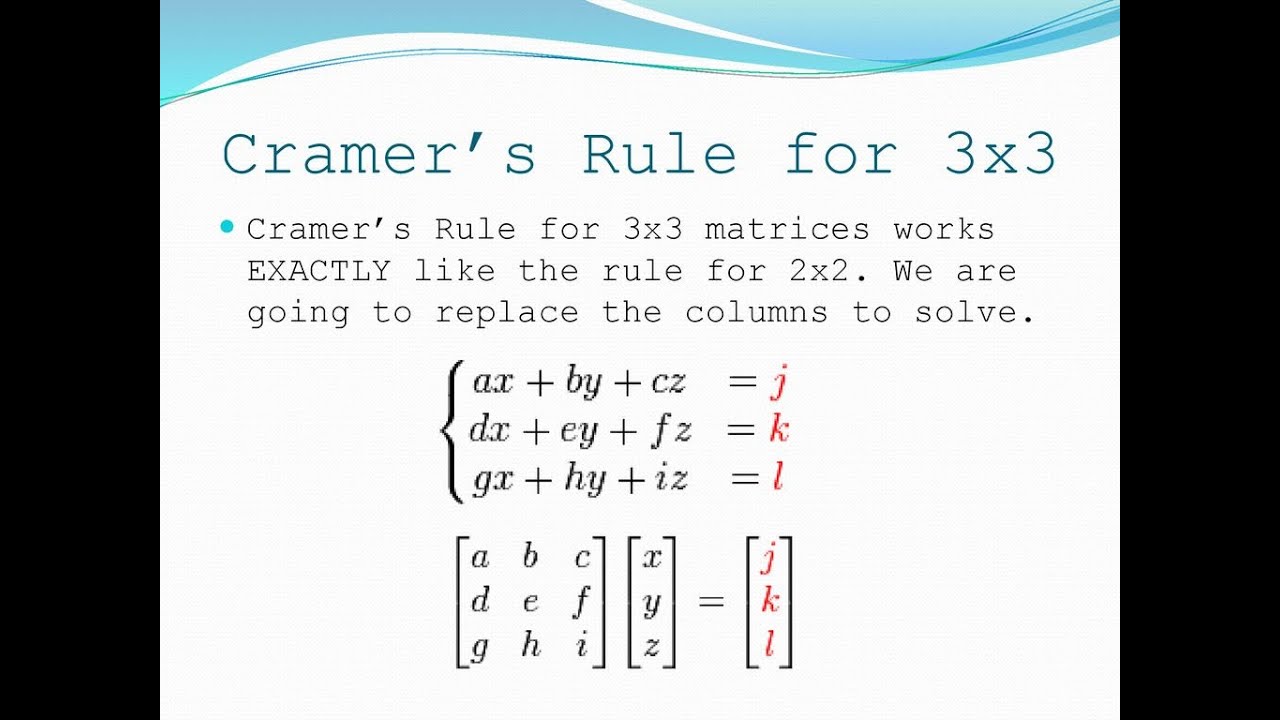
Cramer’s Rule can be used to solve any system of linear equations that has a unique solution. To do this, we first write the system in matrix form:
“`Ax = b“`
where A is the coefficient matrix, x is the column vector of variables, and b is the column vector of constants. If the determinant of A is nonzero, then the system has a unique solution, and we can use Cramer’s Rule to find it.
For each variable xi, we compute the following:
“`xi = det(Ai) / det(A)“`
where Ai is the matrix formed by replacing the ith column of A with b.
Practical Problems
Cramer’s Rule can be used to solve a wide variety of practical problems. Here are a few examples:
- Finding the currents in a circuit
- Determining the forces acting on a rigid body
- Solving chemical equilibrium problems
- Finding the optimal solution to a linear programming problem
Advantages and Disadvantages of Cramer’s Rule
Cramer’s Rule is a method for solving systems of linear equations by using determinants. It is a useful tool in many applications, but it also has some drawbacks.
One of the advantages of Cramer’s Rule is that it is easy to apply. The formula for solving a system of linear equations using Cramer’s Rule is straightforward, and it can be applied to any system of linear equations.
Another advantage of Cramer’s Rule is that it is accurate. The formula for Cramer’s Rule is based on the determinant of the coefficient matrix, which is a measure of the size of the system of linear equations. If the determinant is non-zero, then the system of linear equations has a unique solution, and Cramer’s Rule will give that solution.
However, Cramer’s Rule also has some drawbacks. One of the drawbacks is that it can be computationally inefficient. The formula for Cramer’s Rule requires the calculation of the determinant of the coefficient matrix, which can be a time-consuming process for large systems of linear equations.
Another drawback of Cramer’s Rule is that it can be inaccurate for systems of linear equations that are nearly singular. A system of linear equations is nearly singular if the determinant of the coefficient matrix is close to zero. In this case, Cramer’s Rule can give inaccurate solutions.
Computational Efficiency
Cramer’s Rule is not the most computationally efficient method for solving systems of linear equations. For large systems of linear equations, there are more efficient methods, such as Gaussian elimination and LU decomposition.
Accuracy
Cramer’s Rule is accurate for systems of linear equations that are not nearly singular. However, for systems of linear equations that are nearly singular, Cramer’s Rule can give inaccurate solutions.
When to Use Cramer’s Rule
Cramer’s Rule is a useful tool for solving systems of linear equations, but it is not always the best method. For large systems of linear equations, there are more efficient methods, such as Gaussian elimination and LU decomposition. For systems of linear equations that are nearly singular, Cramer’s Rule can give inaccurate solutions.
Cramer’s Rule is best used for small systems of linear equations that are not nearly singular.
Variations and Extensions of Cramer’s Rule
Cramer’s Rule provides a systematic approach to solving systems of linear equations. However, it is not the only method available. Laplace’s expansion and the determinant method offer alternative approaches, each with its own advantages and disadvantages.
Laplace’s Expansion
Laplace’s expansion is a technique for calculating the determinant of a matrix by expanding it along a row or column. This can be particularly useful when the matrix is large or sparse.Advantages:
- Can be used to calculate the determinant of any matrix, regardless of its size or structure.
- Can be applied to matrices that are not square.
- Can be used to find the inverse of a matrix.
Disadvantages:
- Can be computationally expensive for large matrices.
- Requires a deep understanding of matrix theory.
Determinant Method, Cramers rule calculator
The determinant method involves using the determinant of a matrix to solve a system of linear equations. This method is similar to Cramer’s Rule but does not require the calculation of cofactors.Advantages:
- Can be used to solve systems of linear equations of any size.
- Does not require the calculation of cofactors.
- Can be used to determine the consistency of a system of linear equations.
Disadvantages:
- Can be computationally expensive for large matrices.
- Not as straightforward as Cramer’s Rule for small systems of equations.
Ending Remarks: Cramers Rule Calculator
In conclusion, Cramer’s rule calculator stands as a valuable asset, simplifying the process of solving linear equations. Its computational efficiency and accuracy make it a reliable choice for various applications. While it may not be the optimal approach in all scenarios, its versatility and ease of use render it an indispensable tool for anyone seeking to master the art of linear algebra.
