Introducing the secant line calculator, an invaluable tool for understanding the slope of a secant line and its relationship to the derivative of a function. This comprehensive guide delves into the intricacies of secant line calculations, their applications in various fields, and advanced topics for further exploration.
Discover the formula for finding the slope of a secant line, explore the connection between secant lines and derivatives, and learn how to use a secant line calculator to approximate the derivative of a function.
Secant Line Formula and Properties
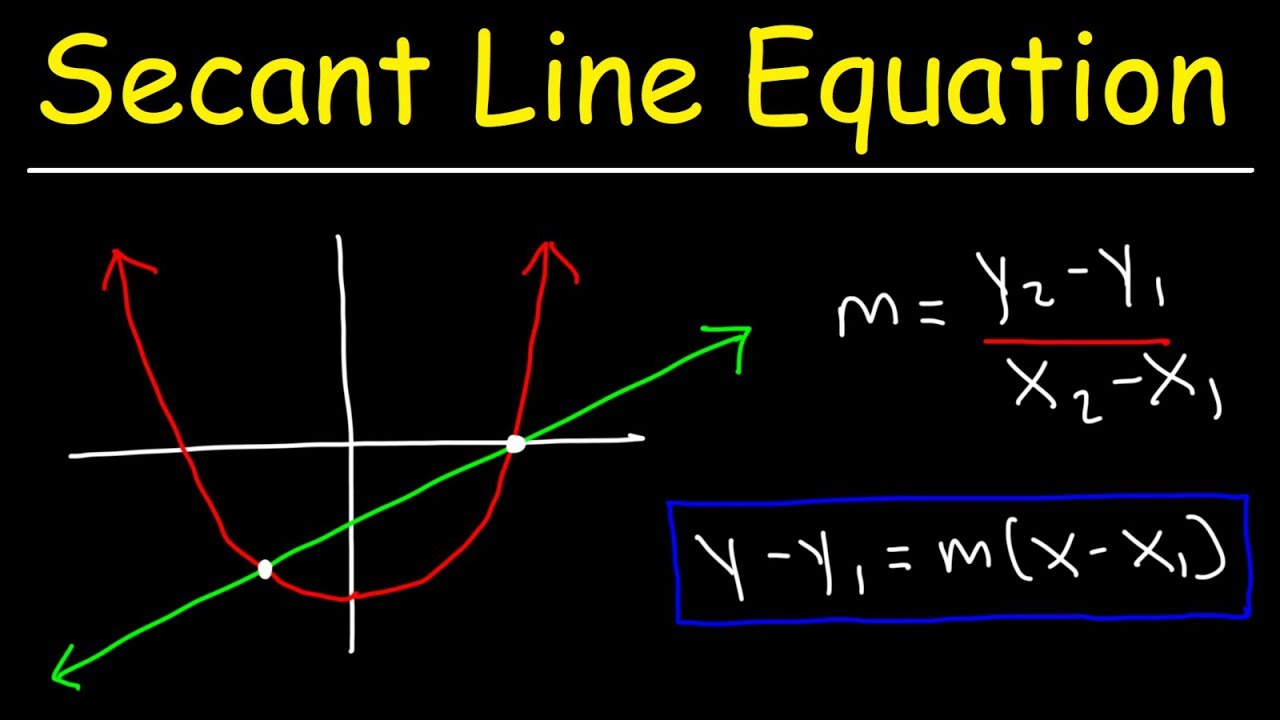
In mathematics, a secant line is a line that intersects a curve at two distinct points. The slope of a secant line can be used to approximate the derivative of a function at a given point.
The formula for finding the slope of a secant line is as follows:
$$m_sec = \fracf(x_2)
- f(x_1)x_2
- x_1$$
where $f(x)$ is the function, $x_1$ and $x_2$ are the two points on the curve, and $m_sec$ is the slope of the secant line.
Relationship to Derivative, Secant line calculator
The slope of a secant line approaches the derivative of a function as the two points on the curve approach each other. In other words:
$$\lim_x_2 \to x_1 m_sec = f'(x_1)$$where $f'(x_1)$ is the derivative of $f(x)$ at $x_1$.
Approximating the Derivative
The secant line formula can be used to approximate the derivative of a function at a given point. To do this, we choose two points on the curve that are close to each other and calculate the slope of the secant line.
As the two points get closer together, the slope of the secant line will approach the derivative of the function.
For example, suppose we want to approximate the derivative of the function $f(x) = x^2$ at $x = 1$. We can choose two points on the curve, such as $(1, 1)$ and $(1.1, 1.21)$, and calculate the slope of the secant line:
$$m_sec = \fracf(1.1)
- f(1)1.1
- 1 = \frac1.21
- 10.1 = 2.1$$
As the two points get closer together, the slope of the secant line will approach the derivative of $f(x)$ at $x = 1$, which is $2$.
Calculator Functionality and Features
A secant line calculator is a mathematical tool that allows users to determine the slope of a secant line drawn between two points on a curve.
Using a Secant Line Calculator
To use a secant line calculator, you need to input the coordinates of the two points on the curve. The calculator will then calculate the slope of the secant line using the following formula:
$$m = \fracy_2
- y_1x_2
- x_1$$
where:
- $m$ is the slope of the secant line
- $x_1$ and $y_1$ are the coordinates of the first point
- $x_2$ and $y_2$ are the coordinates of the second point
Advantages of Using a Secant Line Calculator
There are several advantages to using a secant line calculator:
- It is fast and easy to use.
- It is accurate.
- It can be used to calculate the slope of a secant line for any curve.
Disadvantages of Using a Secant Line Calculator
There are also some disadvantages to using a secant line calculator:
- It can only be used to calculate the slope of a secant line.
- It does not provide any information about the curvature of the curve.
Applications of Secant Line Calculations

Secant line calculations have wide applications in various fields, providing valuable insights into the behavior of functions and solving real-world problems.
In physics, secant line calculations are used to estimate the average velocity of an object over a given time interval. This information is crucial for analyzing motion, calculating acceleration, and predicting future positions.
Engineering
In engineering, secant line calculations are employed in structural analysis to approximate the deflection of beams and bridges under load. They also play a role in fluid dynamics, where they are used to estimate the flow rate of fluids through pipes.
Economics
In economics, secant line calculations are used to analyze the slope of demand and supply curves. This information helps economists predict changes in prices, quantities, and consumer behavior.
While secant line calculations provide valuable approximations, they have limitations. They are only accurate for small changes in the independent variable and may not capture the true behavior of a function over a larger interval.
Advanced Topics in Secant Line Analysis
In addition to the basic applications mentioned earlier, secant lines play a crucial role in advanced mathematical concepts and numerical methods.
Secant Method for Finding Roots of Equations
The secant method is an iterative numerical method used to find roots of equations. It utilizes a series of secant lines to approximate the root of a function. Starting with two initial guesses, the method constructs a sequence of secant lines and updates the guesses based on their intersection points.
This process continues until the desired accuracy is achieved.
Approximating Area Under a Curve Using Secant Lines
Secant lines can be used to approximate the area under a curve. By dividing the curve into a series of trapezoids formed by secant lines, the area under the curve can be estimated as the sum of the areas of these trapezoids.
Secant Lines in Numerical Integration and Differentiation
In numerical integration, secant lines are used to approximate integrals. By dividing the area under a curve into trapezoids, the integral can be approximated as the sum of the areas of these trapezoids. Similarly, in numerical differentiation, secant lines are used to approximate the derivative of a function by calculating the slope of the secant line between two points.
Last Recap: Secant Line Calculator
Secant line calculations prove indispensable in fields like physics, engineering, and economics, enabling the solution of complex real-world problems. While limitations exist in certain situations, the secant method, area approximation, and numerical integration and differentiation further showcase the versatility of secant lines in mathematical analysis.