
Jacobian matrix calculator, a powerful tool for mathematical computations, opens the door to a world of problem-solving possibilities. From its theoretical underpinnings to practical applications, this comprehensive guide will delve into the intricacies of the Jacobian matrix, empowering you with the knowledge and skills to harness its potential.
The Jacobian matrix, a fundamental concept in mathematics, provides a concise representation of the relationship between two sets of variables. Its versatility extends across diverse fields, including coordinate transformations, differential geometry, and optimization, making it an indispensable tool for researchers, engineers, and data scientists alike.
Jacobian Matrix Theory and Calculations
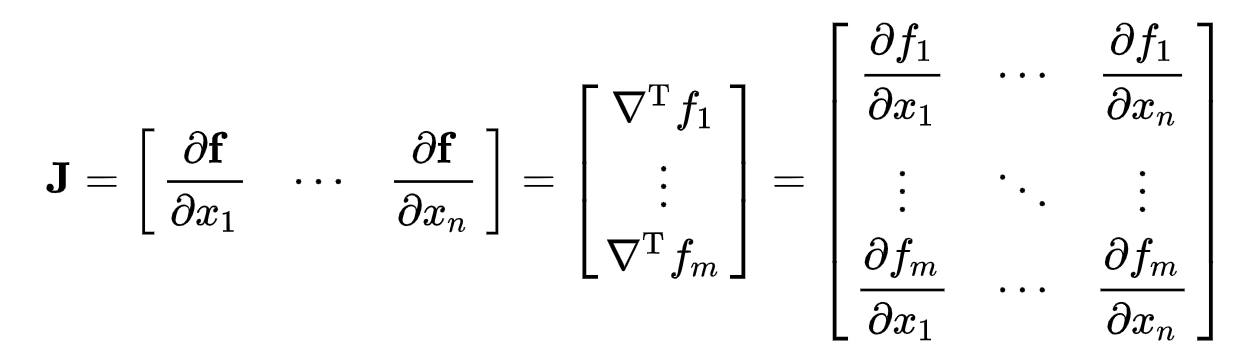
The Jacobian matrix, named after the mathematician Carl Jacobi, is a mathematical tool used to represent the derivative of a vector-valued function with respect to a vector of independent variables. It plays a crucial role in various fields, including calculus, optimization, and differential geometry.
The Jacobian matrix is a rectangular matrix with dimensions m x n, where m is the number of output variables and n is the number of input variables. The (i, j)th element of the Jacobian matrix is the partial derivative of the i-th output variable with respect to the j-th input variable.
Calculating the Jacobian Matrix
To calculate the Jacobian matrix, we need to compute the partial derivatives of each output variable with respect to each input variable. For a vector-valued function F(x1, x2, …, xn) = (f1(x1, x2, …, xn), f2(x1, x2, …, xn), …, fm(x1, x2, …, xn)), the Jacobian matrix is given by:
$$J(F(x)) = \beginbmatrix \frac\partial f_1\partial x_1 & \frac\partial f_1\partial x_2 & \cdots & \frac\partial f_1\partial x_n \\\ \frac\partial f_2\partial x_1 & \frac\partial f_2\partial x_2 & \cdots & \frac\partial f_2\partial x_n \\\ \vdots & \vdots & \ddots & \vdots \\\ \frac\partial f_m\partial x_1 & \frac\partial f_m\partial x_2 & \cdots & \frac\partial f_m\partial x_n \endbmatrix$$
Applications of the Jacobian Matrix
The Jacobian matrix finds applications in various areas, including:
- Change of variables:The Jacobian matrix is used to transform derivatives and integrals from one coordinate system to another.
- Optimization:The Jacobian matrix is used to find critical points (maxima, minima, and saddle points) of multivariable functions.
- Differential geometry:The Jacobian matrix is used to calculate the tangent space and normal vector to a surface.
Jacobian Matrix Applications: Jacobian Matrix Calculator
The Jacobian matrix finds extensive applications across various scientific and engineering disciplines. Its versatility in transforming coordinates, aiding differential geometry, and optimizing complex functions makes it a crucial tool for solving real-world problems.
Coordinate Transformations
The Jacobian matrix plays a vital role in coordinate transformations, allowing us to map points between different coordinate systems. It provides the necessary information about how the coordinates of a point change when we move from one system to another.
This knowledge is essential in fields such as computer graphics, robotics, and navigation.
For example, in computer graphics, the Jacobian matrix is used to transform objects from one coordinate system to another, ensuring smooth movement and accurate positioning.
Differential Geometry
In differential geometry, the Jacobian matrix is used to study the local properties of surfaces. It provides information about the surface’s curvature, tangent planes, and normal vectors. This knowledge is crucial for understanding the geometry of complex shapes and analyzing their behavior under different conditions.
For instance, in architecture, the Jacobian matrix is used to analyze the curvature of surfaces in buildings, ensuring structural stability and aesthetic appeal.
Optimization
The Jacobian matrix is also essential in optimization problems, where it provides information about the rate of change of a function with respect to its input variables. This knowledge helps in finding the optimal values of the function and understanding how the function behaves in the vicinity of those values.
For example, in finance, the Jacobian matrix is used to optimize investment portfolios, maximizing returns while minimizing risks.
Jacobian Matrix Calculator Features
Jacobian matrix calculators are online tools that provide efficient computation of Jacobian matrices. These calculators typically offer a user-friendly interface, making it easy for users to input their functions and obtain accurate results.
Key Features and Functionality
Jacobian matrix calculators offer various key features, including:
- User-friendly interface:Calculators are designed to be easy to use, with intuitive input fields and clear output displays.
- Function input:Users can input their functions in various formats, such as symbolic expressions or numerical values.
- Automatic computation:Calculators automatically compute the Jacobian matrix for the input function, saving users time and effort.
- Accuracy and precision:Calculators provide accurate and precise results, ensuring reliable computations.
- Export options:Results can be exported in various formats, such as text, CSV, or LaTeX, for further analysis or documentation.
Using a Calculator for Efficient Computation
To use a Jacobian matrix calculator efficiently, follow these steps:
- Input the function:Enter the function for which you want to compute the Jacobian matrix into the designated input field.
- Select options:Choose any additional options provided by the calculator, such as the number of variables or the format of the output.
- Compute:Click the “Compute” button to initiate the calculation.
- Review results:The calculator will display the computed Jacobian matrix in the output field.
Types of Jacobian Matrix Calculators
There are various types of Jacobian matrix calculators available online, each with its own unique features and capabilities. Some common types include:
- Symbolic calculators:These calculators accept symbolic expressions as input and provide symbolic results for the Jacobian matrix.
- Numerical calculators:These calculators accept numerical values as input and provide numerical results for the Jacobian matrix.
- Hybrid calculators:These calculators combine symbolic and numerical capabilities, allowing users to input a mix of symbolic and numerical values.
Jacobian Matrix Calculator Examples
Jacobian matrix calculators offer a convenient way to perform complex calculations and gain insights into nonlinear systems. Let’s explore some examples and use cases.
Table of Jacobian Matrix Calculator Features
Here’s a comparison table showcasing the key features of different Jacobian matrix calculators:
| Feature | Calculator A | Calculator B | Calculator C |
|---|---|---|---|
| Matrix Size | 2×2 to 5×5 | Any size | Limited to 3×3 |
| Function Support | Polynomials, trigonometric functions | User-defined functions | Basic functions only |
| Derivative Calculation | Automatic | Manual entry required | Numerical approximation |
| Visualization | 2D and 3D plots | Interactive 3D visualization | None |
Step-by-Step Guide to Using a Jacobian Matrix Calculator
Follow these steps to use a Jacobian matrix calculator:
- Enter the function(s) for which you need the Jacobian matrix.
- Specify the variables with respect to which the derivatives will be calculated.
- Select the desired output format (e.g., matrix, determinant).
- Calculate the Jacobian matrix by clicking the “Calculate” button.
- Analyze the results and interpret the behavior of the system.
Common Use Cases for Jacobian Matrix Calculators
Jacobian matrix calculators find applications in various industries, including:
- Engineering: Analyzing the behavior of complex systems, such as robots, vehicles, and structures.
- Physics: Solving problems involving fluid dynamics, heat transfer, and electromagnetic fields.
- Economics: Modeling economic systems and predicting their behavior under different scenarios.
- Computer Graphics: Transforming objects and manipulating shapes in 3D modeling and animation.
- Data Science: Analyzing and visualizing high-dimensional datasets, such as those in machine learning and deep learning.
Conclusive Thoughts
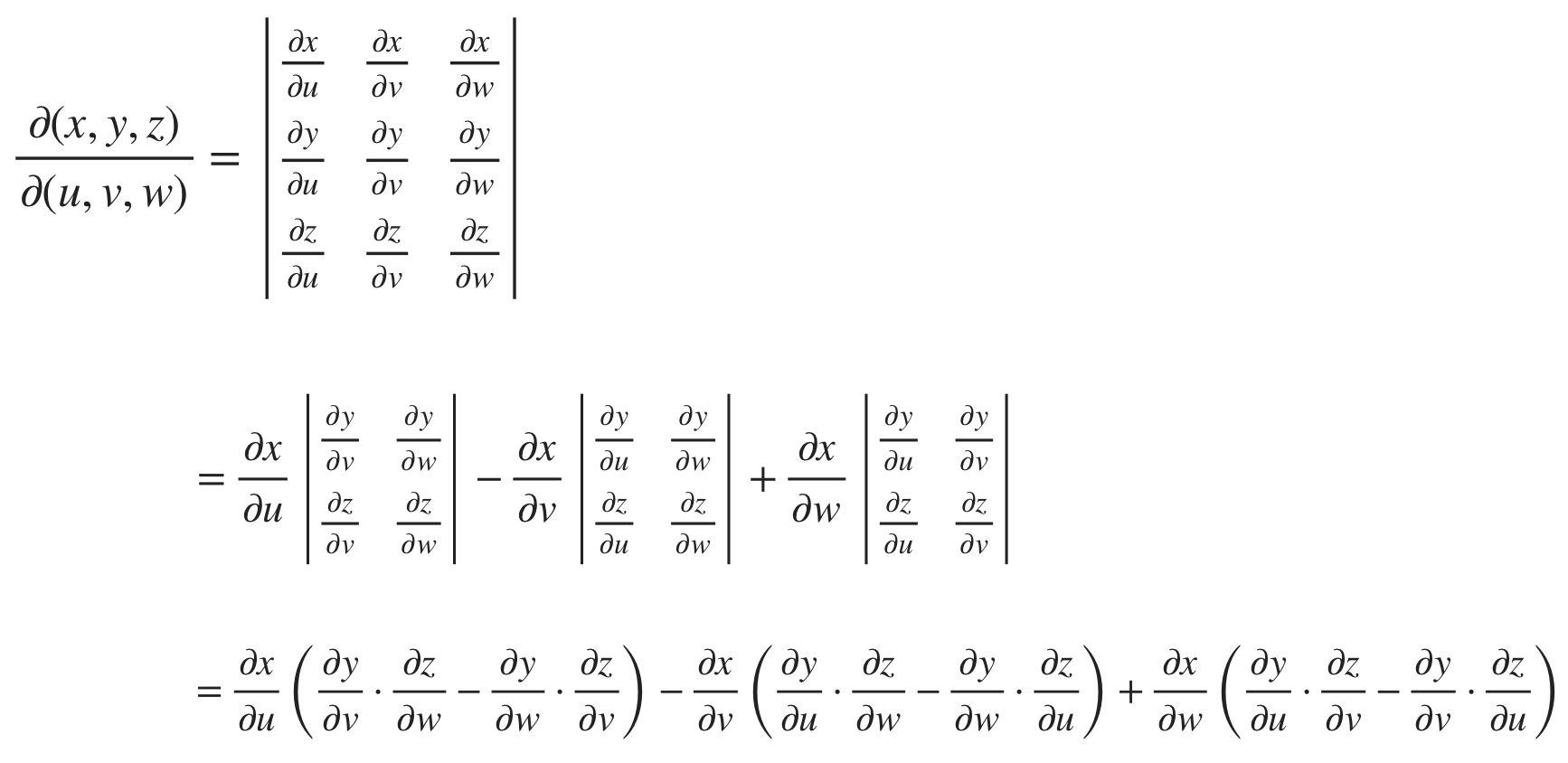
In conclusion, the Jacobian matrix calculator stands as a valuable asset for anyone seeking to simplify complex mathematical operations and gain deeper insights into the behavior of systems. Its ability to compute Jacobian matrices efficiently and accurately makes it an indispensable tool for tackling real-world problems in a wide range of disciplines.
