
The cost of debt calculator is an indispensable tool for businesses and individuals seeking to understand and manage their debt obligations. This comprehensive guide explores the concept of cost of debt, its impact on financial decisions, and provides a detailed walkthrough of the calculator’s functionality, empowering users to make informed choices about their borrowing.
Factors such as interest rates, risk premiums, and transaction costs significantly influence the cost of debt. The calculator incorporates these factors, enabling users to calculate the effective interest rate and total cost of borrowing with precision.
Factors Influencing Cost of Debt
The cost of debt is a crucial factor in financial decision-making. It represents the interest rate and other expenses associated with borrowing funds. Understanding the factors that influence the cost of debt is essential for businesses and individuals alike.
Interest Rates
Interest rates are the primary determinant of the cost of debt. Lenders charge interest to compensate for the risk and opportunity cost of providing funds. Changes in interest rates can significantly impact the cost of borrowing.
- Higher interest rates lead to a higher cost of debt, making borrowing more expensive.
- Lower interest rates result in a lower cost of debt, reducing the cost of borrowing.
Risk Premiums
Risk premiums are additional interest charges imposed by lenders to compensate for the perceived risk of default. Factors such as the borrower’s creditworthiness, industry conditions, and economic outlook can affect the risk premium.
- Higher risk premiums result in a higher cost of debt for borrowers perceived as riskier.
- Lower risk premiums indicate a lower perceived risk, leading to a lower cost of debt.
Transaction Costs
Transaction costs are expenses incurred during the borrowing process, such as legal fees, underwriting fees, and administrative costs. These costs can vary depending on the size and complexity of the loan.
- Higher transaction costs increase the overall cost of debt.
- Lower transaction costs reduce the cost of borrowing.
Methods for Calculating Cost of Debt

Determining the cost of debt is crucial for evaluating the financial viability of a project or investment. Two widely used methods for calculating the cost of debt are the effective interest rate method and the yield-to-maturity method. This section will delve into the details of each method, explaining their steps and providing examples.
Effective Interest Rate Method
The effective interest rate method calculates the cost of debt as the annual interest expense divided by the average carrying value of the debt. This method is straightforward and easy to apply, making it suitable for quick estimations. However, it does not account for the time value of money, which can lead to inaccuracies over longer periods.
Steps:
- Calculate the annual interest expense by multiplying the debt principal by the annual interest rate.
- Calculate the average carrying value of the debt by taking the average of the debt’s beginning and ending balances.
- Divide the annual interest expense by the average carrying value of the debt.
Example:
A company has a $100,000 debt with an annual interest rate of 5%. The debt’s beginning balance is $95,000, and its ending balance is $105,000.
- Annual interest expense: $100,000 x 0.05 = $5,000
- Average carrying value: ($95,000 + $105,000) / 2 = $100,000
- Cost of debt: $5,000 / $100,000 = 5%
Yield-to-Maturity Method
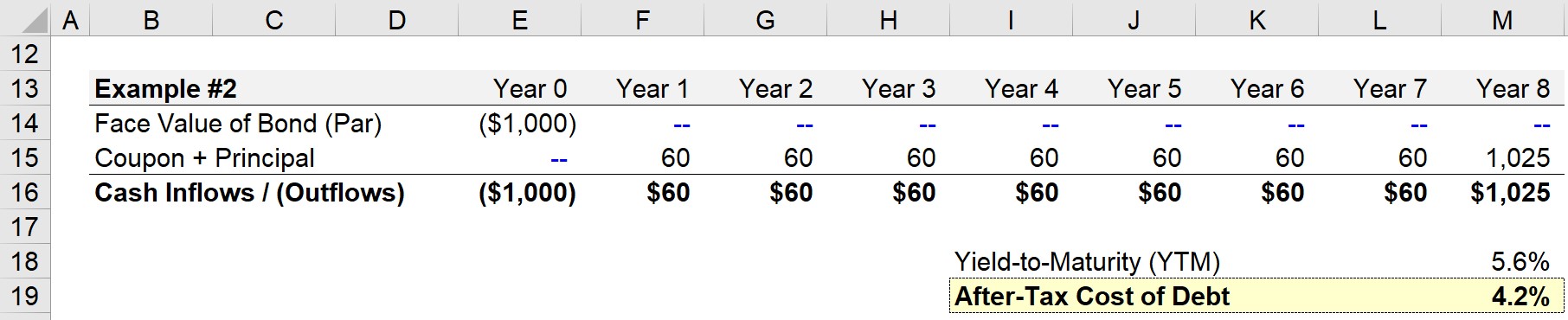
The yield-to-maturity method calculates the cost of debt as the internal rate of return (IRR) on the debt investment. This method considers the time value of money and provides a more accurate representation of the cost of debt over the entire life of the loan.
However, it can be more complex to calculate, especially for bonds with complex payment schedules.
Steps:
- Determine the present value of all future interest payments and the principal repayment using the present value formula: PV = FV / (1 + r)^n, where PV is the present value, FV is the future value, r is the yield-to-maturity, and n is the number of periods.
- Set the sum of the present values equal to the current market price of the debt and solve for the yield-to-maturity using a financial calculator or spreadsheet.
Example:
A company purchases a $1,000 bond with a face value of $1,000, a maturity of 5 years, and an annual coupon rate of 6%. The bond is currently priced at $950.
- Present value of interest payments:$60 x (1
1 / (1 + r)^5) / r
- Present value of principal repayment:$1,000 / (1 + r)^5
- Set the sum of present values equal to $950:$60 x (1
1 / (1 + r)^5) / r + $1,000 / (1 + r)^5 = $950
- Solve for r using a financial calculator or spreadsheet, which yields a yield-to-maturity of approximately 6.51%.
Advantages and Disadvantages
The effective interest rate method is simple and straightforward, but it does not consider the time value of money. The yield-to-maturity method is more accurate, but it can be more complex to calculate. The choice of method depends on the specific needs and the level of accuracy required.
Impact of Cost of Debt on Business Decisions
The cost of debt is a crucial factor that influences a business’s financial decisions, particularly in relation to capital structure, investment, and financing. A higher cost of debt implies higher interest payments, which can impact profitability and overall financial health.
Capital Structure
The cost of debt affects a company’s capital structure, which refers to the mix of debt and equity financing. A higher cost of debt makes it more expensive to issue debt, potentially leading businesses to rely more on equity financing.
However, this can also dilute ownership and control for existing shareholders.
Investment, Cost of debt calculator
The cost of debt can influence investment decisions. Companies may be less likely to undertake new investments if the cost of debt is high, as it increases the overall cost of capital. This can hinder growth and expansion opportunities.
Financing
The cost of debt impacts the choice of financing options. Businesses may opt for lower-cost debt sources, such as bank loans or bonds with favorable interest rates. However, these may come with restrictive covenants or require collateral, which can limit financial flexibility.
Weighted Average Cost of Capital (WACC)
The weighted average cost of capital (WACC) is a metric that measures the overall cost of financing for a business. It considers the cost of debt and equity, weighted by their respective proportions in the capital structure. A higher WACC indicates a higher overall cost of financing, which can affect investment decisions and profitability.
Real-World Examples
- Company A, a manufacturing firm, issued bonds with a high interest rate. The increased cost of debt led the company to reduce its capital expenditures, affecting its growth prospects.
- Company B, a technology startup, secured a loan with a favorable interest rate. The lower cost of debt allowed the company to invest aggressively in research and development, driving its market share.
Cost of Debt Calculator
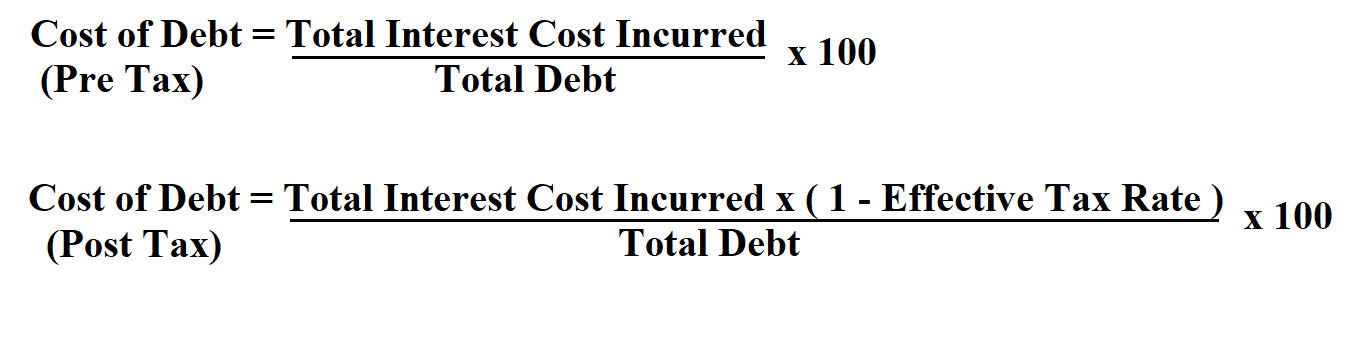
The cost of debt calculator is a valuable tool for businesses to determine the effective interest rate and total cost of borrowing. It allows users to input relevant data and generate customized calculations, providing insights into the financial implications of debt financing.
Calculator Design
The calculator is organized into sections for different input parameters, including loan amount, interest rate, and loan term. Each section provides clear instructions on how to input the data and interpret the results. The calculator calculates the effective interest rate, which takes into account the compounding effect of interest over the loan term, and the total cost of borrowing, which includes both the principal and interest payments.
Final Thoughts: Cost Of Debt Calculator

By leveraging the cost of debt calculator, businesses can optimize their capital structure, make strategic investment decisions, and effectively manage their financing strategies. Its user-friendly interface and comprehensive calculations provide invaluable insights into the true cost of debt, empowering users to make well-informed financial choices.
