1s complement calculator – Enter the realm of digital computation with our comprehensive 1’s complement calculator, an invaluable tool for effortlessly navigating the intricacies of binary arithmetic. Its user-friendly interface and robust functionality empower you to delve into the fascinating world of 1’s complement representation, unlocking a deeper understanding of digital circuits and their applications.
As you embark on this journey, you’ll discover the nuances of 1’s complement representation, unravel its applications in arithmetic operations, and explore its advantages and limitations in comparison to other complement representations. Prepare to be captivated by the elegance and practicality of 1’s complement, a cornerstone of digital computing.
1’s Complement Representation: 1s Complement Calculator

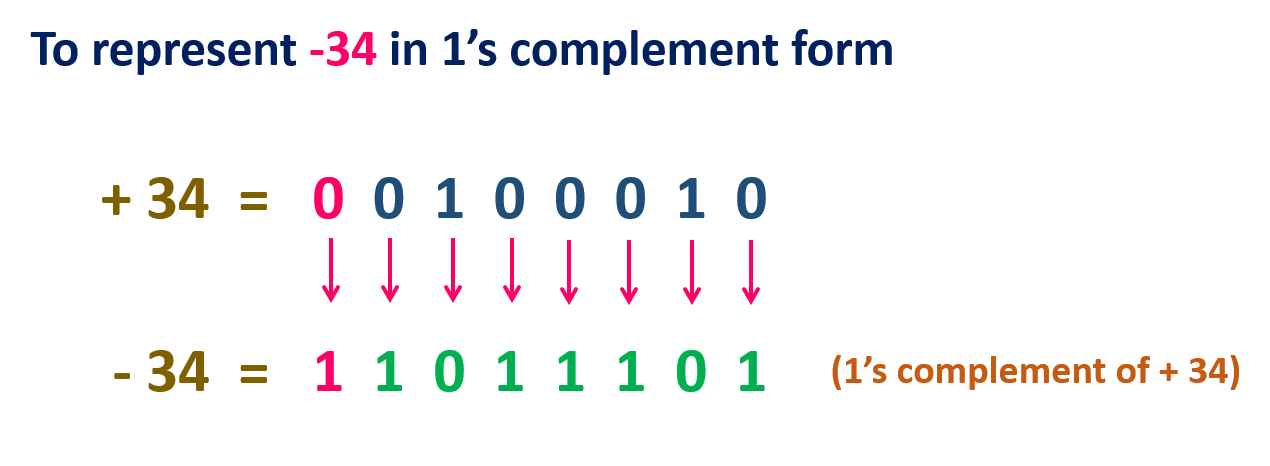
1’s complement representation is a way of representing negative numbers in binary form. It is a simple and straightforward method that involves inverting all the bits of the binary representation of the number. For example, the 1’s complement of the binary number 0110 is 1001.
1’s complement representation is commonly used in computer systems because it is easy to implement in hardware. However, it has the disadvantage of not being able to represent the number 0 in a unique way. The 1’s complement of 0 is 1111, which is also the 1’s complement of -1.
Examples of 1’s Complement Representation
- The 1’s complement of 0000 is 1111.
- The 1’s complement of 0001 is 1110.
- The 1’s complement of 0010 is 1101.
- The 1’s complement of 0011 is 1100.
- The 1’s complement of 0100 is 1011.
- The 1’s complement of 0101 is 1010.
- The 1’s complement of 0110 is 1001.
- The 1’s complement of 0111 is 1000.
- The 1’s complement of 1000 is 0111.
- The 1’s complement of 1001 is 0110.
- The 1’s complement of 1010 is 0101.
- The 1’s complement of 1011 is 0100.
- The 1’s complement of 1100 is 0011.
- The 1’s complement of 1101 is 0010.
- The 1’s complement of 1110 is 0001.
- The 1’s complement of 1111 is 0000.
1’s Complement Calculator
1’s Complement Calculator
To use the 1’s complement calculator, simply enter the binary number you want to convert into its 1’s complement representation in the input field. The calculator will automatically generate the 1’s complement representation of the input binary number.
Applications of 1’s Complement
1’s complement has practical applications in digital circuits, particularly in arithmetic operations.
It plays a crucial role in simplifying subtraction and implementing negation in computer systems.
Subtraction using 1’s Complement, 1s complement calculator
Subtraction can be performed using 1’s complement by converting the subtrahend to its 1’s complement form and then adding it to the minuend. The result obtained is the difference between the two numbers.
‘s complement of a binary number = Invert all bits (0 to 1 and 1 to 0)
For example, to subtract 5 (0101) from 10 (1010) using 1’s complement:
- 1’s complement of 5 = 1010
- Add 1’s complement of 5 to 10: 1010 + 1010 = 10000
- Ignore the leftmost carry bit (1): Result = 0000, which represents 0
Negation using 1’s Complement
Negation (finding the opposite sign) of a binary number can be obtained by taking its 1’s complement. The 1’s complement of a number represents its negative value.
For example, to find the negation of 10 (1010):
- 1’s complement of 10 = 0101
- 0101 represents -10
Comparison with Other Complements
1’s complement is one of several complement representations used in digital systems. It is important to compare it with other representations, such as 2’s complement and sign-magnitude, to understand its advantages and disadvantages.
The table below summarizes the key differences between 1’s complement, 2’s complement, and sign-magnitude representations:
| Representation | Positive Numbers | Negative Numbers | 0 Representation |
|---|---|---|---|
| 1’s complement | Same as binary representation | 1’s complement of binary representation | 0000 |
| 2’s complement | Same as binary representation | 2’s complement of binary representation | 0000 |
| Sign-magnitude | MSB is 0, followed by binary representation | MSB is 1, followed by binary representation | 0000 and 1000 |
Advantages and Disadvantages
Each representation has its own advantages and disadvantages:
- 1’s complementis simple to implement in hardware, but it has the disadvantage of having two representations for 0 (0000 and 1111).
- 2’s complementis also simple to implement in hardware, and it has the advantage of having only one representation for 0 (0000). However, it can be more difficult to understand than 1’s complement.
- Sign-magnitudeis the easiest to understand, but it is more difficult to implement in hardware than 1’s complement or 2’s complement.
Ultimately, the choice of which complement representation to use depends on the specific application.
Closing Summary
In conclusion, the 1’s complement calculator serves as a gateway to a deeper understanding of digital circuits and their applications. Its ability to simplify arithmetic operations, such as subtraction and negation, makes it an indispensable tool for students, engineers, and anyone seeking to unravel the intricacies of binary computation.
Embrace the power of 1’s complement and unlock the full potential of digital technology.